Quite a title that – I think Gainward would have use believe that this is a good one.

- RRP: £75 – £85
- Release date: March 22 2006
- Purchased in August 2025
- Purchase Price: £18.37
Note: Some in-game screenshots are from previous tests with other systems
Introduction – The GeForce 7000 Series
The intro to all GeForce 7000 articles
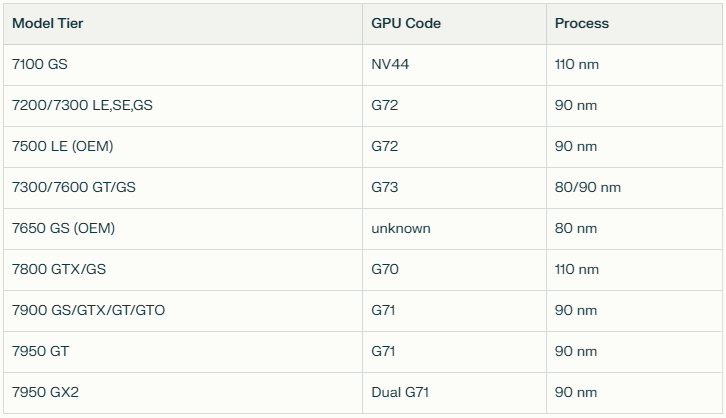
Released between 2005 and 2006, the GeForce 7000 series represented NVIDIA’s final push under the Curie architecture and served as a graceful swan song for AGP support, while laying groundwork for PCI Express dominance. The 7000 series spanned a wide range — from the ‘display adaptor’ 7100 GS to the best that was the dual-core 7950 GX2 (oh to afford one of those).
While visually similar to the previous GeForce 6 lineup, this generation brought architectural refinements and broader feature maturity, including:
- IntelliSample 4.0 for improved gamma-corrected anti-aliasing and transparency support
- TurboCache on budget cards like the 7300 GS to borrow system RAM as cost-effective VRAM
- PureVideo enhancements for smoother MPEG decode with VP2 support on select models
- Expanded SLI support for multi-GPU setups in the high end
One of the most iconic entries was the 7800 AGP versions, a rare, high-performance card that gave aging systems a final breath of life — probably all dead now due to insufficient cooling on the bridge chips.
The series even reached beyond PC gaming: a modified 7800 GTX core formed the heart of Sony’s PlayStation 3.
Here are some model names and codenames, it seems simple but I’m sure there are OEM cards that will mess with each of these tiers.
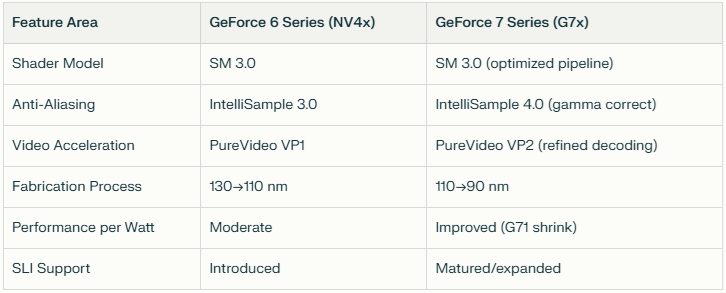
Architectural Contrast: GeForce6 vs GeForce7
The 7000 series, based on the G7x family, didn’t reinvent the wheel but refined it. NVIDIA moved to a 90 nm process for most chips, allowing higher clock speeds and lower power draw. The G71 core, for example, was a more efficient shrink of the G70, delivering similar or better performance with reduced heat output. This made cards like the 7900 GT and GTX more viable for compact or quieter builds.
Feature-wise, the 7000 series improved anti-aliasing with IntelliSample 4.0, added better transparency rendering, and enhanced video playback through PureVideo VP2. SLI support became more robust, and AGP compatibility was extended via bridge chips — a nod to users still clinging to older platforms.
In short, the 7000 series was a polish pass on the 6000 series: same core ideas, but better execution. It offered smoother performance, more efficient dies, and broader compatibility — especially for those navigating the AGP-to-PCIe transition.
Some differences highlighted here:
The Card – Gainwood GeForce 7300 GT

I seem to be deep in a GeForce 7000 phase right now. This is the third card in a row I’ve been tinkering with.
Luck has not been kind so far. The 7300SE was modest at best, though I won’t blame the G72 chip entirely. It was crippled by a 32-bit(!) memory bus and just 64MB of DDR. Want proof of how rough that was? Check the review here.
Next came the 7600GS, which actually impressed me until it died halfway through testing. That story’s here if you’re curious.
Before grabbing this one, I already had a passively cooled Gigabyte 7300GT in the collection that looked promising. Sadly, it was plagued with screen artifacts right at boot — the BIOS was barely readable.
Back to eBay I went. Plenty of passive GTs out there, but I’ve learned to spot bad capacitors from the listing photos — probably from overheating.
This Gainward card caught my eye. Fair price, though I prefer my budget cards closer to £10 than £20, especially without a box. I didn’t realise when ordering that it might be a bit special.
It’s a true dual-slot card, which suits me fine. There’s a large frame over the top, though I’m not sure it does much for cooling. It doesn’t seem properly connected to transfer heat — maybe just for looks or light PCB protection? Hard to say.
It also has an SLI connector. Would have been fun to pair with the 7600GS… not that I’m bitter.
Like the Palit 7600GS, it uses a rear clamp instead of four screws, which I approve of completely. It came apart easily for a repaste. The original thermal paste was still there (yes, I broke the warranty sticker gasp), but not baked on like you often see with passive cards. A bit of isopropyl and gentle rubbing cleaned it right up

I managed to track down a picture of the original box this card would have come in, and it’s peak 2000s. Loud graphics, bold fonts, and that unmistakable era-specific flair. Sadly, mine arrived tucked inside an old Amazon box — not quite the same, but a step up from a jiffy bag.
It’d be nice if original packaging popped up on eBay as a standalone listing, but I’m not holding my breath. These things usually vanish into attic oblivion or get recycled without ceremony. Still, one can hope

Who are Gainward
Another Taiwanese hardware company best known for manufacturing Nvidia based GPU’s. The parent company is Palit who aquired Gainward in 2005.
Both Palit and Gainward are still going today, so pick up a RTX 5090 or two from them anytime.
Gainward were apparently a bit niche in the UK but more prominent in Continental Europe and Asia, most of the sites I can see when I was browsing around for photos and info were in Polish.
Overclocking and unlocking locked potential.
The Golden Sample, goes like hell, super duper, extra metal shield thing special edition here stacks up well against the stock stats for the 7300GT which are themselves far more impressive than the other 7300 (and OEM-world only 7500).
Under the hood, we’re still dealing with the G73 GPU—a solid mid-range chip that also powers the 7600 series. The 7300GT version has a few pixel and vertex shaders disabled, which RivaTuner teasingly displays as inactive. Sadly, there’s no way to flip them back on, no matter how tempting that checkbox might look.

This did leave a small issue about whether to test this as a ‘budget’ card or ‘mid-range’ but, the name says 7300 so let’s throw it into the budget tier. Something needs to take that X1300 Pro off of the top step anyway.
The GPU-z screenshot for this card below:

A love a good comparison table so here it is against the X1300 pro, a stock 7300GT and the 7600GS tested previously
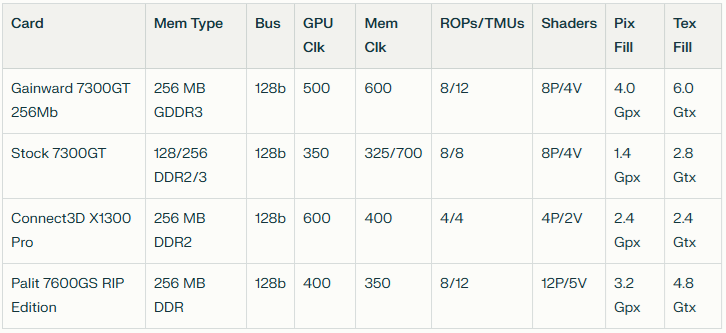
ROPs and TMUs to match the 7600GS? That’s more than you’d expect on a 7300GT — a real surprise. A solid factory overclock on the GPU core seals the deal and makes this very impressive overall, with better performance that should put it on par with higher‑binned cards.
I hear the X1300XT also borrows a GPU from ATI’s mid‑range lineup, so that could make for a fun comparison. I tracked one down and tested it Here

The Test System
Details are as follows:
- CPU: AMD Phenom II X4 955 3.2Ghz Black edition
- 8Gb of 1866Mhz DDR3 Memory (showing as 3.25Gb on 32bit Windows XP and 1600Mhz limited by the platform)
- Windows XP (build 2600, Service Pack 3)
- Kingston SATA 240Gb SSD
- ASRock 960GM-GS3 FX
- Driver Version 6.14.11.7516 from May 2008 (Forceware 175.16).
Moto Racer 3 (2001)
Minimum: Windows 98/ Pentium III 450 MHz / 16 MB DirectX 8 GPU / 64 MB RAM;
Recommended: Windows XP / Pentium III 600 MHz / 32 MB DirectX 8 GPU / 128 MB RAM.
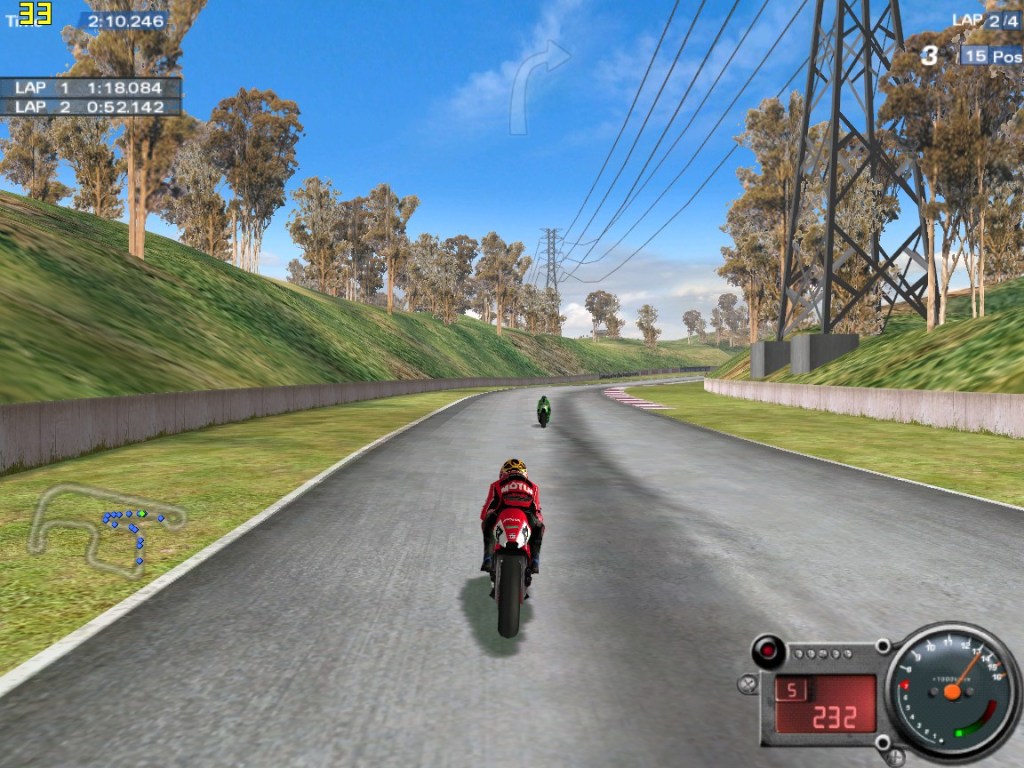
Unsuprisingly the 7300GT has the beans to run this lowly title at highest resolution at the (annoyingly low) 33 fps frame cap.
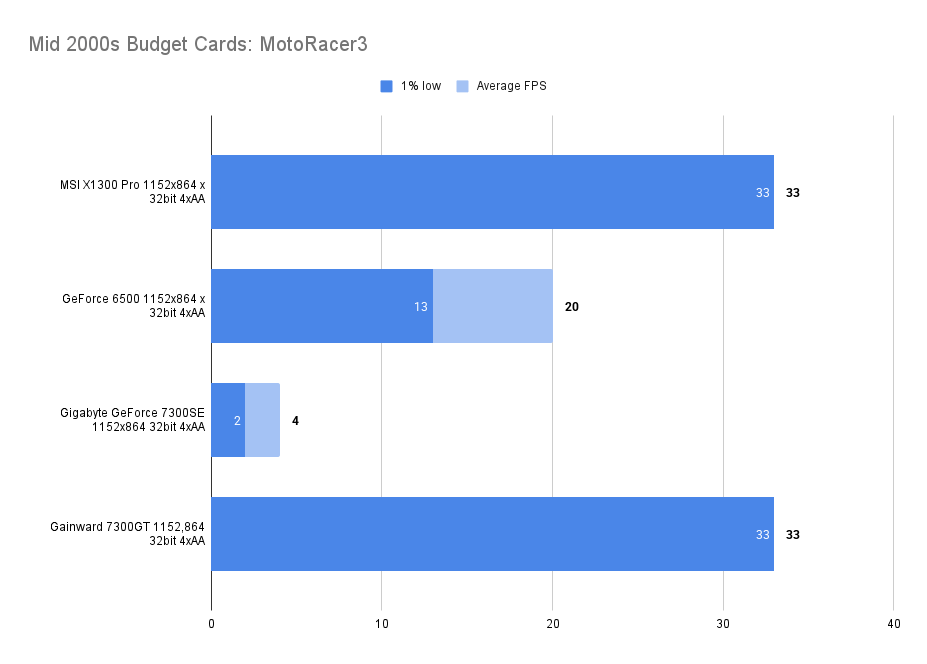
Definitely an advantage over that godawful 7300SE

The same mess on the screen appeared with this card but it turns out that it was being caused by MSI Afterburner conflicting with this resolution.
Alt-tab out of the game and go back in and the Afterburner info disappears but it is still running in the background and recorded a benchmarking run.

Return to Castle Wolfenstein (2001)
Minimum: Windows 95/400 MHz Pentium II/16 MB OpenGL GPU/128 MB RAM;
Recommended: Windows XP/600 MHz Pentium III/32 MB OpenGL GPU/256 MB RAM.

Much faster than the 7300SE (no surprise) but I still thought we would be getting triple digits in this old game.. I took my suspicions to an internet search it turns out that the engine is limited to 91 which, is the average framerate.
Building suspense you see… a big tick for OpenGL compatibility also, which is nice.


Mafia (2002)
Minimum: Windows 98/500 MHz Pentium III/16 MB DirectX 8.1 GPU/96 MB RAM
Recommended: Windows XP/700 MHz Pentium III/32 MB DirectX 8.1 GPU/128 MB RAM.
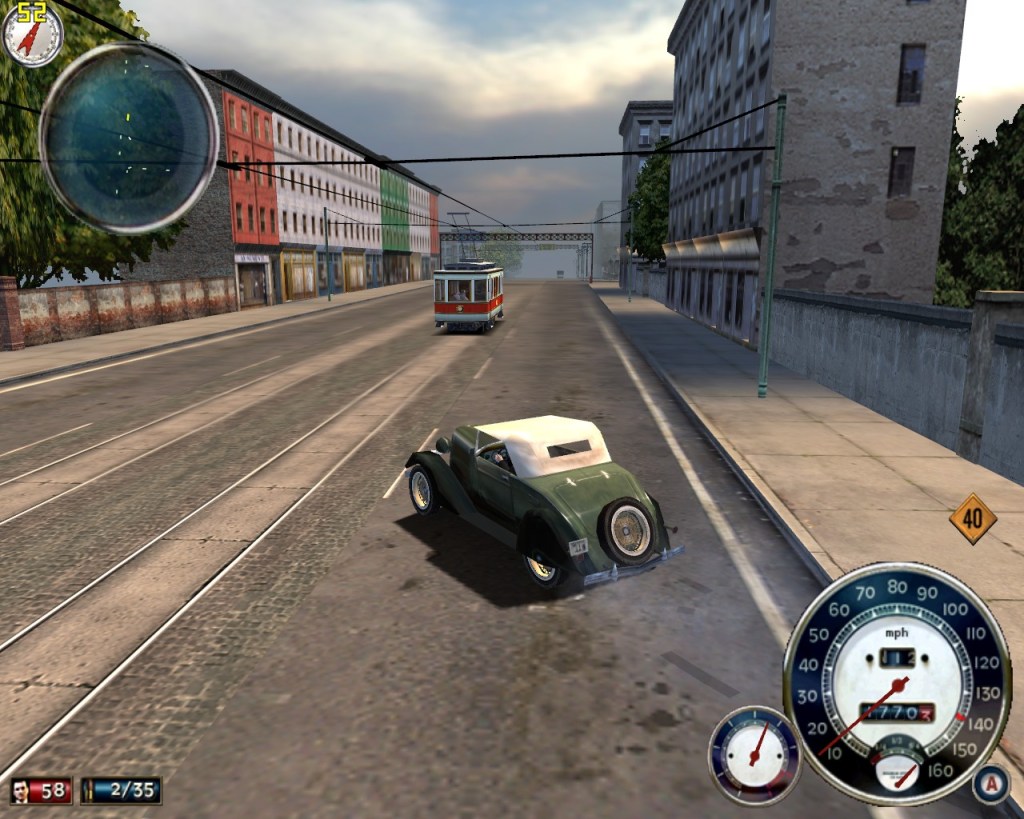
A year newer now, how will the 7300SE stack up when playing some of the awesome Mafia.
The settings used:

Frame limited by the game.. again, this time to 63fps (evidentially this translates to an actual 62fps as measured by FRAPS and Afterburner).
The X1300Pro hit’s the limit and so does the 7300GT.
Interestingly the 1% Low on the Gainward card is actually lower than the competition by nearly half.

Freelancer (2003)
Minimum: Windows 98/Pentium III 600 MHz/16 MB DirectX 8.1 GPU/128 MB RAM
Recommended: Windows XP/Pentium III 600 MHz/32 MB DirectX 8.1 GPU/256 MB RAM.
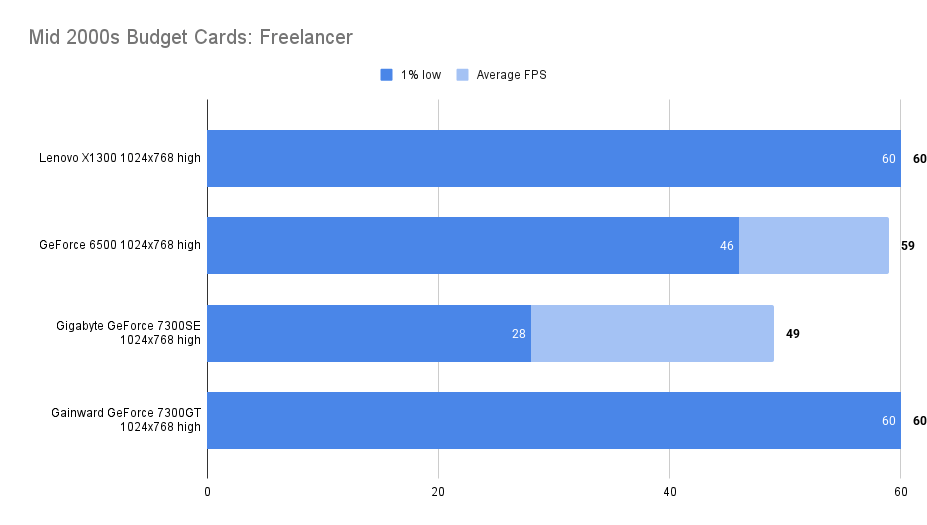
All games run freelancer well, I thought I’d load in just to make sure that the 60fps framecap could be reached and.. definitely yes. Better than the previous low-end Nvidia cards tested.
Settings used as follows:



Unreal Tournament 2003
Minimum: Windows 98/ME/2000/XP, Pentium III 733 MHz, DirectX 8.1, TNT2/Kyro II/Voodoo 3/Radeon 7000 (16 MB), 128 MB RAM;
Recommended: Windows XP, Pentium 4 1 GHz, DirectX 8.1 or higher, GeForce2/Radeon 8500 (64–128 MB), 256 MB RAM.

As with the 7600GS, this game did crash whenever I changed the resolution in-game, but it can be adjusted in one of the settings files in the game folder.
Although not a budget card, I have the results for the 7600GS on this one and the 7300GT actually beats it by a small but clear margin. The higher clock speeds more than compensating for the missing shaders.
A great result.
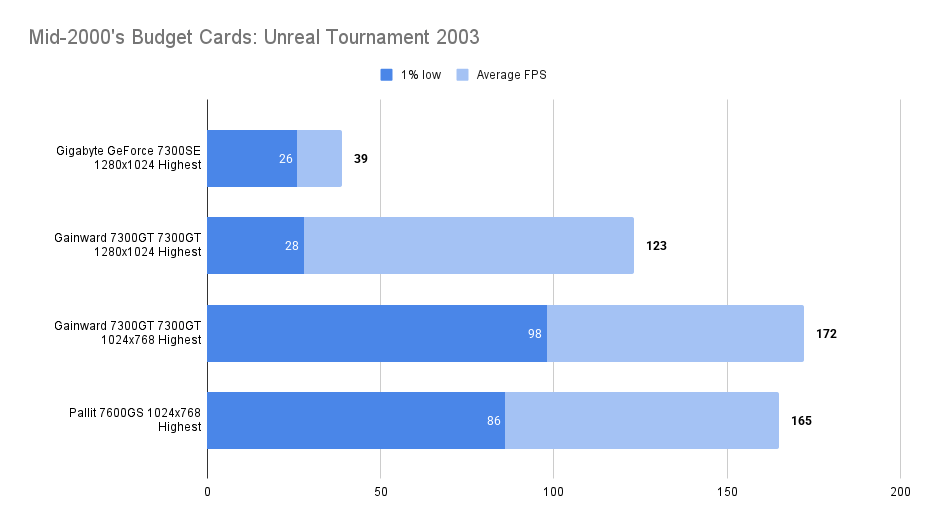
The 7600GS was only tested at 1024 x 768 so we are unable to see how this result scaled.
123 fps vs 39 between the two 7300 cards, wow.

FarCry (2004)
Minimum: Windows 98SE/2000/XP, Pentium III 1 GHz, DirectX 9.0b, GeForce2 MX/Radeon 7000 (64 MB), 256 MB RAM
Recommended: Windows XP, Pentium 4 2 GHz, DirectX 9.0b or higher, GeForce4 Ti/Radeon 9500 (128 MB), 512 MB RAM.
The 7300GT was an absolute beast in FarCry giving 80fps at 1024 x 768 with the Very High Preset.

This is the first head to head with the X1300 Pro now frame-limits arent a thing and it does finish comfortably ahead.
Furthermore, our Gainward card also beats the 7600GS by 10 fps! The GS can claim a slight edge in frame time consistency still but not enough to make the difference up.
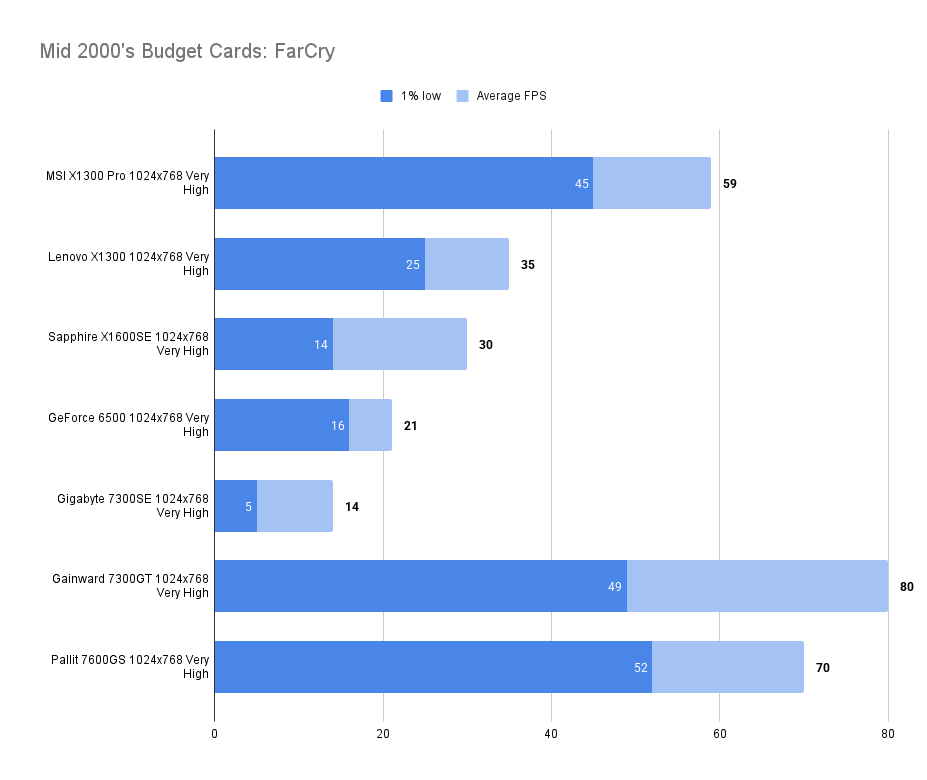
If there was a bad thing to say then it’s perhaps that this card has the most inconsistent frame times of the main three contenders here, the 1% low being a bit over 60% of the average framerate.

Scaling would be interesting as the above shows the 7600GS ahead, the extra shaders perhaps? would AA on and off make the only difference?
Perhaps later games and the 3d mark tests will give more insight.
Doom 3 (2004)
Minimum: Windows 2000/XP, Pentium IV 1.5 GHz, DirectX 9.0b, GeForce 3/Radeon 8500 (64 MB), 384 MB RAM
Recommended: Windows XP, Pentium IV 2 GHz, DirectX 9.0b, GeForce 4 Ti/Radeon 9700 (128 MB), 512 MB RAM.
Back to Doom 3 and back to a much more intensive OpenGL game, I had high hopes for the 7300GT

Using the in-game benchmark against the budget cards only (the 7600GS died before I could use it) the results are more than impressive.
Usually I would highlight the card in question on these longer charts, or split them into something easier to read… but in this case I think you can see where the 7300GT sits

111fps at 1024×768 is well over double the MSI Pro result. In fact, you can run the game with 4x Anti-Aliasing and still outperform the X1300Pro running with no AA
Need for Speed: Most Wanted (2005)
Minimum: Windows 2000/XP, Pentium IV 1.4 GHz, DirectX 9.0c, GeForce2 MX/Radeon 7500 (32 MB), 256 MB RAM
Recommended: Windows XP, Pentium IV 3 GHz, DirectX 9.0c, GeForce 5900/Radeon 9800 (256 MB), 1 GB RAM
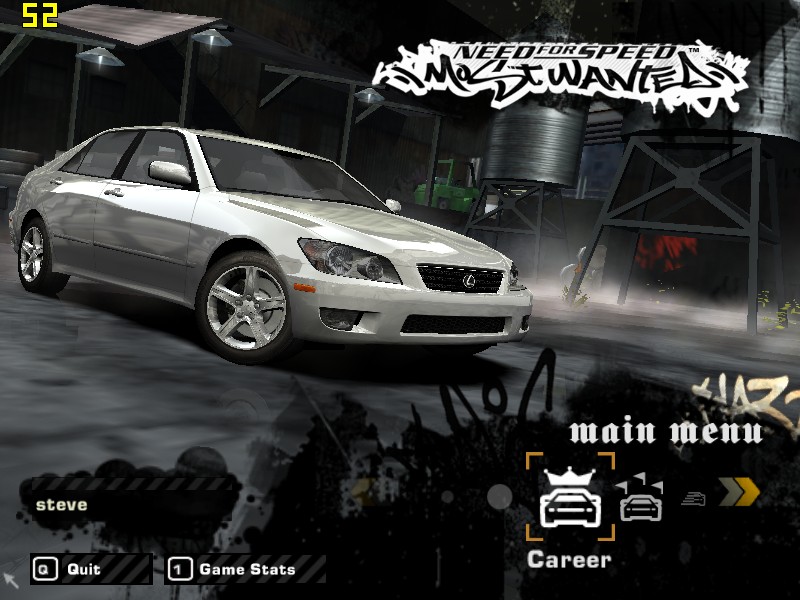
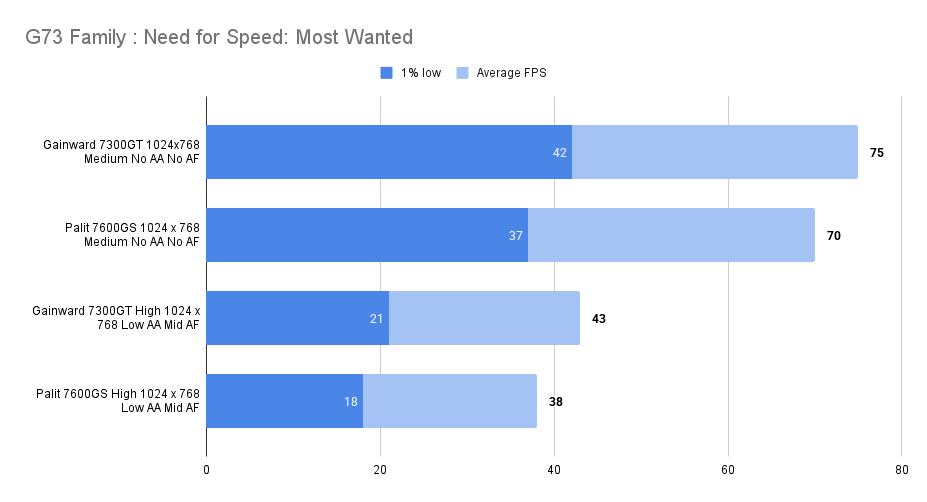
Well here’s an interesting one now we’re getting used to the 7300GT slaying all before it.
It’s a win on average framerate but the two X1300 cards gives much more consistent frame times. The X1600SE is sort-of a X1300 but does struggle with the lower memory bus which may be the source if it’s issues in this one.

The problem scales, the average framerate lead over the X1300 pro improves but there is still a huge gap between 1% low and average framerate.
To be fair, it’s 42fps so unlikely to be a stutter as you would see when the X1600SE so maybe I’m making to much of this.

I didn’t test the budget cards at 1024 x 768 Medium and left AA and AF but I did get the data from the 7600GS and.. the 7300GT wins out by a consistent amount over it’s bigger brother.
The GS card also seems to struggle with consistency in this title.

Medieval II: Total War (2006)
Minimum: Windows 2000/XP, Pentium 4 1.5 GHz, DirectX 9.0c, GeForce 4 Ti 4400/Radeon 9600 SE (128 MB), 512 MB RAM
Recommended: Windows XP, Pentium 4 2.4 GHz, DirectX 9.0c, GeForce 7300/Radeon X1600 (256 MB), 1 GB RAM.
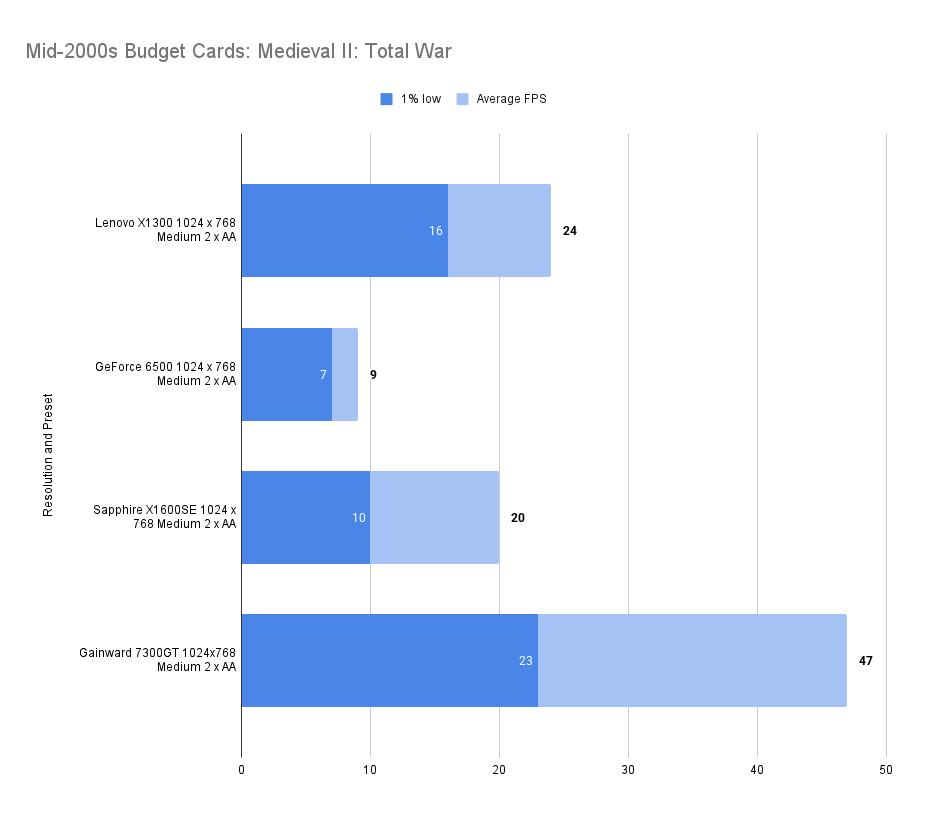
The first game from 2006, the year of release for the 7300GT and look…. It’s the recommended spec, so it must be good?
Well, of course it is, 50fps average with the medium preset. A win over the X1300 Pro but not a huge one for a change and the ATi card wins out with consistency again (at least as a percentage of total framerate).
Anyway, all good here, another huge margin betwee this and the 7300SEs paltry 12fps.

Interestingly, switching on AA tanked the performance of the ATI card but barely dented the results of the 7300GT, a sign that the Nvidia card deals with AA better than the competition.

FlatOut 2 (2006)
Minimum: Windows 98/ME/2000/XP, Pentium 4 2.0 GHz, DirectX 9.0c, 64 MB 3D GPU (e.g. GeForce FX 5200 or Radeon 9600 Pro), 256 MB RAM, 3.5 GB HDD;
Recommended: Windows XP, Pentium 4 3.0 GHz, 256 MB 3D GPU (e.g. GeForce 6600 GT or Radeon X1600), 512 MB RAM

Another game for the 7300GT to show off how much it is better than other options, look at those results against the earlier Nvidia card.
At 1280 x 1024 the 7300GT is faster than the previously impressive X1300Pro at 1024 x 768.

The poor 1% low in comparison to the average framerate is a continuing trend.
The Elder Scrolls IV: Oblivion
Minimum: Windows XP/Pentium 4 2 GHz/128 MB DirectX 9.0c GPU (e.g. GeForce FX/Radeon 9600)/512 MB RAM
Recommended: Windows XP/Pentium 4 3 GHz/ATI X800 or GeForce 6800 (256 MB)/1 GB RAM.
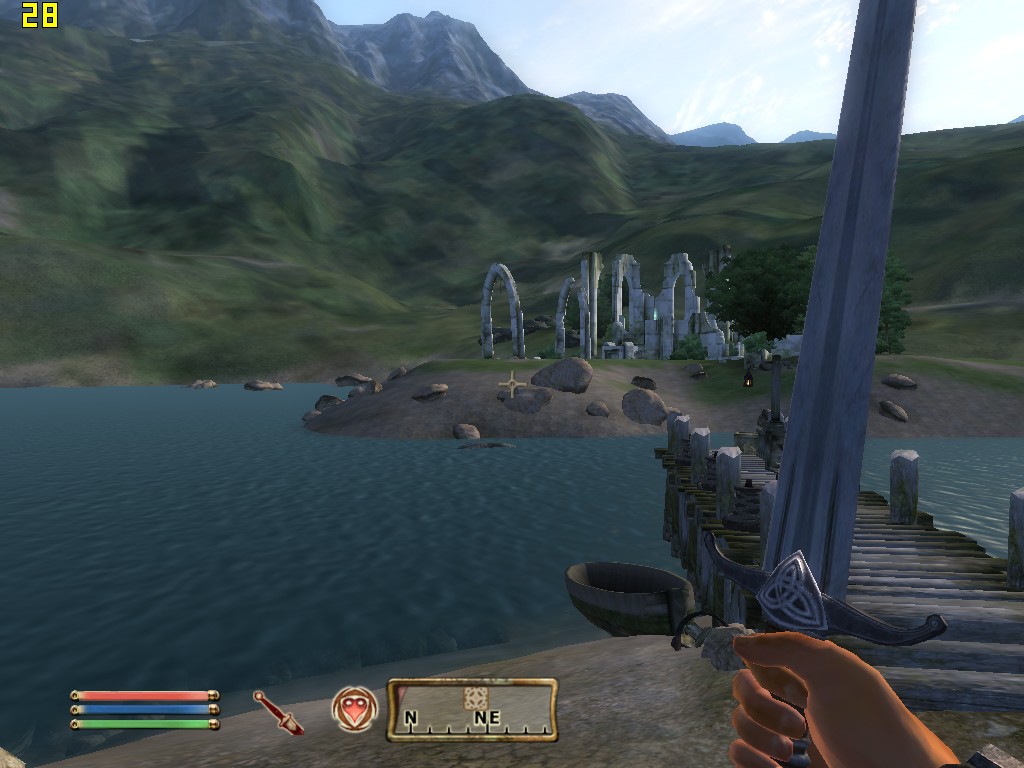
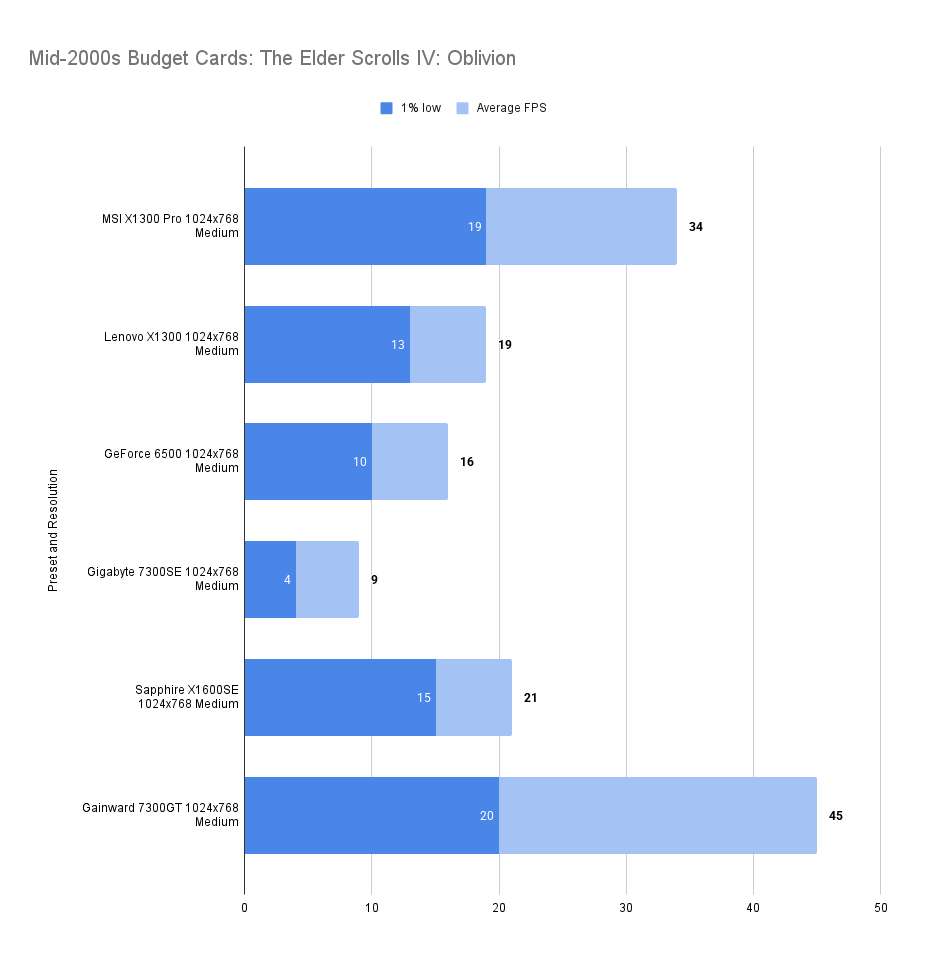
In Oblivion we see the familiar strong performance in comparison to the other budget cards of the Mid-2000’s but not winning by quite the normal margin.
It’s a useful improvement over the X1300Pro whilst matching the 1% low at 1024 x 768 medium.
At high settings all cards struggle, even with the lower 800×600 resolution. Only the Gainward 7300GT can give a ‘playable’ experience at high settings in this game.


Just Cause (2006)
Minimum: Windows 2000/XP/Pentium IV 1.4 GHz/64 MB DirectX 9.0c GPU with Shader Model 1.1 (e.g. GeForce 4 Ti 4200 or Radeon 9500)/512 MB RAM/5.8 GB disk space.
Recommended: Pentium IV 2.8 GHz or Athlon 64/256 MB Shader Model 2.0 GPU (e.g. GeForce 7 series)/1 GB RAM/7.4 GB disk space.

This game is a struggle for budget cards, the 7300GT does ok with this, an inconsistent 35fps when driving about and blowing stuff up in this game.
It does lose out on consistency with the X1300 pro also as well, it’s own 28fps is far more reliable.

Settings as follows:

S.T.A.L.K.E.R.: Shadow of Chernobyl (2007)
Minimum: Windows XP/2000 SP4, Pentium 4 2.0 GHz or AMD XP 2200+, 128 MB GPU (GeForce 5700 or Radeon 9600), 512 MB RAM, DirectX 9.0c, 10 GB disk space
Recommended: Core 2 Duo E6400 or Athlon 64 X2 4200+, 256 MB GPU (GeForce 7900 or Radeon X1950), 1.5 GB RAM, same OS and disk space

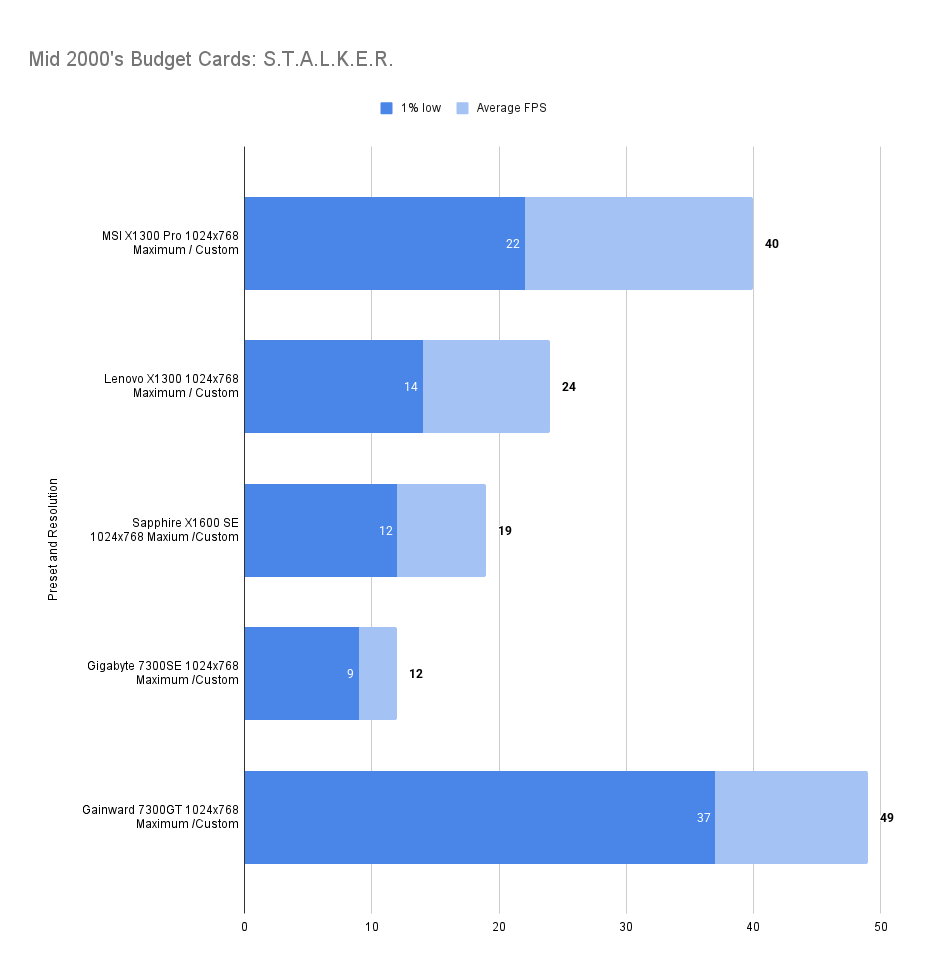
Here we go in stalker, no problems with running the game and a rare win for both average framerate and consistency over the X1300Pro.
Crysis (2007)
Minimum: Windows XP/Vista, Pentium 4 2.8 GHz (3.2 GHz for Vista), 1 GB RAM (1.5 GB for Vista), 256 MB GPU (GeForce 6800 GT or Radeon 9800 Pro), DirectX 9.0c/10, 12 GB disk space
Recommended: Core 2 Duo @ 2.2 GHz or Athlon 64 X2 4400+, 2 GB RAM, 512 MB GPU (GeForce 8800 GTS or Radeon X1800), same OS and disk space
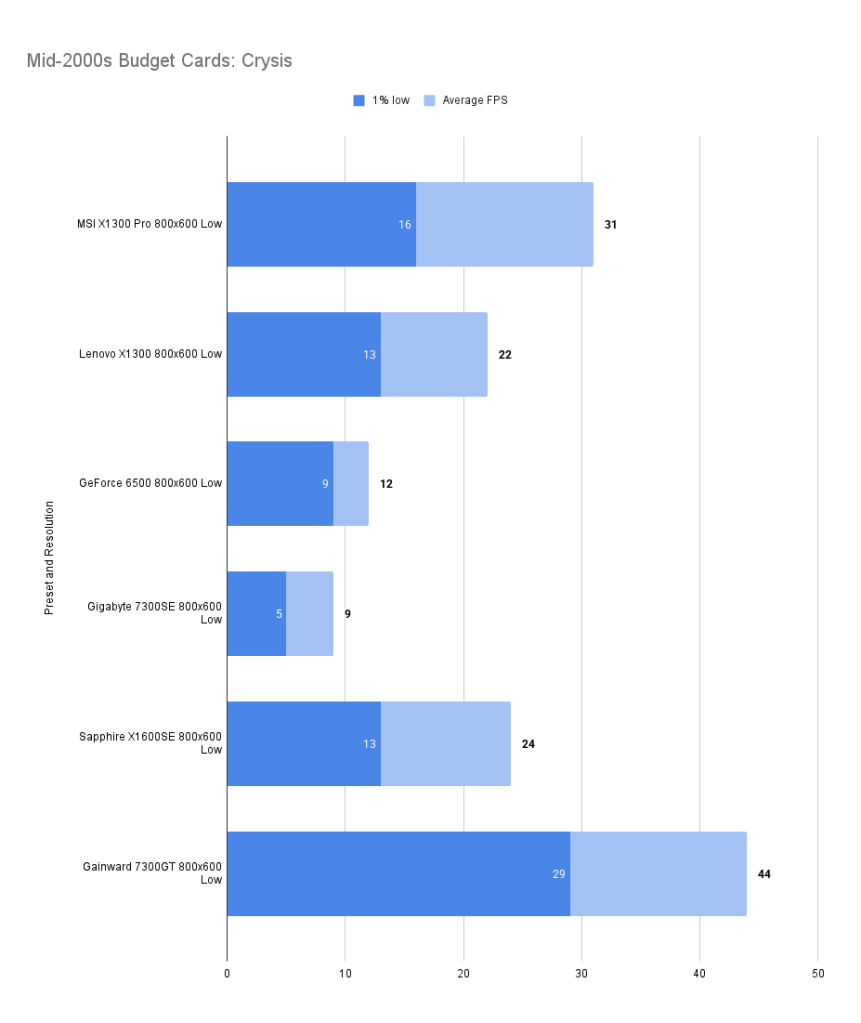
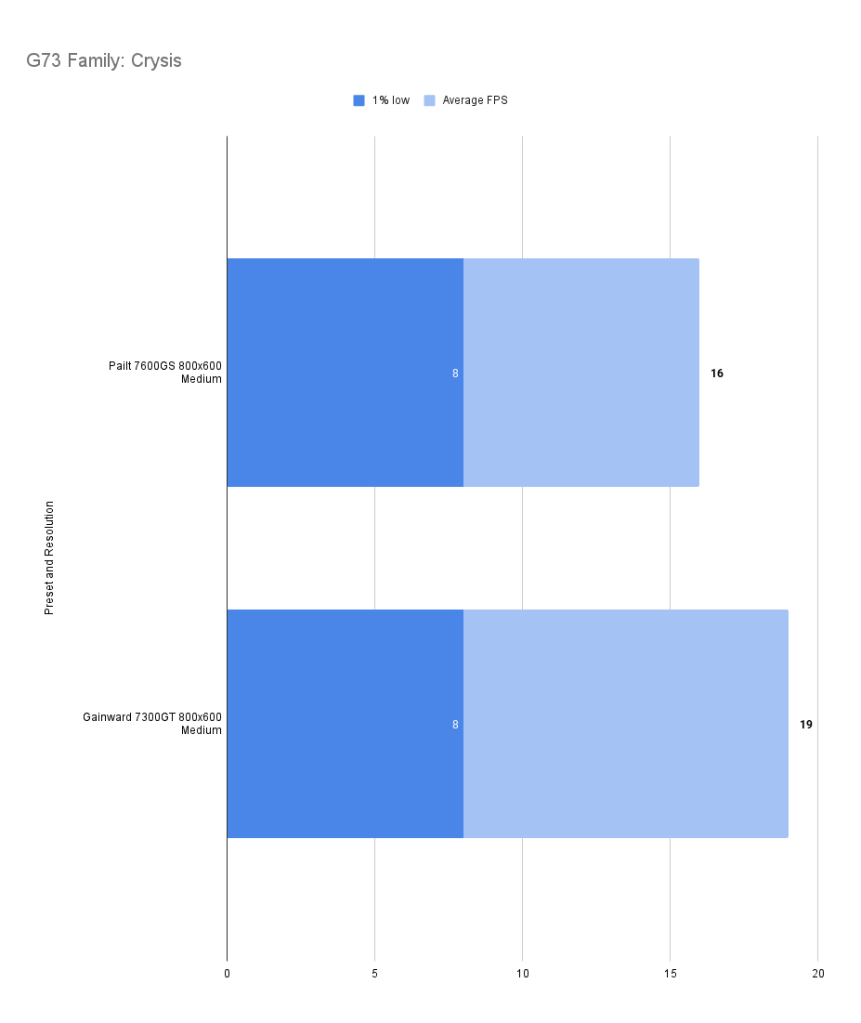
Those are some steep minimum requirements which we’re not even close to matching… despite this, of course though our Gainward card preforms well, 44fps at 800 x 600 low, much better than the X1300 Pro and more consistent to boot.
Pushing the resolution up doesn’t cause as much additional pain as you may think and is probably the better way to play

It’s easy to get carried away though, G73 GPU’s are far from strong enough for the medium preset in this game. the 7300GT wins out over the 7600GS yet again, but we’re used to that now.

Assassin’s Creed (2007)
Minimum: Windows XP/Vista, Dual-core CPU at 2.6 GHz (Pentium D or Athlon 64 X2 3800+), 256 MB GPU (GeForce 6800 or Radeon X1600), 1 GB RAM (2 GB for Vista), DirectX 9.0/10, 12 GB disk space
Recommended: Core 2 Duo at 2.2 GHz or Athlon X2 4400+, 512 MB GPU (GeForce 8800 or Radeon HD 3000 series), 2 GB RAM (3 GB for Vista), same OS and disk space
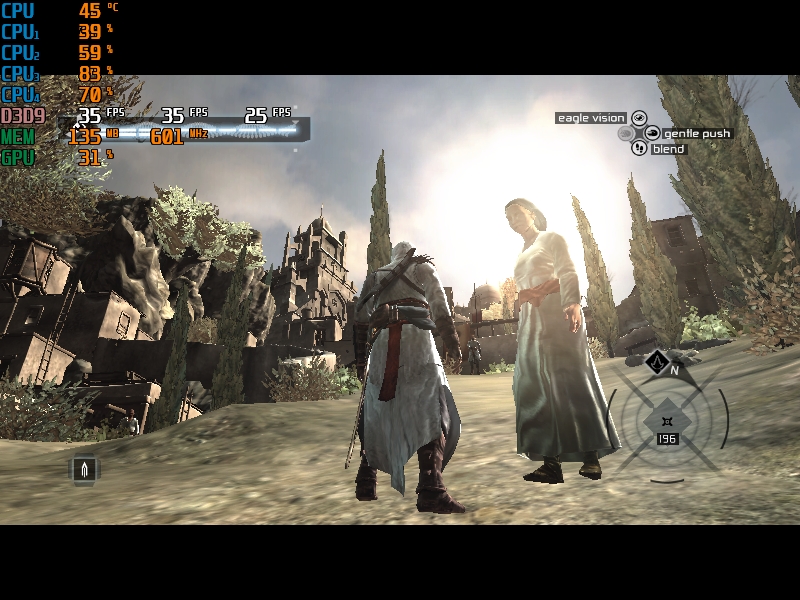
Dropping below the minimum specs again, the game is actually playable on the 7300GT, for the first time it felt actually smooth to run around in with a budget card – albeit at 800×600 low.
It doesn’t look great at these settings but you can run and jump about with painful stuttering, not a bad showing.

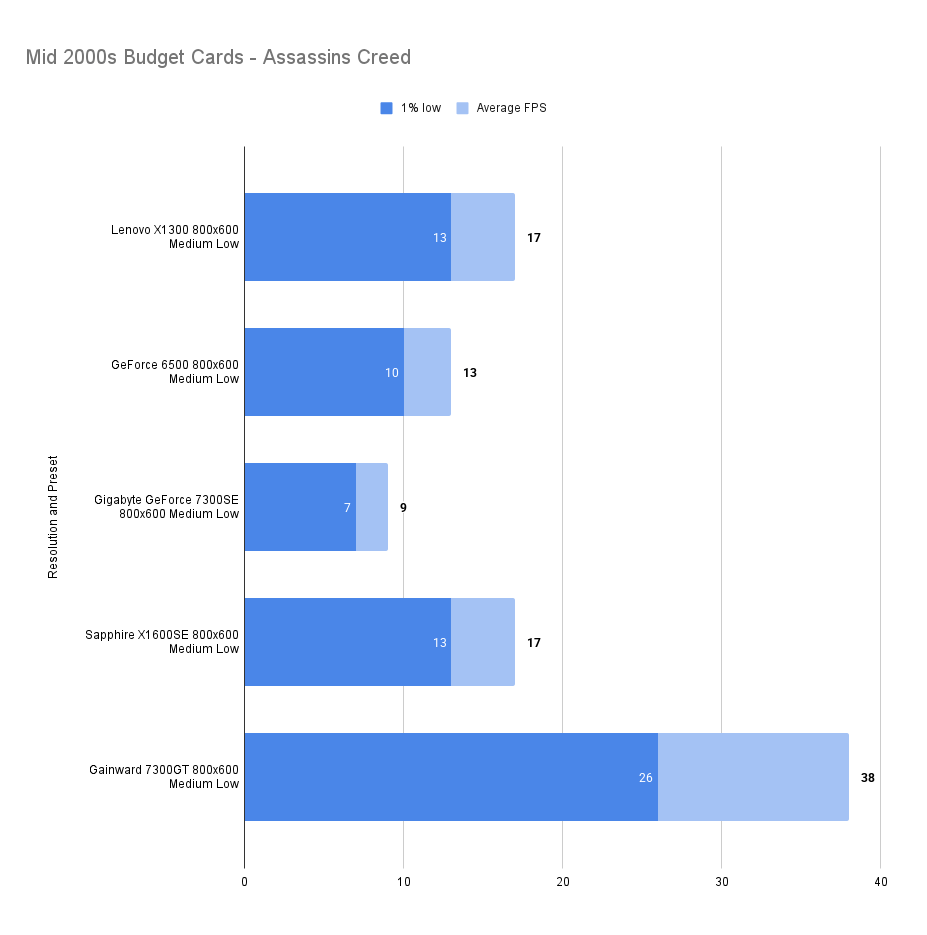
With a few settings switched up to Medium, things did crash down to an average 38fps, still not bad at all and a big increase on all of the other budget options.
If you picked up the 7300SE and not GT by accident you wouldn’t even see double digits, quite the contrast.
Test Drive Unlimited (2007)

Only tested on the 7600GS before and here we see very pretty similar results really. AA performance on the 7300GT is far better than the GS, the raw performance that the higher clock speeds give must be making the difference.

to be fair, this game does not feel really smooth on either card and I can’t see dropping to low really improving things.
A better graphics card is recommended in this title.
Gaming Summary
In games, the 7300GT clearly leads the pack among the mid-2000s budget cards I’ve tested. It even edges out the lower mid-range 7600GS in several benchmarks, which caught me off guard.
That said, it’s still a budget card at heart. Tempting as it is to overhype it, some later titles still struggle to deliver a smooth experience. Keep expectations era-appropriate.
While average framerates beat the competition handily, consistency could have been tighter.
Synthetic Benchmarks
3d Mark 2001SE
Intro to the software:
3DMark 2001 SE is a hallmark of early-2000s performance benchmarking, crafted to assess system capabilities in DirectX 8.1 environments. Its suite of synthetic tests—ranging from cinematic scenes like Car Chase and Dragothic to feature-specific shader evaluations—pushed GPUs and CPUs to their limits in a period defined by rapid innovation.
Designed to highlight graphics and processor performance with a focus on vertex and pixel shader throughput, 3DMark 2001 SE delivers a unified score that reflects real-world gaming potential for the era. Systems leveraging hardware-accelerated DX8.1 features, high memory bandwidth, and fast front-side buses typically land at the top of the charts.
Cards such as the ATI Radeon 9700 Pro and GeForce Ti 4600 exemplify peak compatibility, balancing brute force with support for the necessary shader models.
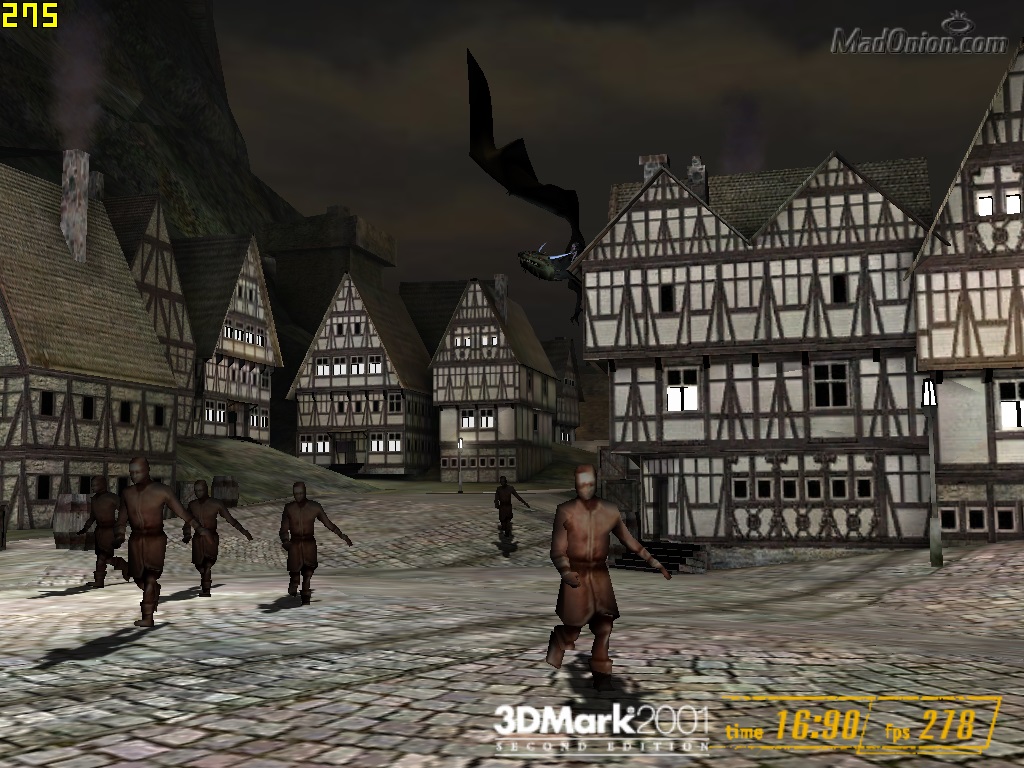
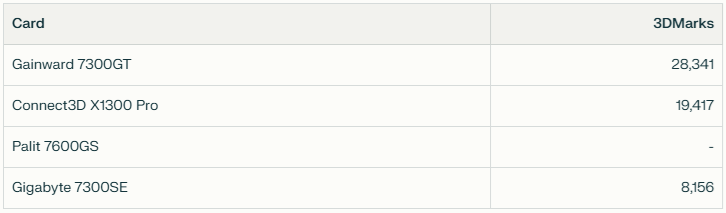
the Gainward card posted a very respectable 28,341 3d Marks.. nearly 10k above the X1300 Pro and a massive 20k more than the 7300SE in this early title.
Unfortunately, there is no 7600GS result for this one, this wasn’t a compatibility problem, the card just died before I ran the test.


3d Mark 2003
Introduction
3DMark 2003 marked a major leap in synthetic benchmarking, introducing full support for DirectX 9.0a and a new generation of shader-heavy test scenes. With cinematic sequences like Wings of Fury, Battle of Proxycon, Troll’s Lair, and Mother Nature, it pushed GPU pixel and vertex shader capabilities far beyond the fixed-function pipeline era.
Unlike its predecessor, 3DMark 2003 places greater emphasis on GPU architecture and shader throughput, with CPU tests included for the first time. The scoring system reflects this shift, favoring cards that excel in programmable pipelines and multitexturing performance.
GPUs such as the Radeon 9800 Pro and GeForce FX 5900 Ultra were designed with these workloads in mind, delivering high scores thanks to robust DX9 feature support and ample memory bandwidth.


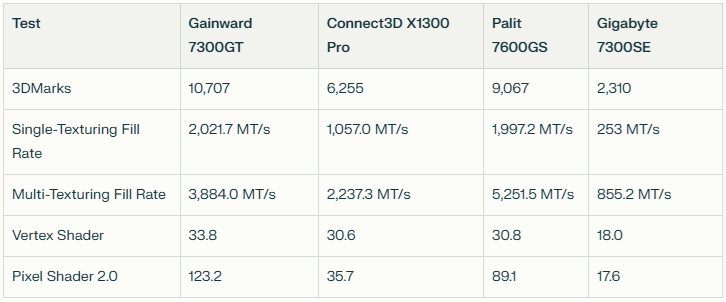
A healthy lead of the 7600GS and much faster than the X1300 Pro.
3d Mark 2006
Introduction
3DMark 2006 builds on its predecessors with a more demanding suite of tests that reflect the evolving complexity of DirectX 9.0c-era games. Featuring scenes like Return to Proxycon, Firefly Forest, Canyon Flight, and Deep Freeze, it introduces Shader Model 3.0, HDR rendering, and more intricate lighting and geometry workloads. For the first time, CPU performance is factored into the overall score, acknowledging the growing role of physics and AI in modern gaming.
The benchmark outputs three sub-scores—SM2.0, HDR/SM3.0, and CPU—alongside a unified total. GPUs with robust shader pipelines and support for FP16 textures and blending tend to excel, while older cards may struggle to complete all tests.
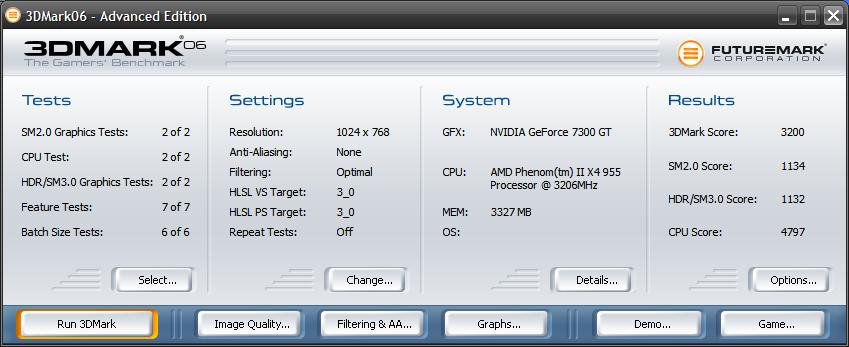
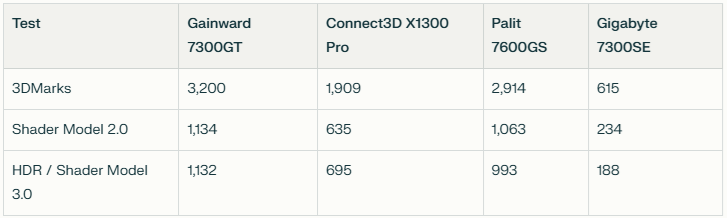
The 7300GT takes the benchmark in its stride doubling the results of the X1300 pro in Shader Model 2 and 3

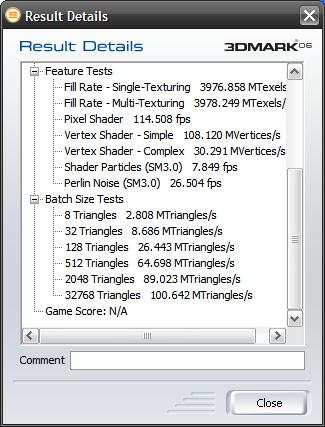
Unigine Sanctuary
Introduction
Unigine Sanctuary is a visually rich GPU benchmark released in 2007, designed to showcase the capabilities of the Unigine 1 engine. Set in a gothic chapel bathed in torchlight and stained glass, it features dynamic lighting, parallax occlusion mapping, volumetric fog, and ambient occlusion—all rendered in real time using DirectX 9.
Unlike synthetic benchmarks, Sanctuary emphasizes scene fidelity and shader realism over raw frame count. It’s particularly sensitive to fill rate, memory bandwidth, and shader execution efficiency, making it a strong test for mid-2000s GPUs and a punishing one for low-end cards.

Even the 7300GT struggles a little with this test at 1024 x 768 Resolution but the 17 FPS is a great result considering what is asked of it.
The 7300SE by comparison couldn’t even manage 2fps.

Conclusions
Well there you go. Hard to imagine another mid 2000s budget card knocking this Gainward 7300GT off the top spot.
I’ve split the decade to include those early unified shader cards. Maybe there’s a GeForce 8000 series contender out there, but I doubt it. Those were probably tuned more for DirectX 10 games at the expense of older titles.
We’ll slot a few into the old Phenom soon enough and find out.
This Gainward version really stands out, with solid cooling, a good factory overclock, and tons of headroom for more. The extra ROPs and TMUs were a total shock — I had no idea that existed. The design works great, and the cooler keeps peak temps around 55 degrees.
Sure, it cheats a bit by using a mid‑tier GPU die, but if the original price stayed in budget range, that’s hardly a complaint.
Oddly, the huge overclock does not seem to deliver much better gaming or benchmark results. Puzzling stuff.
Anyway, the Gainward NVIDIA GeForce 7300 GT GLH Golden Sample — what a great card.
Links
A few relevant articles found are below:
Zogis Overclocked GeForce 7300 GT Review – Hardware Secrets
https://archive.techarp.com/showarticle5c49.html?artno=334 (this for the Gainward silent version – it is an incomplete article, later pages)
Gainward Bliss 7300 GT Golden Sample – OC3D (benchmark result imagines no longer hosted – very annoying)
 Ash's Retro Hardware Reviews
Leave a comment