A Retrospective Review and Benchmarks
- RRP: unknown
- Release date: 2005 (RV515) This card may have been released later
- Purchased in December 2024
- Purchase Price: £13.99 delivered
Introduction to the RV515 & RV516 GPU’s
The ATI Radeon X1300 series (to later include X1550/X1600), launched on October 5, 2005, was the budget end of ATI’s Radeon X1000 series of graphics cards.
The X1300 series was built on a 90 nm manufacturing process and featured the RV515 and later RV516 graphics processor, the latter a close relation but on a smaller 80nm process.
The family did extend on providing a budget option even when successor series of chips were released.
Key specifications included:
- 4 pixel shaders and 2 vertex shaders (except the XT)
- 4 texture mapping units (TMUs) and 4 render output units (ROPs)
- Core clock speeds ranging from 450 MHz to 600 MHz,
- Support for DirectX 9.0c and Shader Model 3.0
- Memory configurations of 128 MB or 256 MB, with DDR or DDR2 memory types
- Memory bus width of 128-bit for standard models, 64-bit for some variants
- Low power consumption (TDP around 31W for the Pro)
These cards would be competing with the lower-end GeForce 6000 and 7000 Series cards of the time.
The RRP for a new X1300 on release were reportedly $79 for the cheapest HyperMemory edition up to $150 for the X1300 Pro.
In 2006, the X1300XT was released, a more serious contender. It had a lower clock speed but with an increase right up to 12 Pixel Shaders and 5 Vertex Shaders, this with an RRP of $89. I really want to own one but, they don’t seem to show up on eBay often.
The final card in the family was the X1550XT released in 2007 slightly different silicon. This was sold as an ultra-budget option with an RRP of $65.
The Card
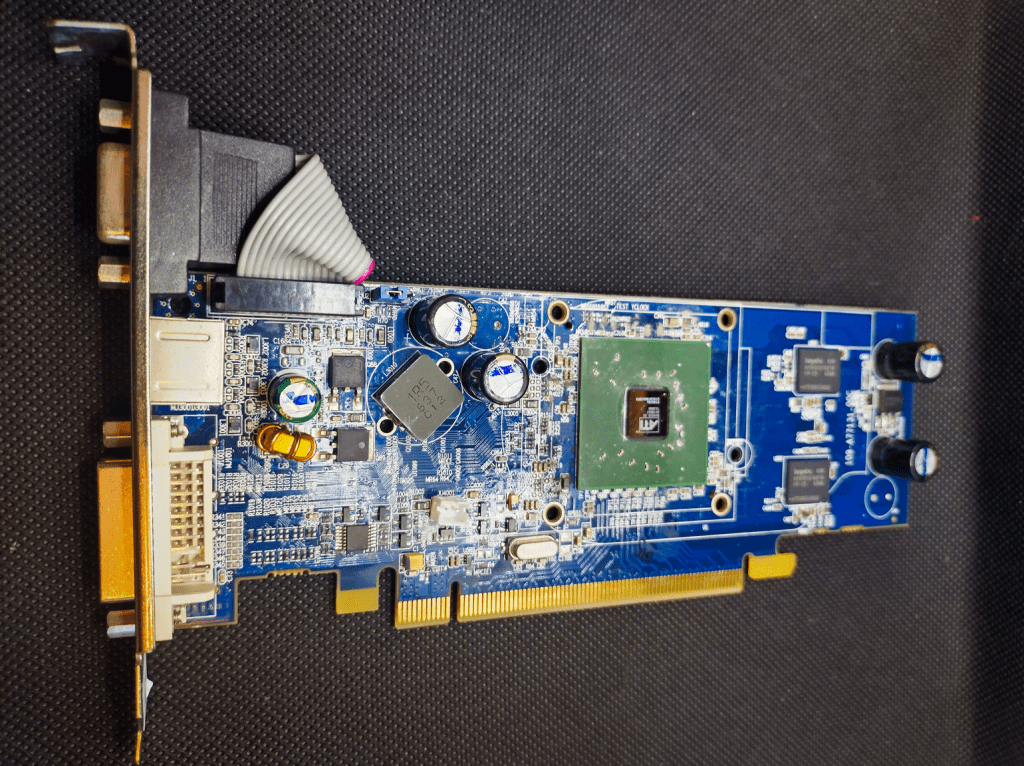
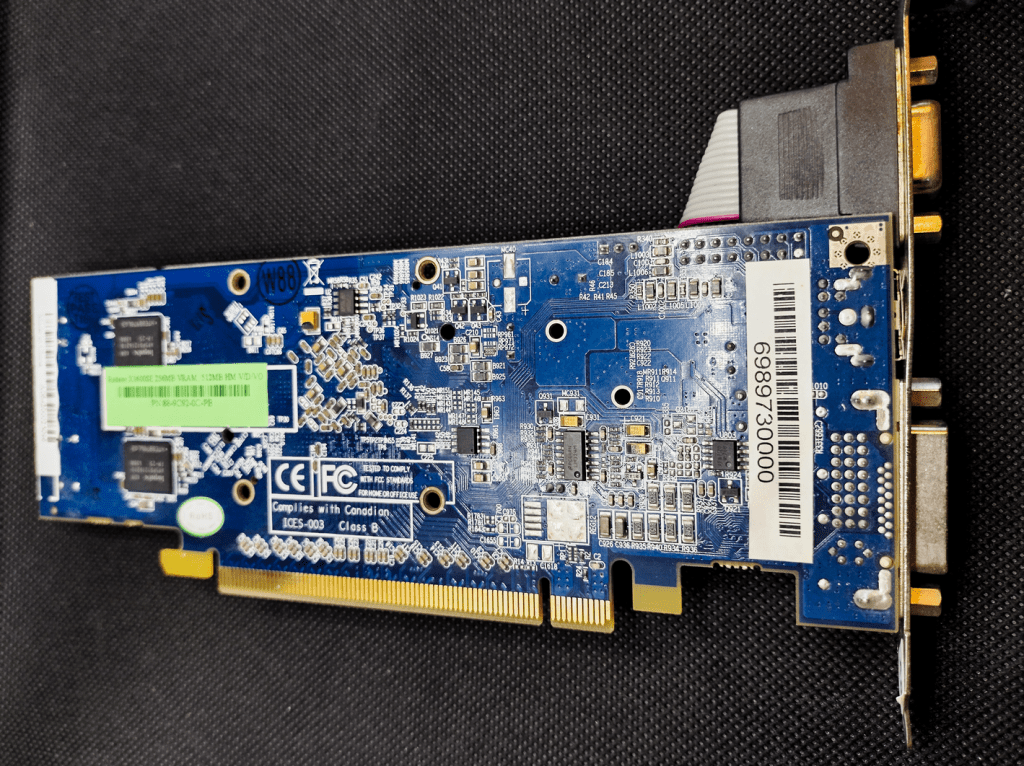
I was growing a little bored of X1300’s and all that madness so I dropped in an X1600SE to see what this is all about
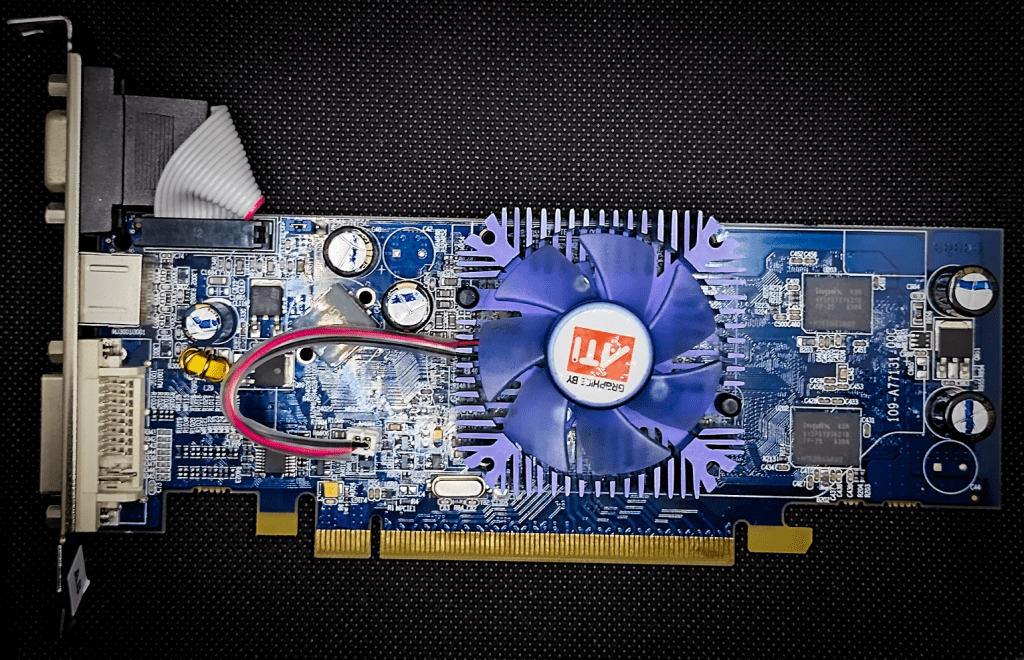
SE after a card rarely means that you’re getting the best but, 1600 is a higher number than 1300 any day of the week so lets see what 300 radeon performance points gives us:
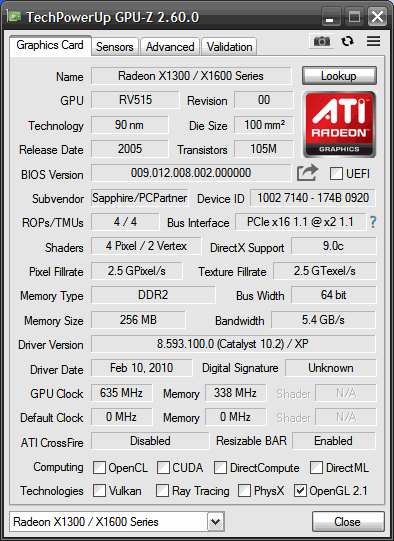
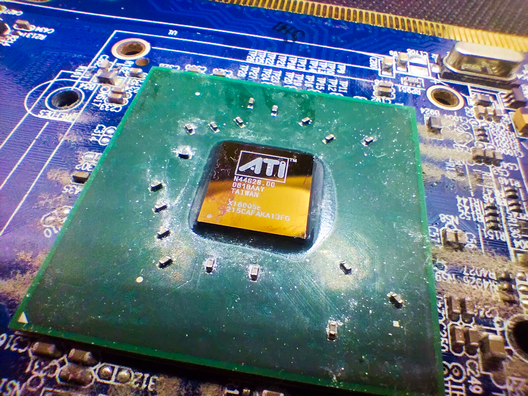
Well, there’s that then: RV515, the old X1300 again but given a new name, outrageous.
With a crappy 64Bit memory bus as well, so not even a good X1300.
Well I’d already paid the £13.99 entry fee so let’s see how it goes.. at least it’s a Sapphire card, so it’s a pretty blue colour and all around nicer to look that than that hideous Lenovo card.
Here’s how it compares to the cards already tested:
| Connect3D Radeon X1300 Pro | Lenovo X1300 (RV516) | GeForce 6500 | Sapphire X1600SE (RV515) | |
| Memory Amount and Type | 256Mb DDR2 | 256Mb DDR2 | 256Mb DDR2 | 256Mb DDR2 |
| Memory Bus Width | 128 bit | 64Bit | 64 Bit | 64 Bit |
| GPU Clock | 594Mhz | 452Mhz | 398Mhz | 635Mhz |
| Memory Clock | 396Mhz | 392Mhz | 250Mhz | 338Mhz |
| ROPs/TMUs | 4/4 | 4/4 | 4/4 | 4/4 |
| Shaders | 4 Pixel / 2 Vertex | 4 Pixel / 2 Vertex | 4 Pixel / 3 Vertex | 4 Pixel / 2 Vertex |
| Pixel Fillrate | 2.4 Gpixel/s | 1.8 Gpixel/s | 1.6 GPixel/s | 2.5 GPixel/s |
| Texture Fillrate | 2.4 Gpixel/s | 1.8 Gpixel/s | 1.6 GPixel/s | 2.5 GPixel/s |
A look at the above and the Sapphire card would seem to compare quite favourably with the X1300 Pro in all but the all-important Memory Bus Width.
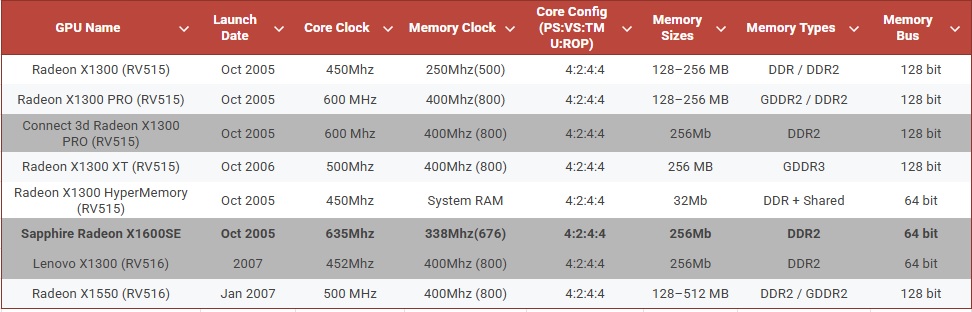
Here’s a table showing some the RV515 and RV516’s (I removed FireGL and Mobility Cards):
Let’s see how it gets on.
The Test System
Details are as follows:
- CPU: AMD Phenom II X4 955 3.2Ghz Black edition
- 8Gb of 1866Mhz DDR3 Memory (showing as 3.25Gb on 32bit Windows XP and 1600Mhz limited by the platform)
- Windows XP (build 2600, Service Pack 3)
- Kingston SATA 240Gb SSD
- ASRock 960GM-GS3 FX
- The latest supported Catalyst Driver 10.2
Return to Castle Wolfenstein (2001)
First off a game that wasn’t tested with the other cards, I had it installed and thought it worth a run-through as it was a popular game at the time.
Things moved very quickly at the start of the century so, unsurprisingly perhaps a card using 2005 technology gave great performance in this game.
despite it’s age it’s a great looking game. I played on the below settings:
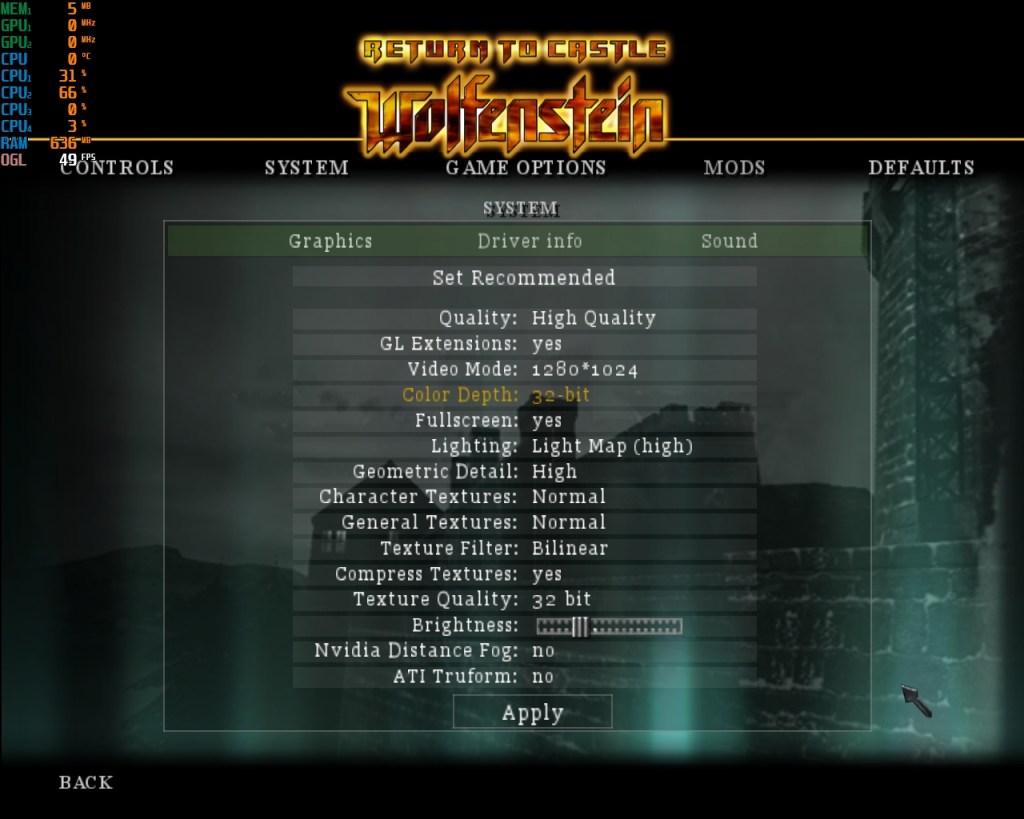
Performance was very smooth, such a great looking game despite it’s age. The gameplay and level design are really good, I recommend this game to anyone.
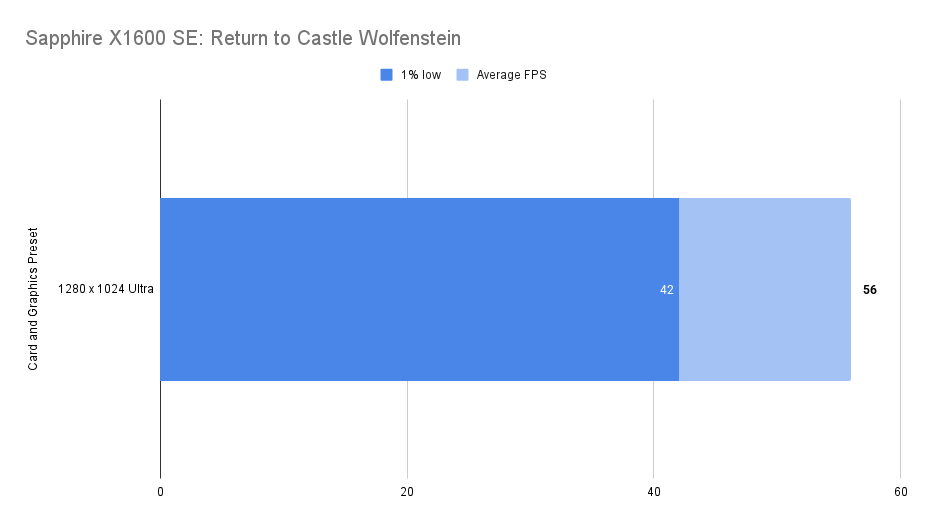
I know this was designed when people were all on GeForce 2’s etc but there we go.. a bit of overkill.
Mafia (2002)
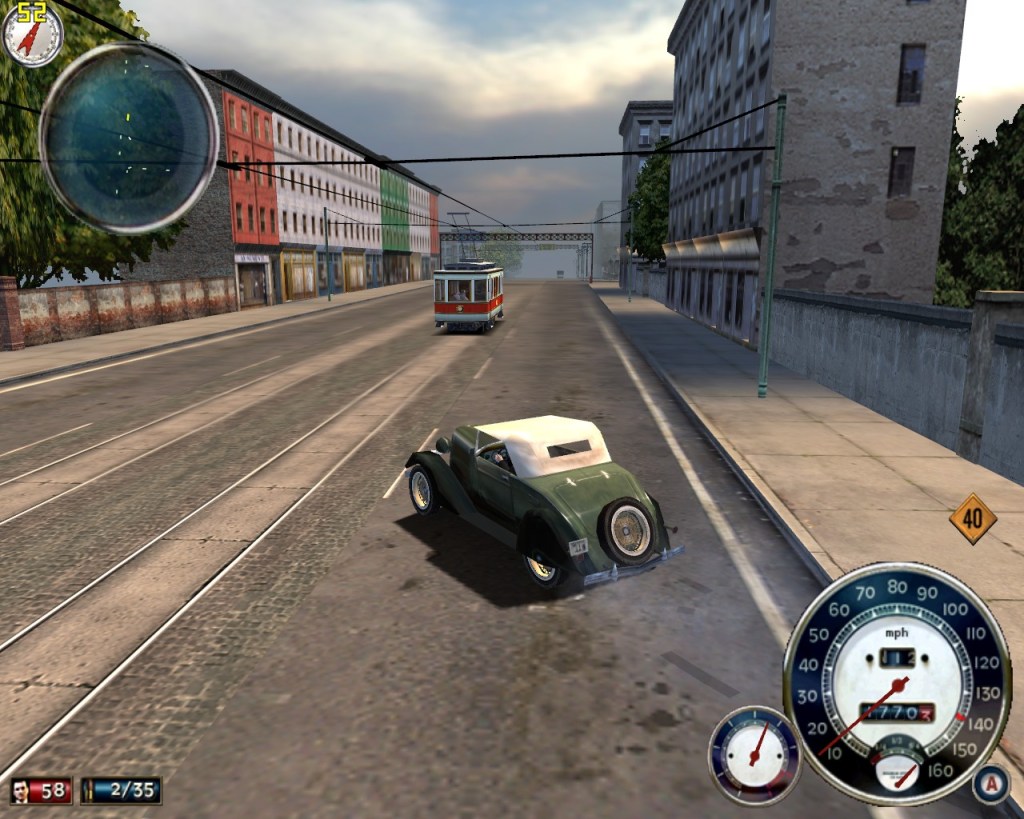
Back to Mafia, capped at 63fps by the game engine but that never came into play for the the X1600SE.
Comparable performance with the Lenovo X1300, a higher 1% low but average framerate. You’d never really know which card you were playing on though.
We’ll call it a tie.
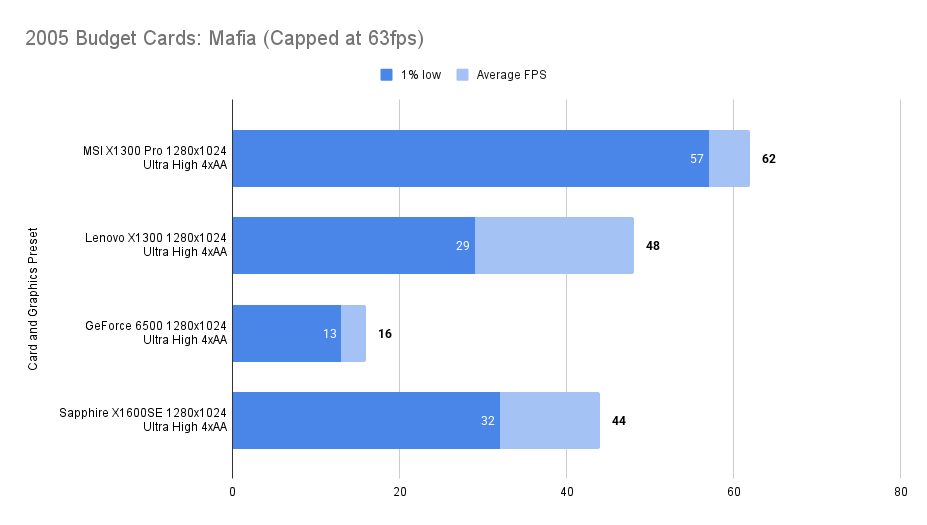
Wiping the floor with the awful Geforce 6500 though and the X1300Pro is out of reach.
Unreal Tournament 2003
Great fun to play even if you can only really go against bots nowadays.
There is a small single player campaign, I got my version from CEX for 50p and I’ve certainly had 50p’s worth of fun already.
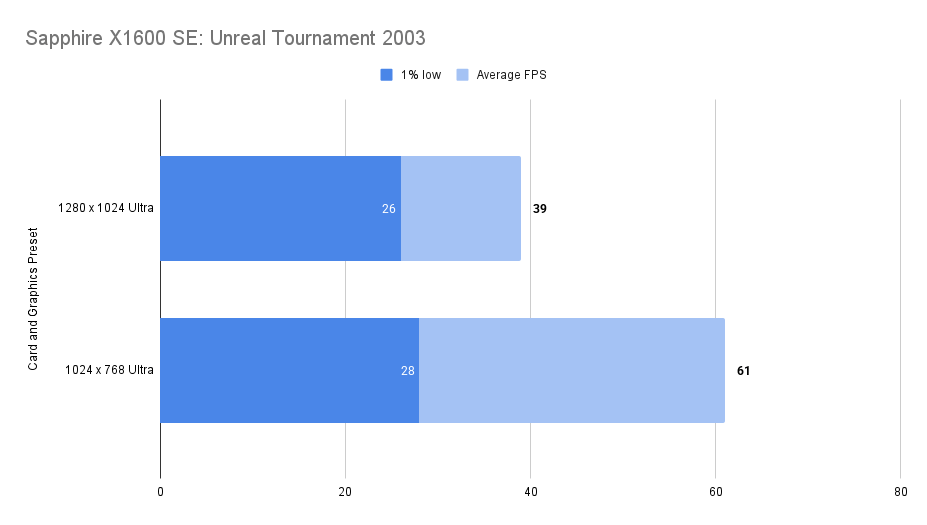
Performance with everything maxed out is fine at 1280 x 1024 but you’d want to play at 1024 x 768 to get some more frames, it’s a fast-paced game and the bots are pretty good at higher levels!
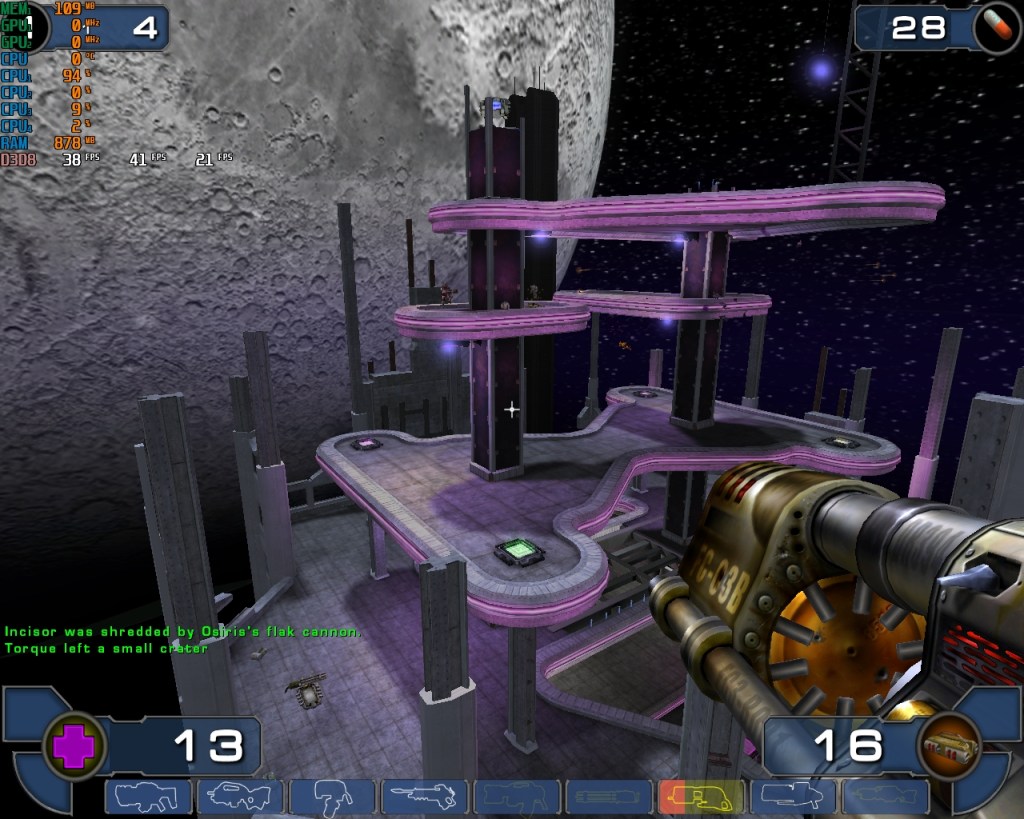
We used to play this at LAN parties, those were some good times.
Another new game added to the list so no comparable results I’m afraid.
FarCry (2004)
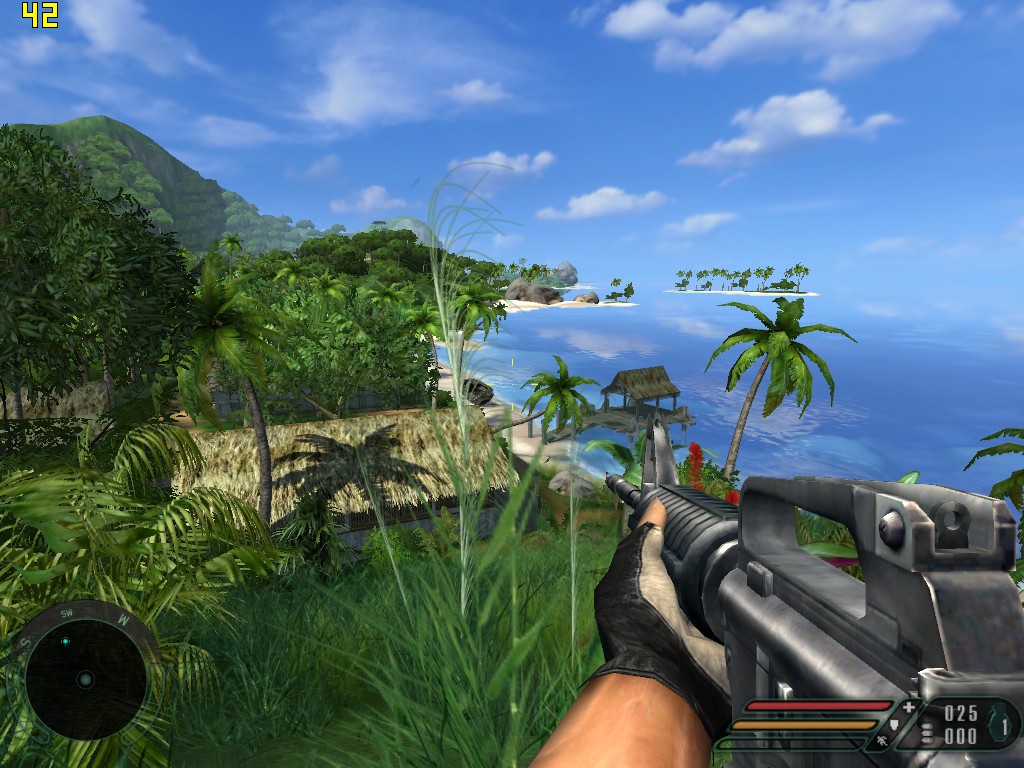
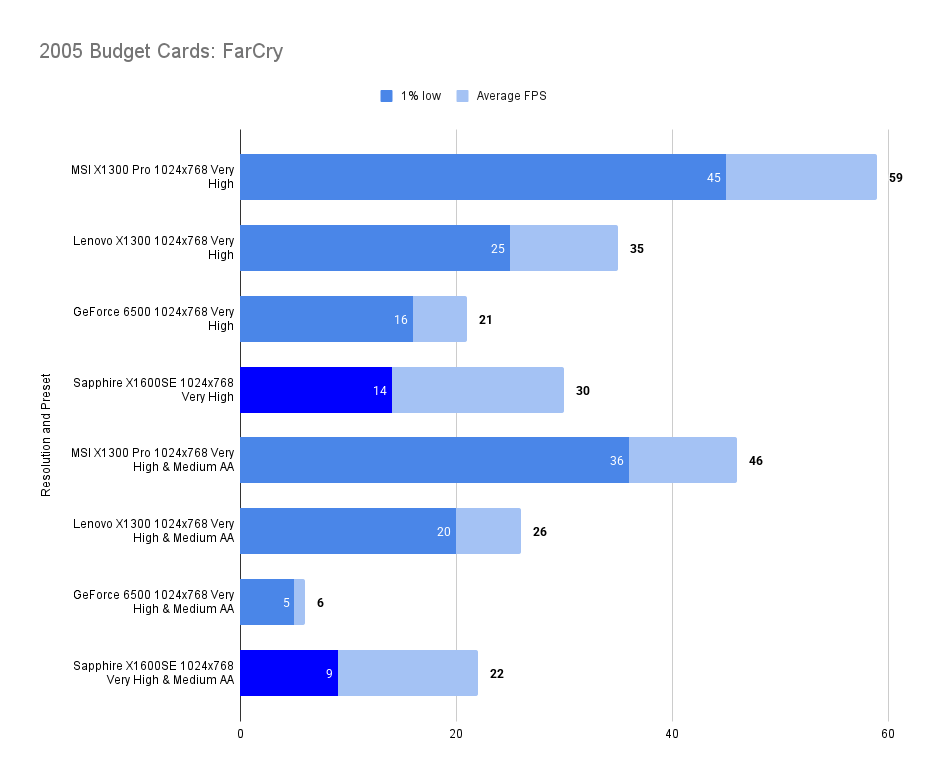
Losing out to the Lenovo card in a big way here.
The RV516 X1300 seems to have something going on that beats our higher clocked RV515 X1600SE quite handily.
These settings are only really playable on the X1300 Pro though.
Doom 3 (2004)
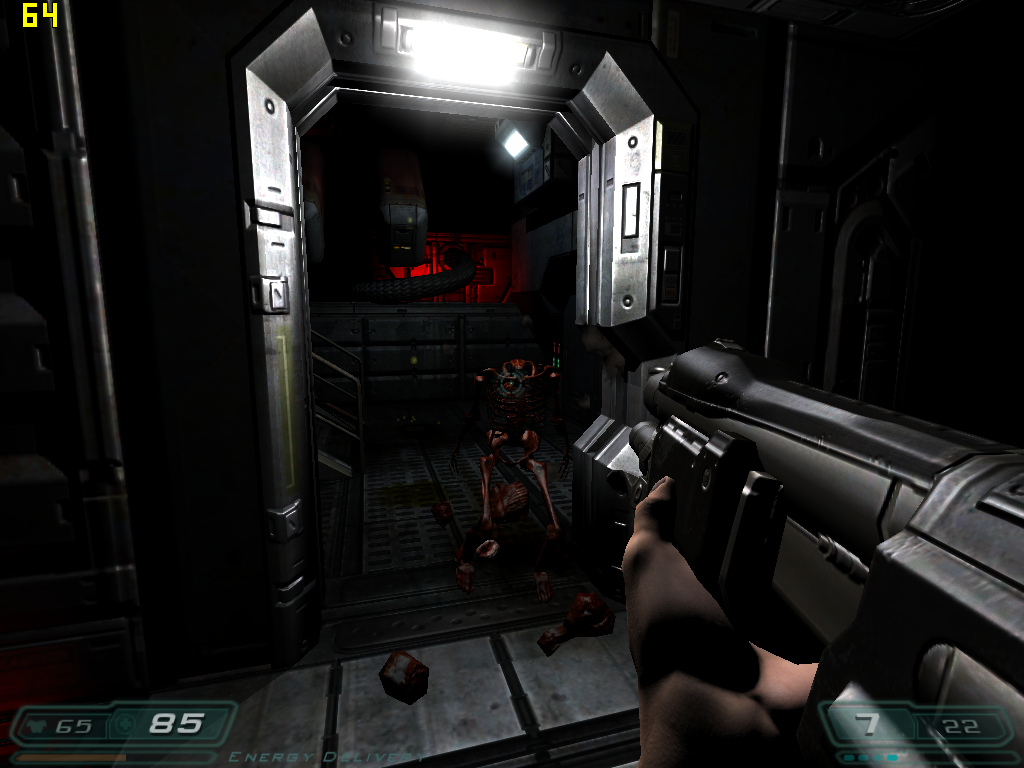
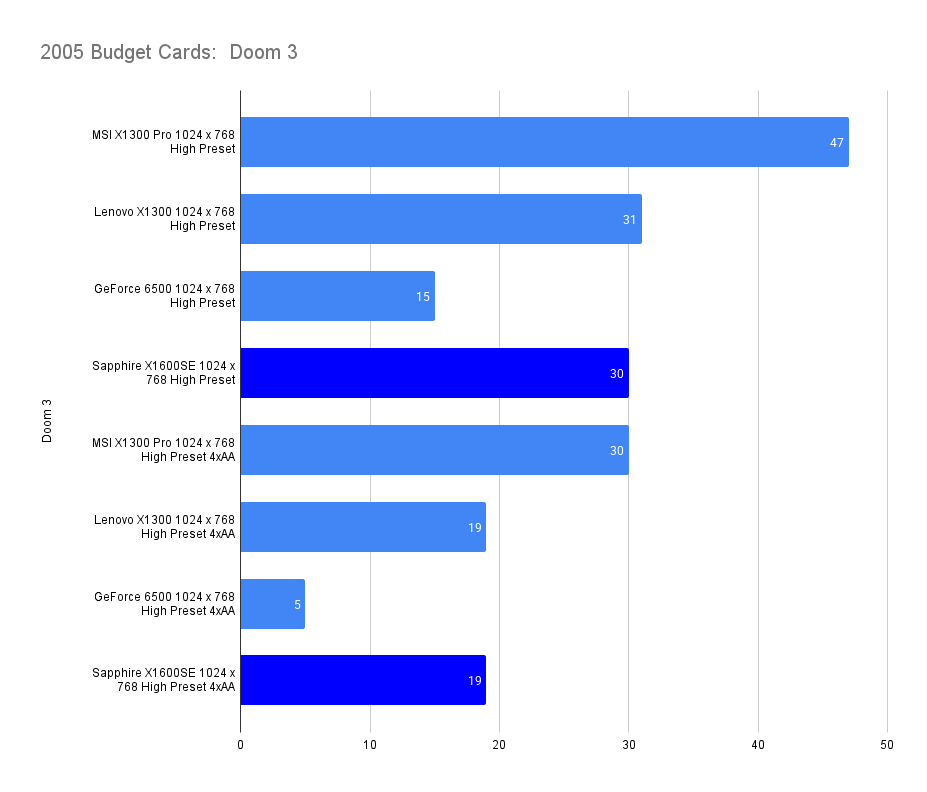
Using two runs of the internal benchmark and recording the second, it’s pretty much a margin-of-error tie but strictly speaking, the Lenovo card wins with it’s 1fps at 1024 x768 High over our Sapphire card.

Need for Speed: Most Wanted (2005)
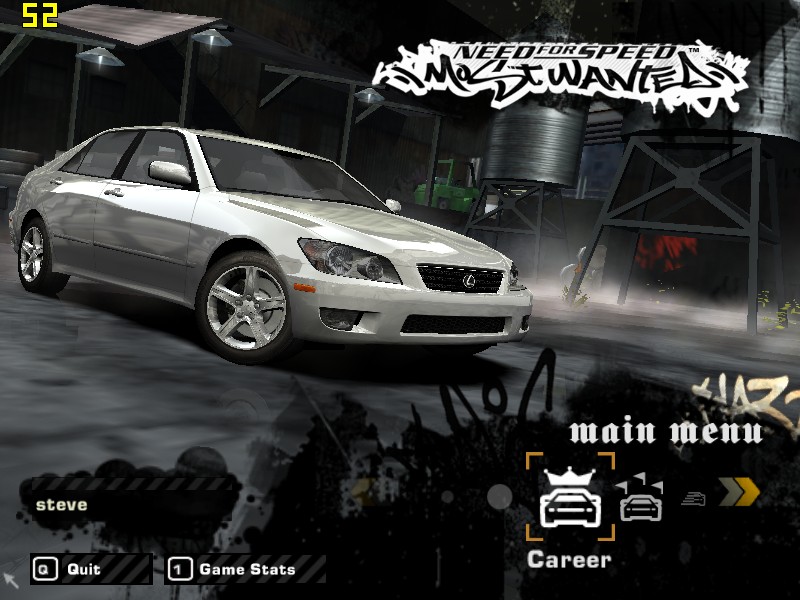
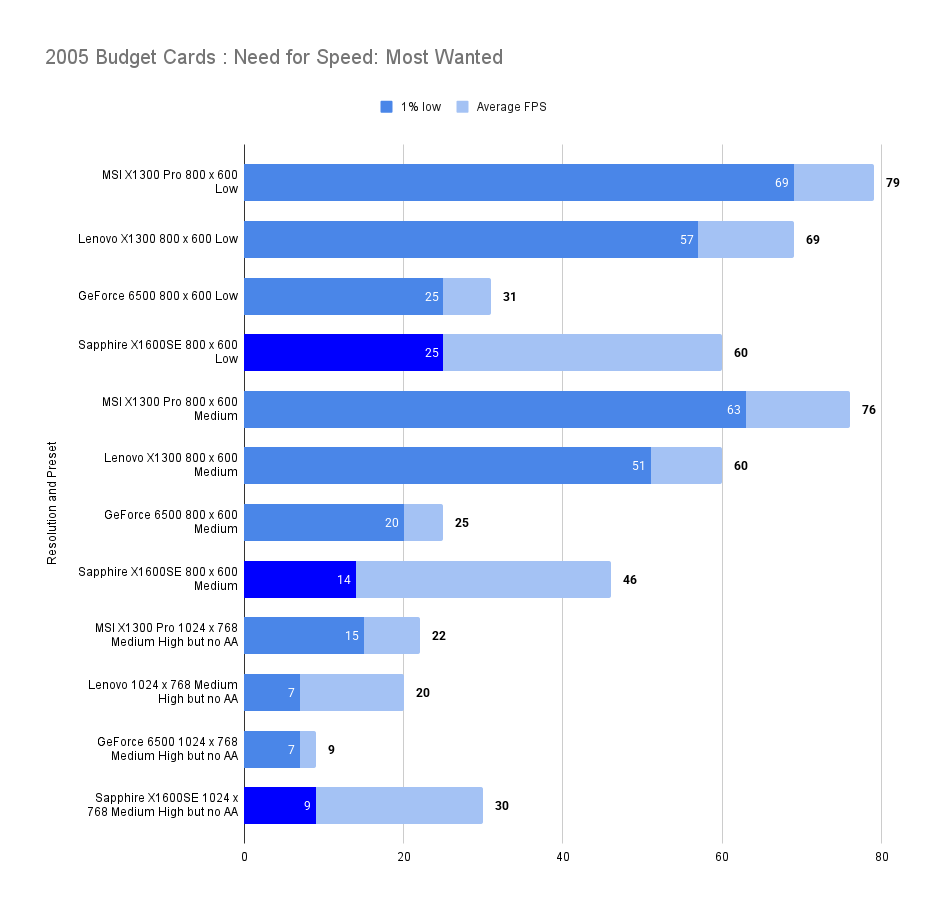
Showing that FarCry wasn’t a fluke, the Lenovo card performs much better than the X1600SE.
Secret RV516 sauce doing its thing then, the 1% low is leading to a huge deficit in gaming experience.

Medieval II: Total War (2006)
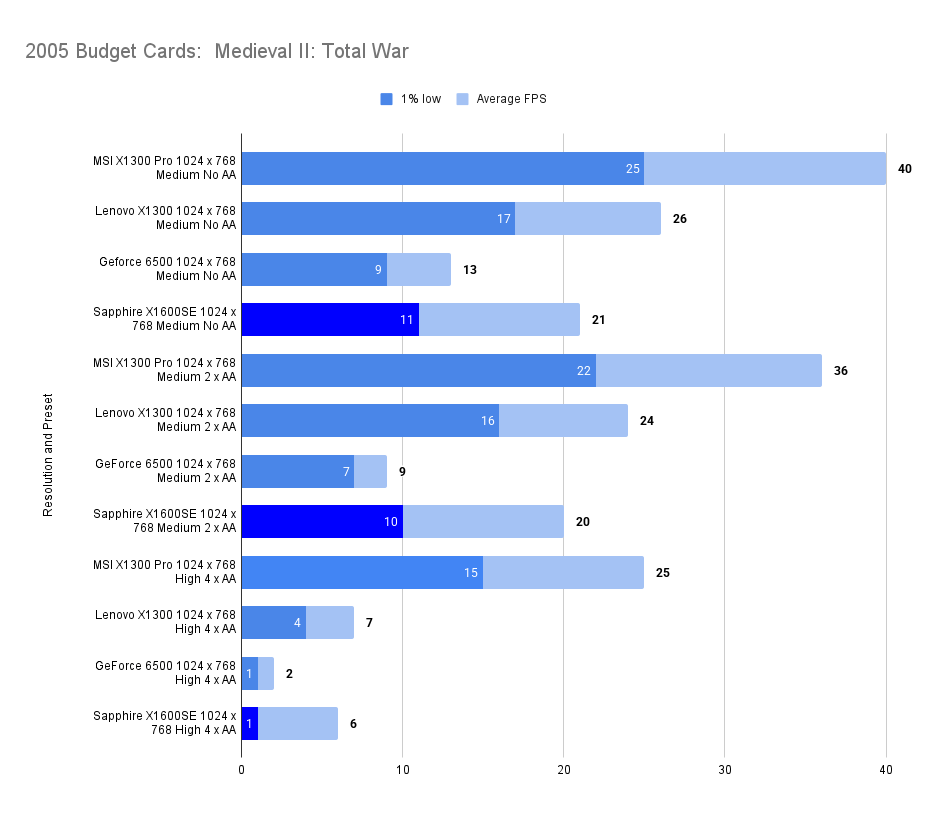
Using the Agincourt intro video, the newer Lenovo OEM card beats our Sapphire card handily again.

FlatOut 2 (2006)

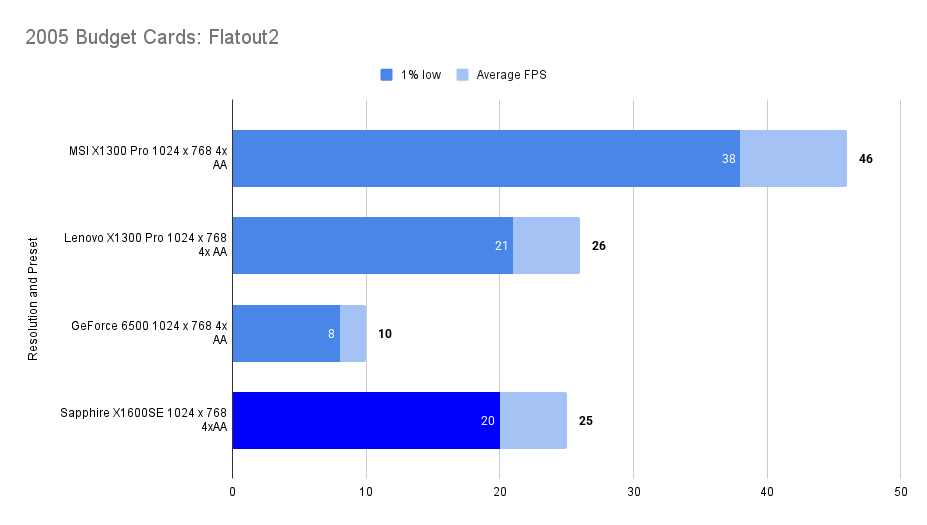
A little closer in flat-out 2, still a loss to the Lenovo card, the 128 Memory bus of the MSI X1300 Pro leaves them both in its dust.
The Elder Scrolls IV: Oblivion
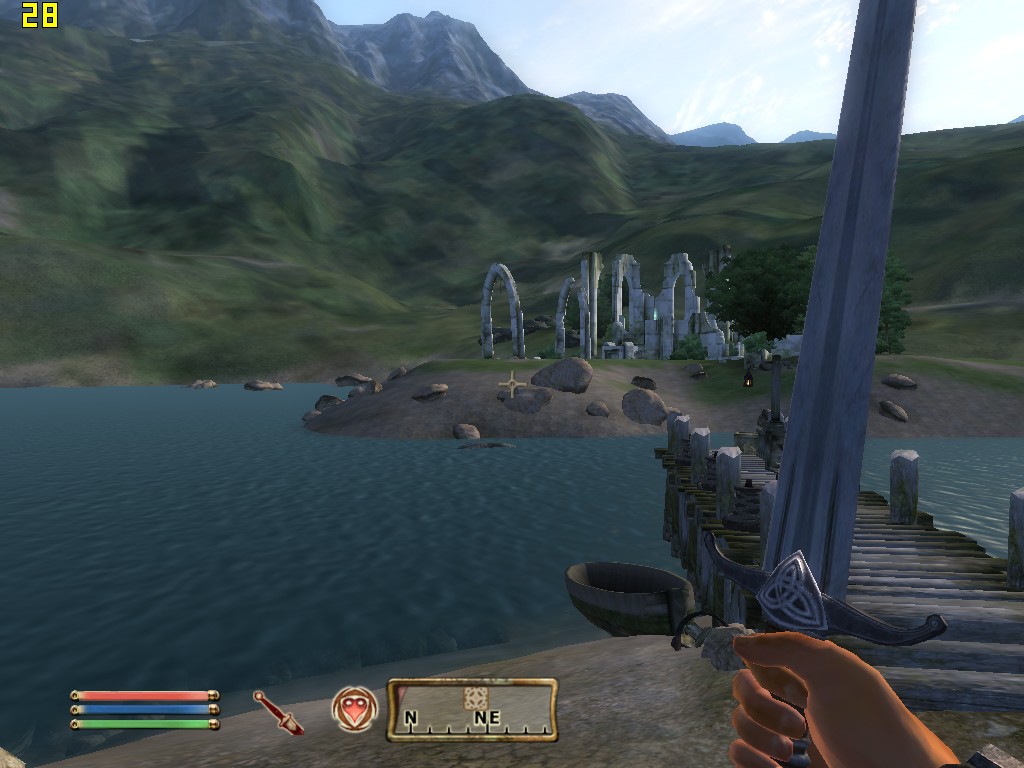
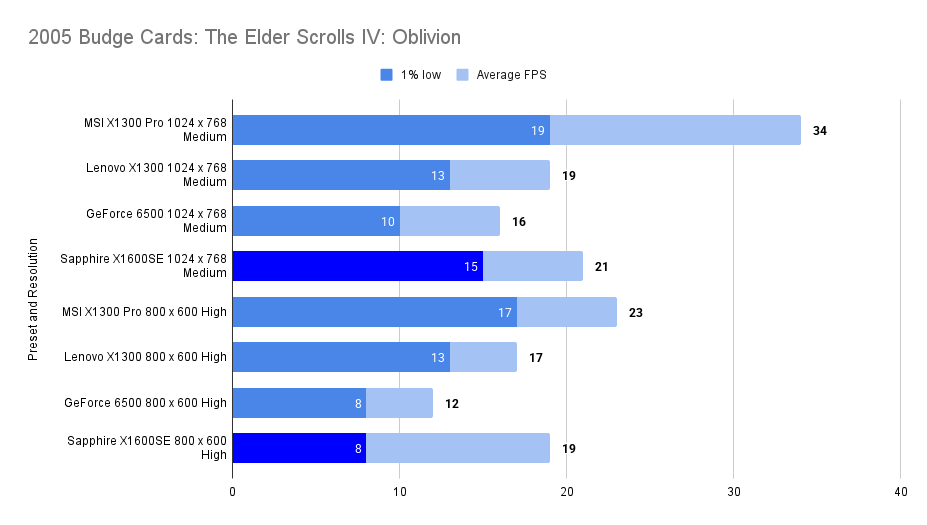
The Sapphire card seems to edge ahead at 1024 x 768 medium against the X1300, not by much of a margin but a win for the first time.
Business as usual at 800 x 600 high though, Lenovo takes the win.
Just Cause (2006)

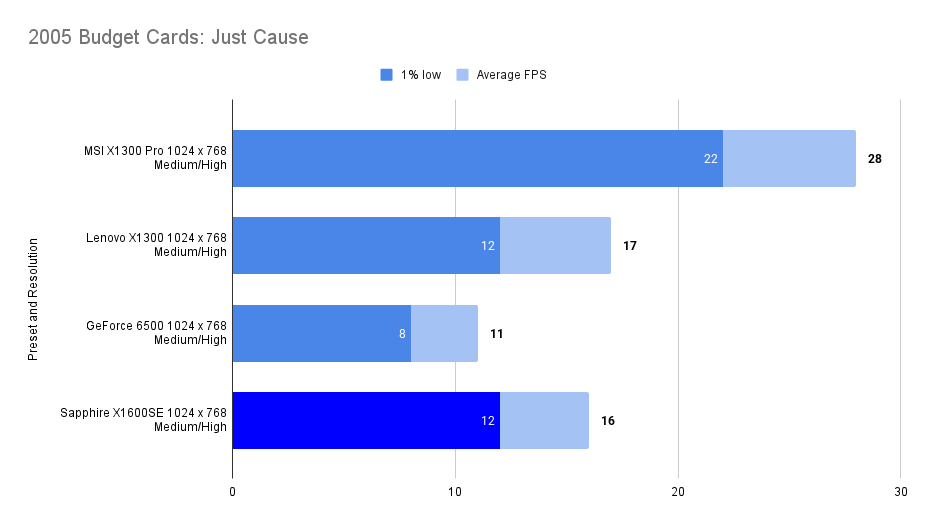
Oh how I wish I had started testing this at a lower resolution with the X1300 pro when I started this series. The X1600SE is roughly level with the X1300 though 1fps down on average framerate.

S.T.A.L.K.E.R.: Shadow of Chernobyl (2007)
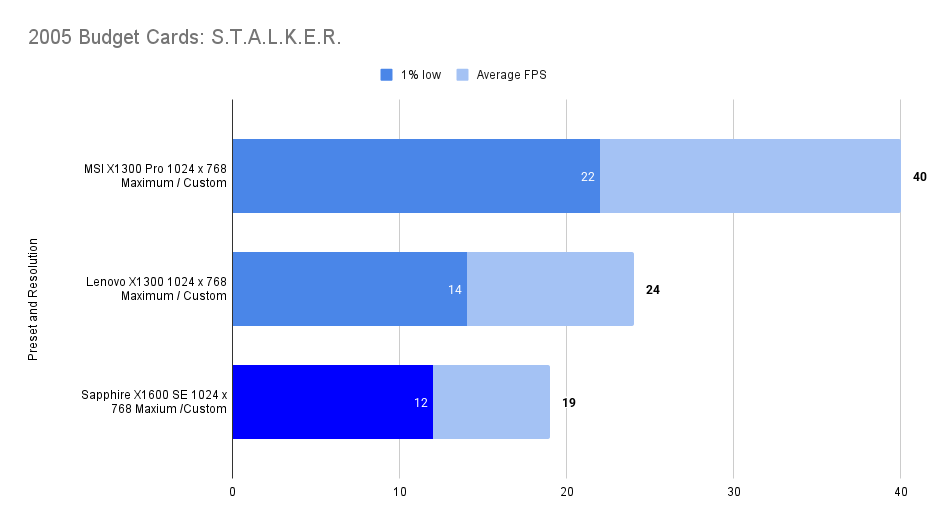
Again with this one, the frame-cap of 60fps meant I tested the X1300 higher settings to get some comparable results with the other budget cards of it’s era.
I didn’t think it was such a powerhouse!
I need to get an X1300XT to vindicate my decision but there’s only one on eBay and it’s £30 without a box or anything.

A Lenovo win vs Sapphire, the GeForce card wouldn’t run this game at any settings which is why it’s missing from the chart.


Crysis (2007)
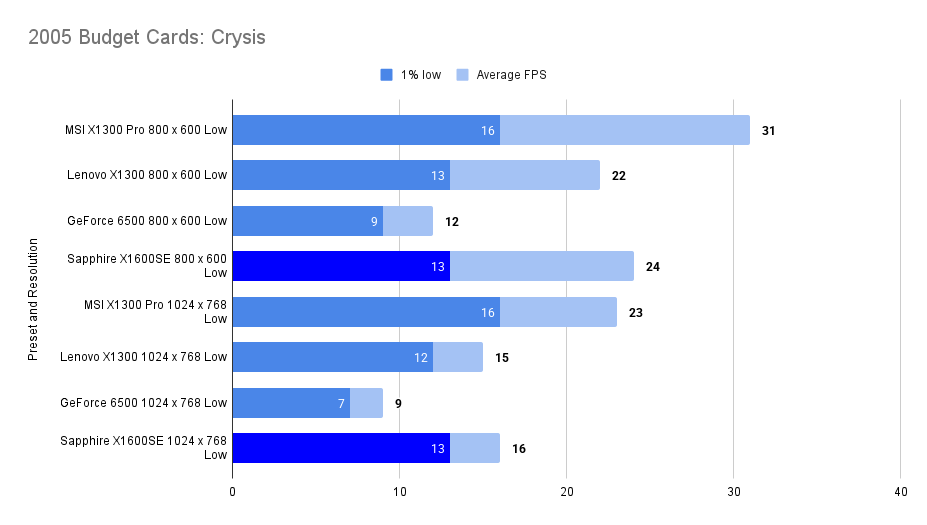
A narrow win for Sapphire in Crysis.
Perhaps the lower memory clock meant less but the higher gpu clock means more with this later title.
1-2fps isn’t much of a win on average framerates and the 1% low matches but, a win is a win – the game remains unplayable on either.

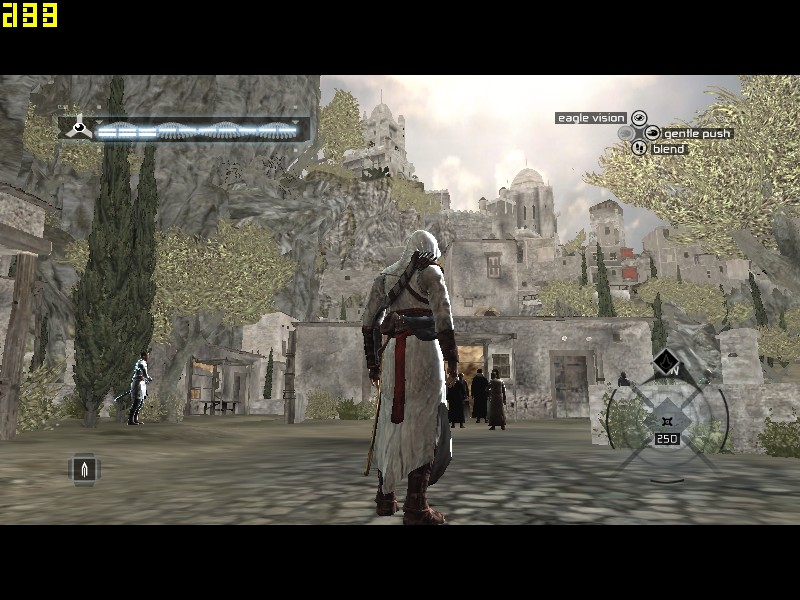
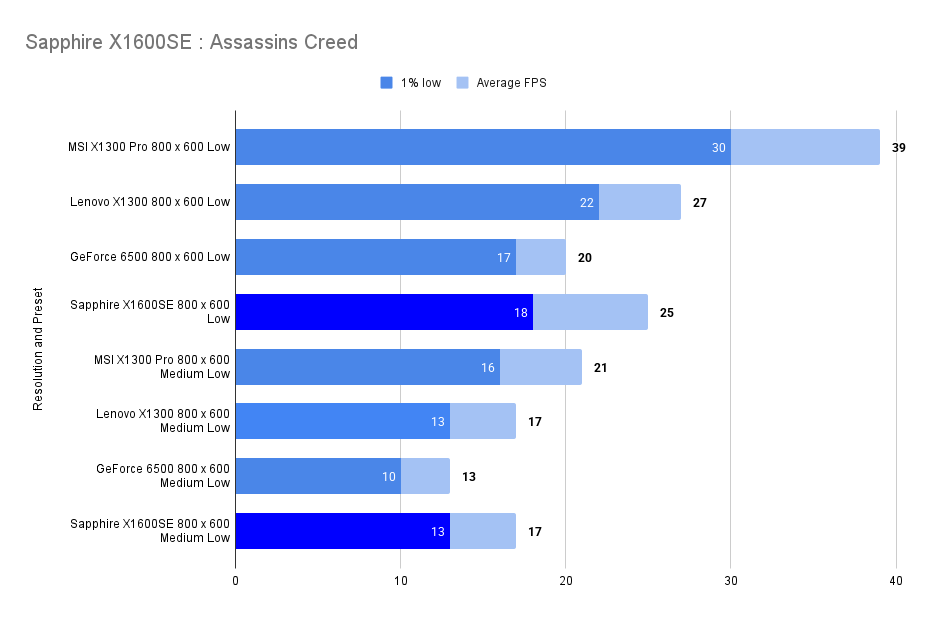
Assassin’s Creed (2007)
A marginal win for Lenovo at 800 x 600 Low, a dead heat with 800 x 600 medium Low.
The Geforce 6500 isn’t so far behind in this title but the X1300 pro has a comfortable lead over all of them.
Gaming Benchmark Summary
Across all titles but Crysis, the Sapphire X1600SE seems to perform worse than the Lenovo OEM X1300 and it’s later RV516 die.
The specifications suggested that things would be the opposite as the Sapphire card had the much higher clock speed, only the memory speed was higher with the Lenovo and that not by a huge amount.
My understanding was that the RV516 was very similar than the RV515 but apparently there is a little more to it.
Both the RV515 did represent quite good for money in 2005, earlier games run well at maximum settings and you can get good framerates on games of that year.
Purchasing in 2007 though and you can see why they would be an ultra-budget option.. it would be good to see how they compare with the Nvidia 7000/8000 series and the HD2000’s from ATI.
Synthetic Benchmarks
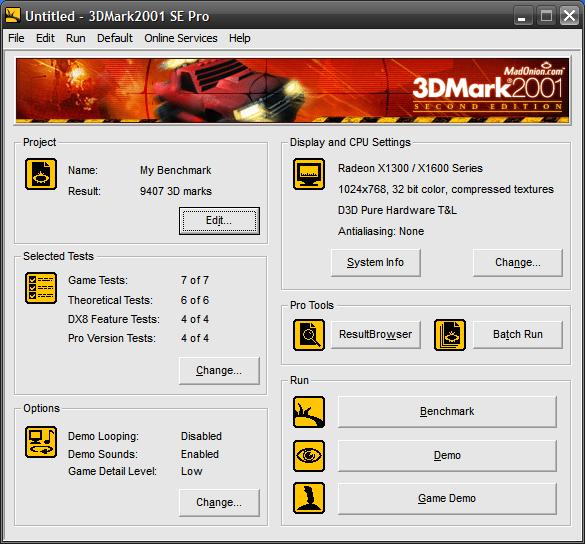
3d Mark 2001SE
| MSI X1300 Pro | Lenovo X1300 | GeForce 6500 | Sapphire X1600SE | |
| 3d Marks | 19,417 | 11,013 | 7,559 | 9,407 |
| % Difference | 0% (Reference) | -43.3% | -61% | -51.6% |
The 128 Bit Memory bus of the X1300 Pro allows a huge lead over the other cards in this early test.
Our Sapphire card loses out to Lenovo by 14.6%, meeting with the expectations set by the game benchmarks.
3d Mark 2003
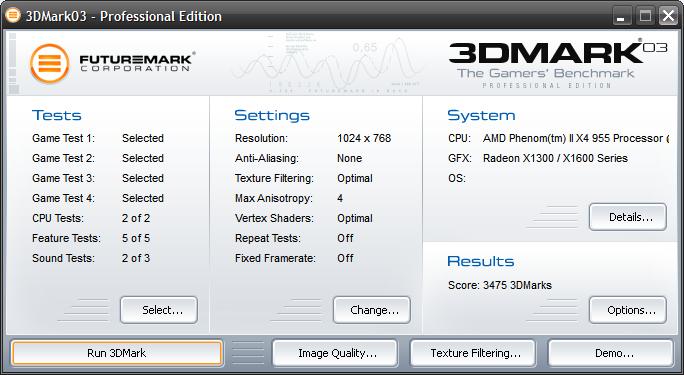
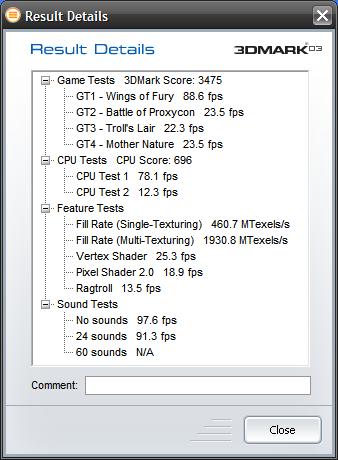
The difference between our Sapphire card in 3d Mark 2003 and the Lenovo card is a much lower 9.44%
| MSI X1300 Pro | Lenovo X1300 | GeForce 6500 | Sapphire X1600SE | |
| 3D Marks | 6,255 | 3,803 | 2,335 | 3,475 |
| % Difference | 0 (reference) | -39.2% | -62.7% | -44.4% |
| Fill Rate (Single- Texturing) | 1,057.0 MTexels/s | 550.9 MTexels/s | 442.9 MTexels/s | 460.7 MTexels/s |
| Fill Rate (Multi- Texturing) | 2,237.3 MTexels/s | 1660.4 MTexels/s | 1,473.7 | 1,930.8 MTexels/s |
| Vertex Shader | 30.6 | 25.4 | 15.7 | 25.3 |
| Pixel Shader 2.0 | 35.7 | 22.3 | 19.3 | 18.9 |
the details are close with a much better multi-texturing fill rate on our Sapphire card, the Lenovo has better in all other categories.
3d Mark 2006
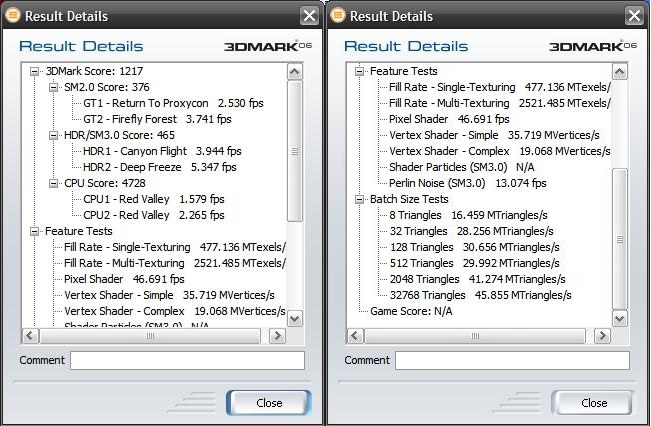
In this later benchmark, the X1600SE is almost on a par with the Lenovo card, the two of them closing the gap with the X1300 Pro. The Geforce 6500 is regressing further.
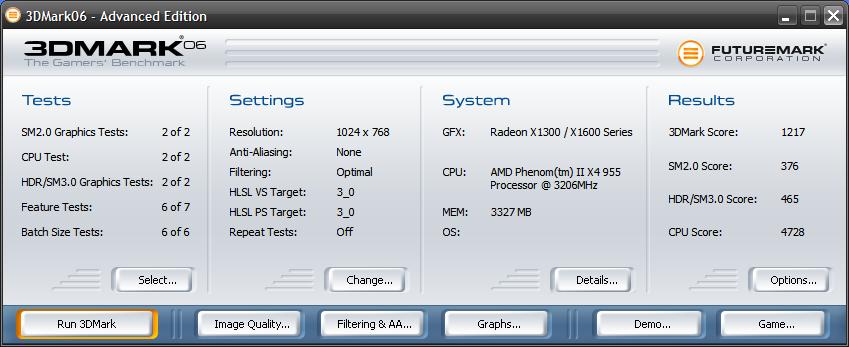
| MSI X1300 Pro | Lenovo X1300 | GeForce 6500 | Sapphire X1600SE | |
| 3D Marks | 1,909 | 1239 | 486 | 1217 |
| % Difference | 0 (reference) | -35.1% | -74.5% | -36.2% |
| Shader Model 2.0 Score | 635 | 402 | 222 | 376 |
| HDR/ Shader Model 3.0 | 695 | 454 | N/A | 465 |
Unigine Sanctuary
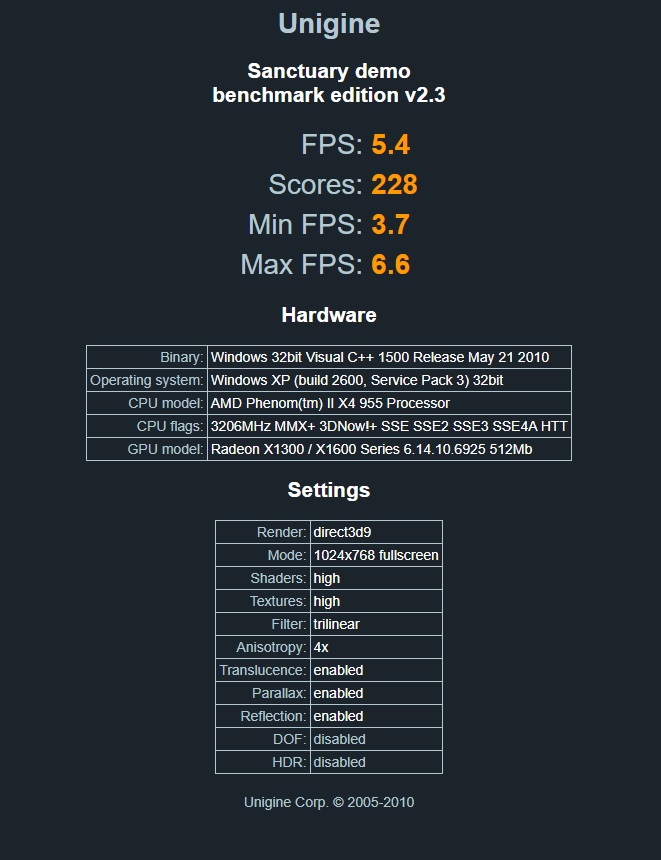
2007’s Unigine awards the card a score of 228 so a surprising win over the Lenovo X1300.
| MSI X1300 Pro | Lenovo X1300 | GeForce 6500 | Sapphire X1600SE | |
| Score | 383 | 191 | 91 | 228 |
| % Difference | 0 (reference) | -50.1% | -76.3% | -40.5% |
| FPS | 9.0 | 4.5 | 2.9 | 5.4 |
Conclusions
There really is nothing wrong with the RV515 and RV516 series of GPU’s though, the big drop in performance over the MSI X1300 Pro just shows the importance of memory bus speed.
These GPU’s are clearly faster than the GeForce budget competition available at the time.
The dates and names of these cards are all over the place, I have spent quite some time researching online and trying to find some reason behind it all.
I have a Sapphire X1550 new in box somewhere, how is that different? We’ll find out someday.
I might try and break from the series again, definitely need to get a Nvidia card in the Phenom for next time. The 6500 is as lonely as it is uninspiring!
 Ash's Retro Hardware Reviews
Leave a comment