A Retrospective Review and Benchmarks
- RRP: £169.99
- Release date: November 2005
- Purchased in March 2026
- Purchase Price: £15
Introduction
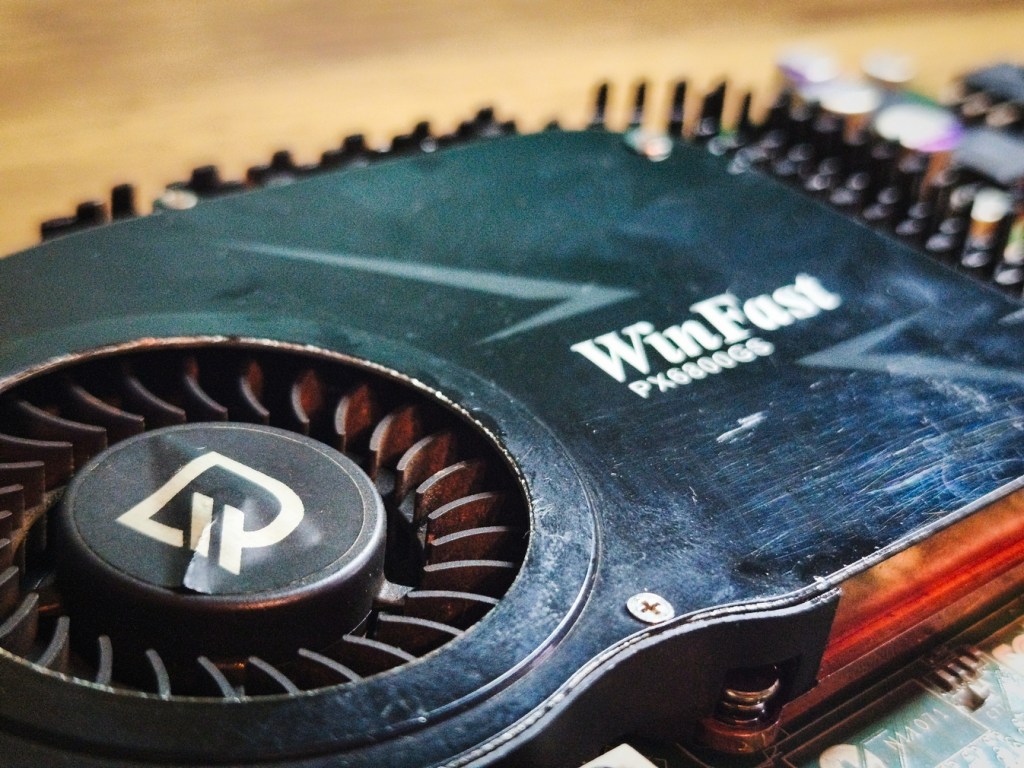
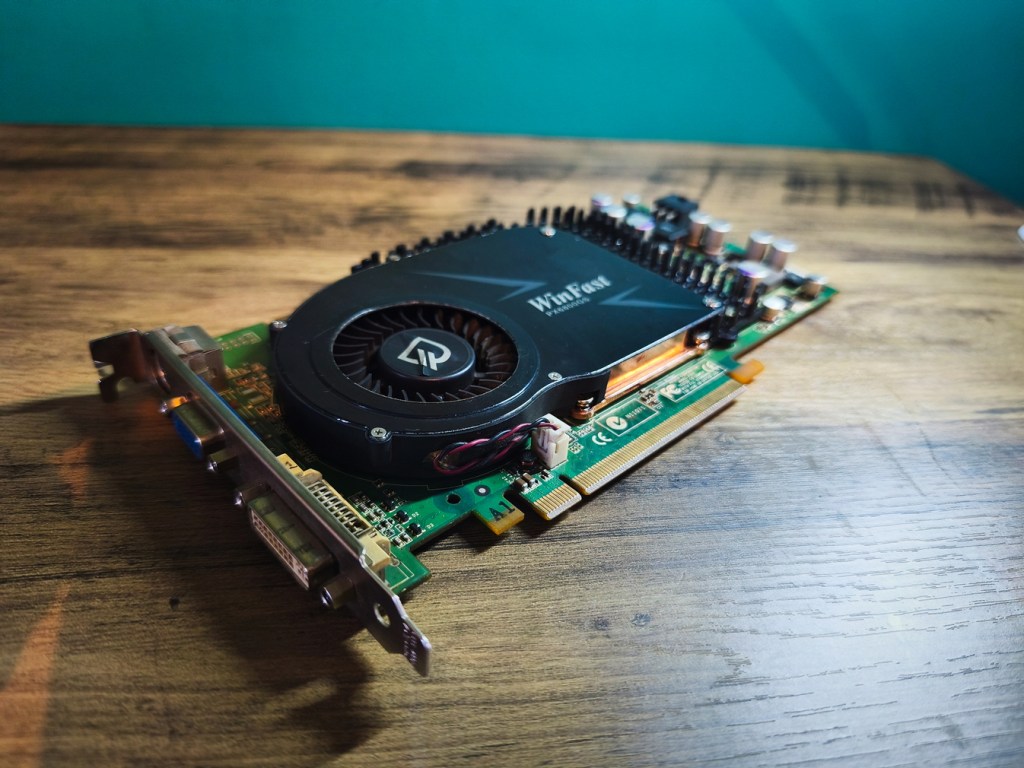
Here we have a rather plain and unassuming looking version of the 6800GS, made by WinFast (Leadteks graphics card brand). There are no computer generated ladies, androids or aliens anything else which started to appear at around this time, just a black cooler cover stating its name and an old-school green coloured PCB.
The single-slot cooling system matches the Nvidia reference design as seen on Tech Power-Up, in fact most pictures of the 6800gs seem to share the same setup.
Personally, I like it. It’s very understated and apparently rare as I can’t seem to find any other Winfast examples online.
The Nvidia 6000 series
The NVIDIA GeForce 6 series, launched in April 2004, bringing Shader Model 3 in a year before ATi got around to it with their X1000 series cards
The series also introduced NVIDIA PureVideo, a hardware-accelerated video decoding feature that improved video playback quality and reduced CPU usage during multimedia tasks.
Another key innovation was the introduction of Scalable Link Interface (SLI), which enabled users to combine two compatible GeForce 6 cards in a single system for increased graphics performance.
The GeForce 6 family covered a wide range of market segments, from entry-level integrated solutions like the 6100 and 6150, through mainstream models such as the 6200 and 6600, up to high-end enthusiast cards like the 6800 Ultra.
The 6000 series supported DirectX 9.0c and OpenGL 2.0.
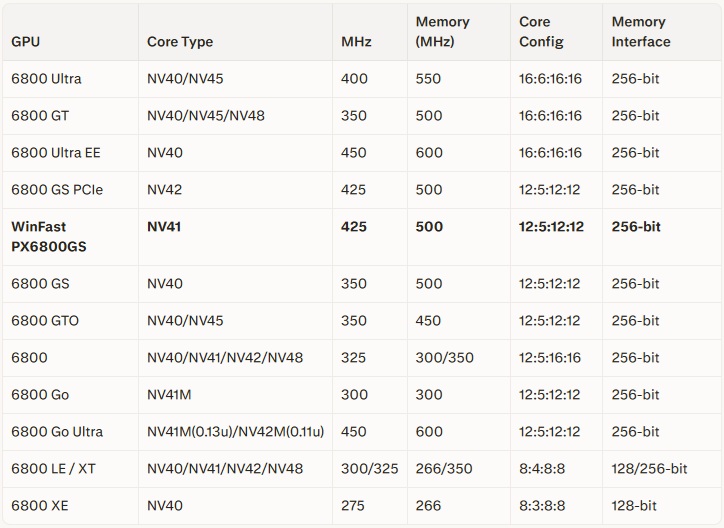
Here are the top-tier 6800 cards only:
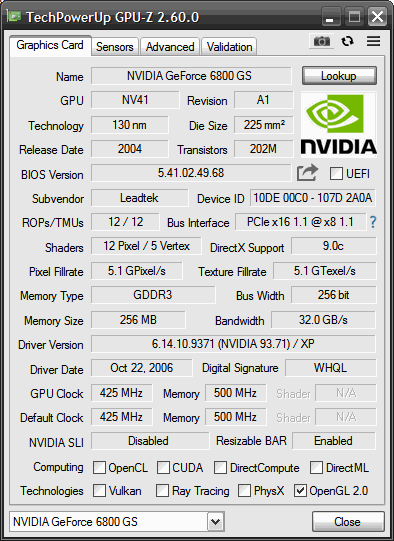
Here is what GPU-z has to say about my Winfast card:
The GeForce 6800GS
The 6800 GS is an interesting card. It was released in November 2005 so after the release of the newer 7800GT (released August ’05) and much later than the original 6800GT which came out back in June ’04.
The 6800GS gpu was released with a lower number of pixel and vertex shaders than the 6800GT but with a higher core clock speed which was allowed for by a smaller 110nm manufacturing process.
From a hardware standpoint, the 6800 GS is often associated with the NV42, I have seen an Nvidia slide showing as much but it seems things weren’t that uniform. Reviews and card databases show that some retail boards, including my WinFast example, used NV41 instead, it’s confusing, but interesting for collectors.
The original NV40 chip was AGP first and used a bridge chip to allow for PCI-E versions, the opposite way around to how it usually goes.
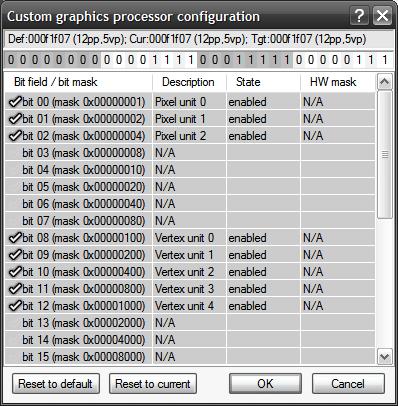
NV41 onwards were all primarily PCI-E first, with bridge chips allowing for AGP versions where appropriate. The AGP version of the 6800GS is a NV40 die with shaders disabled, I had a look but NV41 is all locked in:
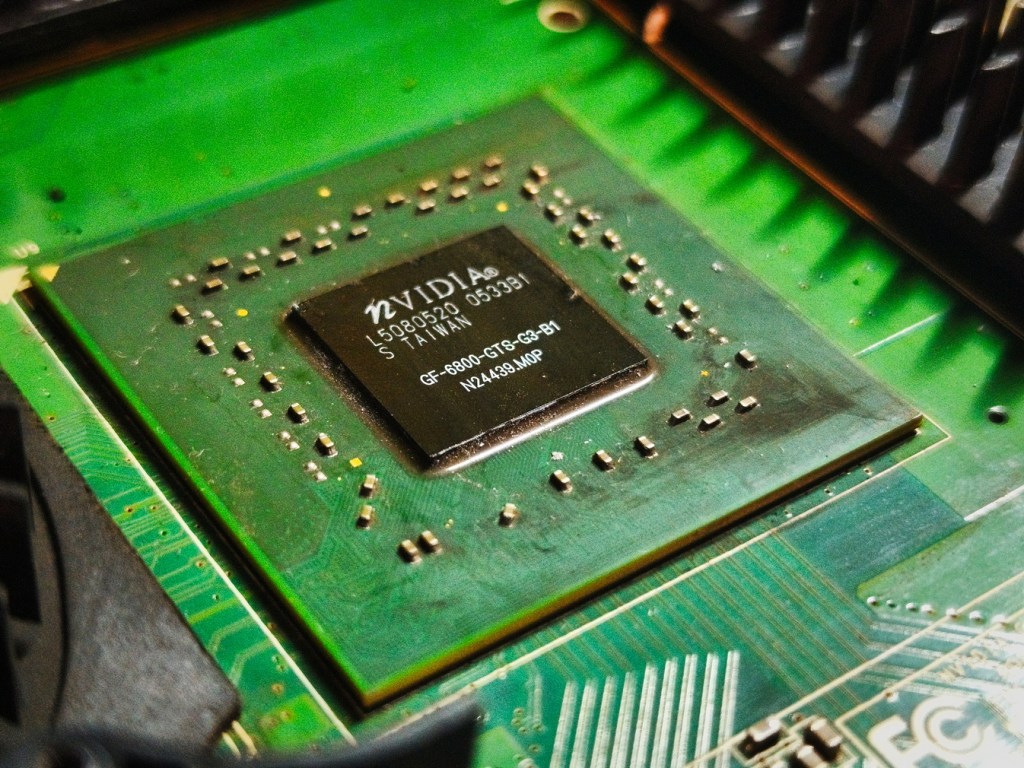
As you can see in the photo, the actual chip is printed with the code 6800GTS so definitely a bit of an identity crisis situation.
Card Stripdown
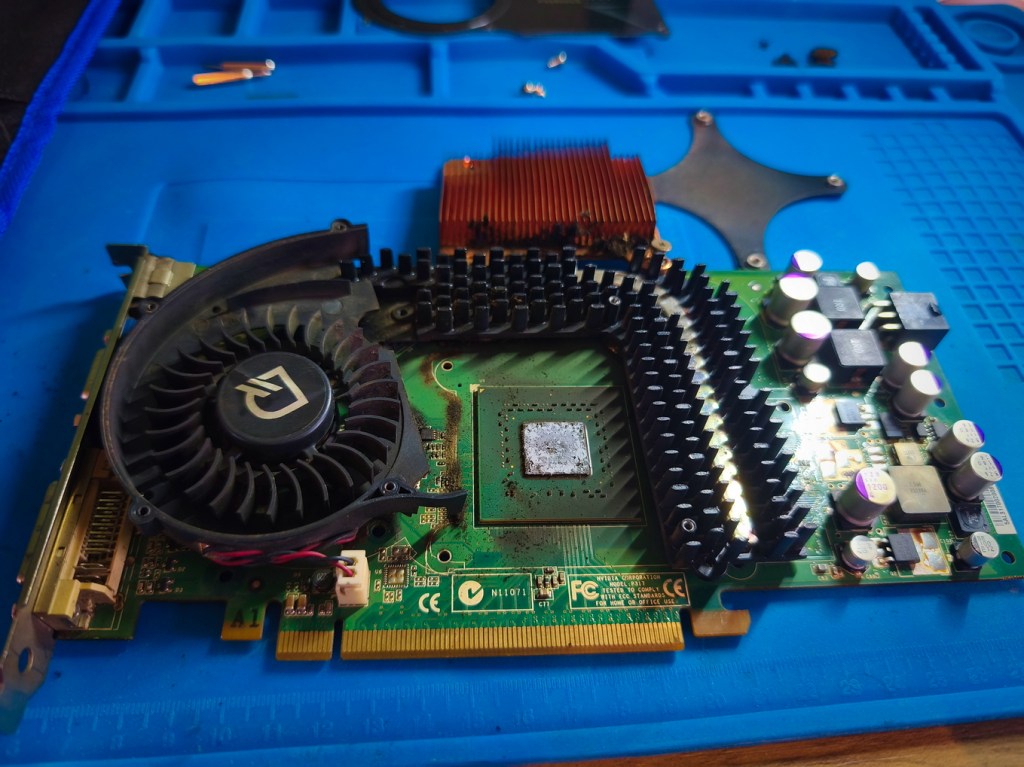
This WinFast card was in a rather sorry state, with rust visible on the PCB so some moisture must have been present whilst stored. The caps are all perfect though and it’s only a little surface rust.
The teardown revealed a surprisingly complex cooling solution for its era, with plenty of individual parts to seperate. The shroud hid a substantial, quality-feeling copper block above the GPU. It was covered in dust and grime, but cleaned up very easily with some isopropyl alcohol which made for a very satisfying job.
The thermal paste was dry, but it also came away without any trouble. The RAM is also cooled by a single metal heatpipe, which I cleaned up, although I didn’t replace the thermal pads; instead, I added a small blob of paste where a section had broken away.
I really should get hold of a proper set of pads and replace them too but It booted and posted first time without any issues. The fan is a little loud as you may expect from a single-slot design, a bit of oil on the bearing may help.
The Test System
Details are as follows:
- CPU: AMD Phenom II X4 955 3.2Ghz Black edition
- 8Gb of 1866Mhz DDR3 Memory (showing as 3.25Gb on 32bit Windows XP and 1600Mhz limited by the platform)
- Windows XP (build 2600, Service Pack 3)
- Kingston SATA 240Gb SSD
- ASUS M4N75TD Mainboard.
- Foreceware version 93.71
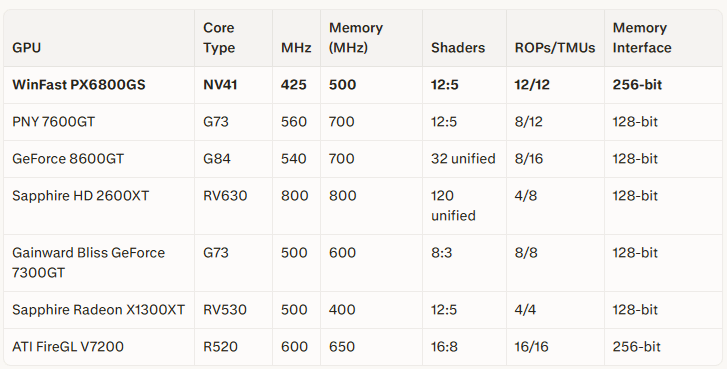
A little comparison with some of the other cards that you’ll see on the graphs:
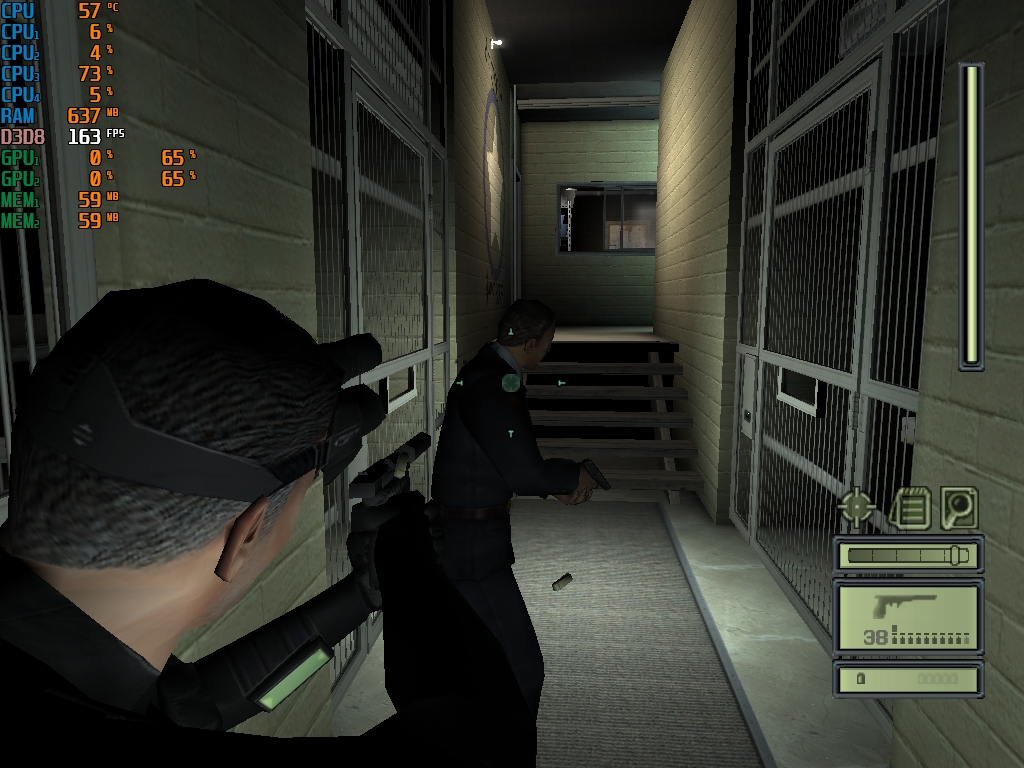
Tom Clancy’s Splinter Cell (2002)
Game Overview:
Tom Clancy’s Splinter Cell launched on November 19, 2002, developed by Ubi Soft Montreal. Built on the LithTech Jupiter engine (Unreal Engine precursor), it pioneered tactical stealth gameplay with groundbreaking light/shadow mechanics and realistic audio design. The game set new standards for immersion through dynamic lighting where visibility literally shaped gameplay.
Known for its revolutionary light-based stealth, Splinter Cell remains the ultimate benchmark for early 2000s GPUs. The game’s real-time shadows, particle effects, and high-poly environments brutally stress fillrate and shader performance even on modern retro hardware.
I have the GOG version of the game which has an internal benchmark that can be used.
Performance Notes:
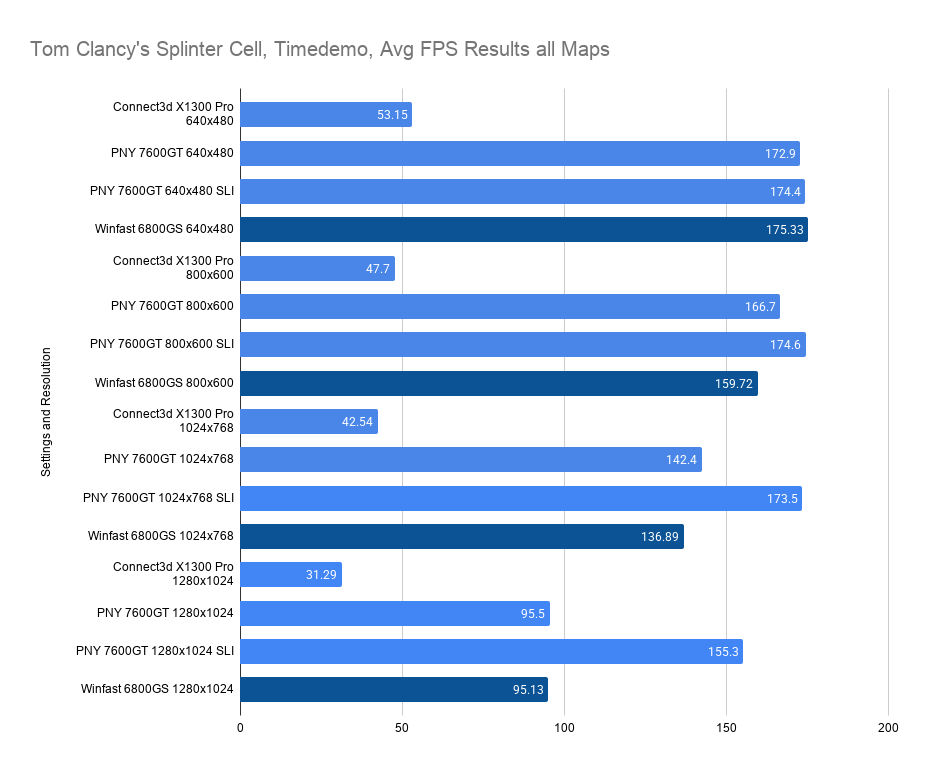
The WinFast 6800 GS delivers a very strong average framerate at 640×480, reaching 175.33 FPS. That puts it right in the same ballpark as the single 7600 GT, and even very close to the 7600 GT SLI result, which shows that at this low resolution we’re CPU limited
At 800×600 and 1024×768, the 6800 GS continues to look very respectable, posting 159.72 FPS and 136.89 FPS respectively. It remains highly comparable to the single 7600 GT across these settings, although the newer card does hold an advantage. The SLI setup, however, is still a step above both and makes the separation more obvious as the resolution rises.
By 1280×1024, the 6800 GS falls to 95.13 FPS, which is still a solid result and comfortably playable for a card of this class. Overall, the 6800 GS comes across as a strong GeForce 6-era performer that is very close to the single 7600 GT in real-world average framerate, while the 7600 GT SLI configuration shows what an extra layer of GPU power can do at higher settings.
Unreal Tournament 2003 (2002)
Game Overview:
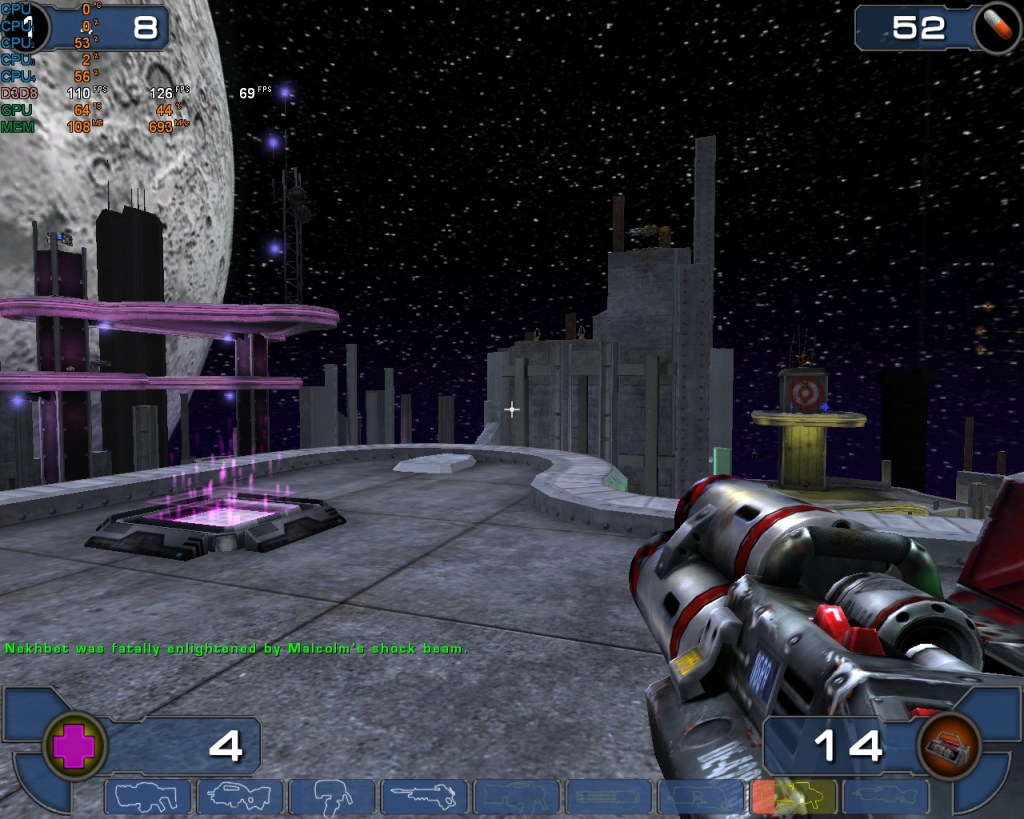
Released in October 2002, Unreal Tournament 2003 was built on the early version of Unreal Engine 2. It was a big leap forward from the original UT, with improved visuals, ragdoll physics, and faster-paced gameplay.
The engine used DirectX 8.1 and introduced support for pixel shaders, dynamic lighting, and high-res textures all of which made it a solid test title for early 2000s hardware.
Still a great game and well worth going back to, even if you’re mostly limited to bot matches these days. There’s even a single-player campaign of sorts, though it’s really just a ladder of bot battles.
The game holds up visually and mechanically, and it’s a good one to throw into the testing suite for older cards. The uncapped frames are pretty useful (and annoyingly rare) on these old titles.
I play a full match of DM Plunge for each run, not exactly replicable as every match will be different but the length of the match means a lot of data is collected and the average should be pretty reliable.
Performance Notes:
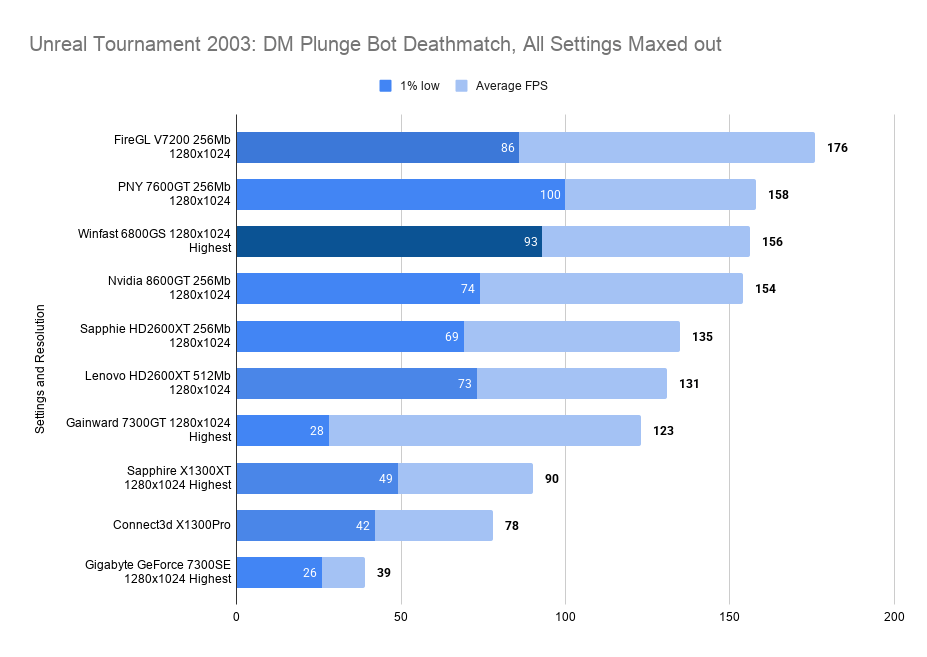
The WinFast 6800 GS looks very solid in these UT2003 results, posting 93 FPS at 1280×1024 on Highest settings. That places it close to the PNY 7600 GT’s 100 FPS and ahead of the 8600 GT and both HD2600XT results in this particular run, which is a nice showing for a GeForce 6 card.
What also stands out is how well it separates itself from the lower-end cards. It is comfortably ahead of the 7300GT, X1300XT, X1300Pro, and 7300SE, so even by later standards it still shows clear mid-range strength in an older DirectX 8/9-era title like UT2003.
X2: The Threat (2003)
Game Overview:
Released for Windows in December 2003, with later ports to Mac OS X and Linux, X2: The Threat is a space trading and combat simulation developed by Egosoft. It continues the story from X: Beyond the Frontier, placing players in the role of Julian Gardna, a former pirate drawn into a conflict with a new alien threat known as the Khaak
While not tied to a widely licensed engine like Unreal, X2 introduced a new in‑house graphics engine built specifically for the X‑Universe. This engine delivered Improved ship and station models, More detailed sectors with nebulae and environmental effects, Dynamic lighting and particle effects and Support for DirectX 8.1‑class hardware, aligning it with early‑2000s GPU capabilities.
This made X2 a solid benchmark title for PCs of the era, especially for players testing mid‑range and high‑end GPUs from the GeForce 3/4 and Radeon 8500/9000 families.
This is the GOG version again and it does have an internal benchmark.
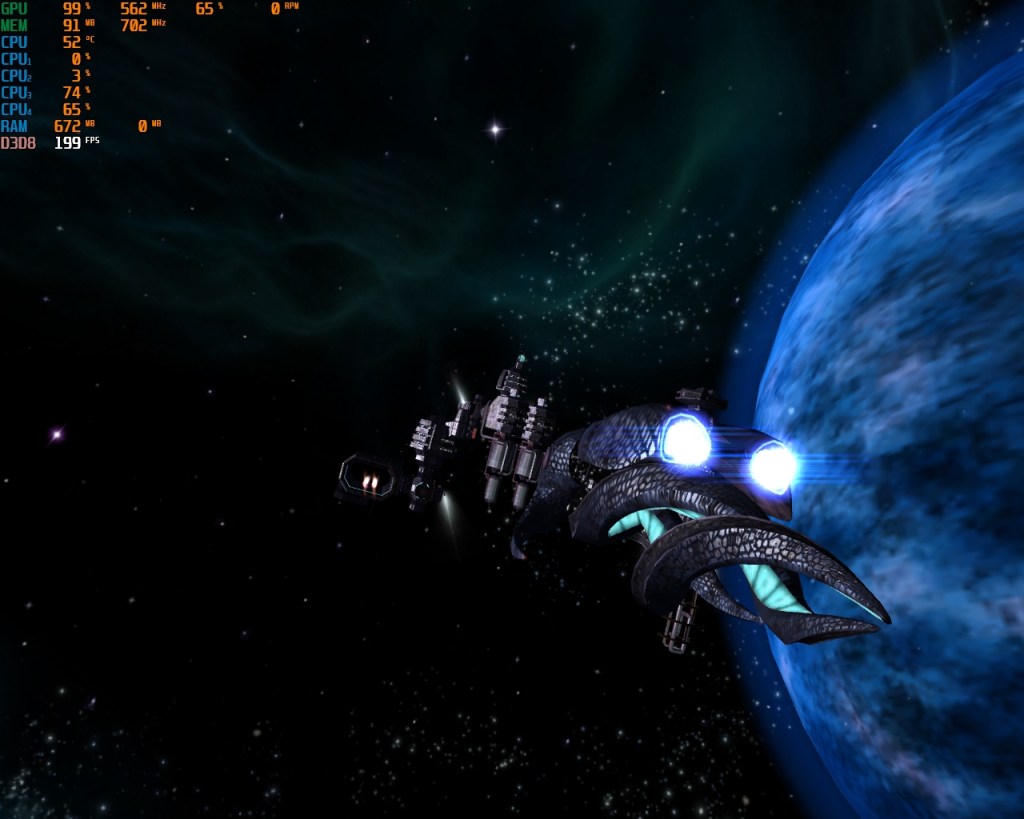
Performance Notes:
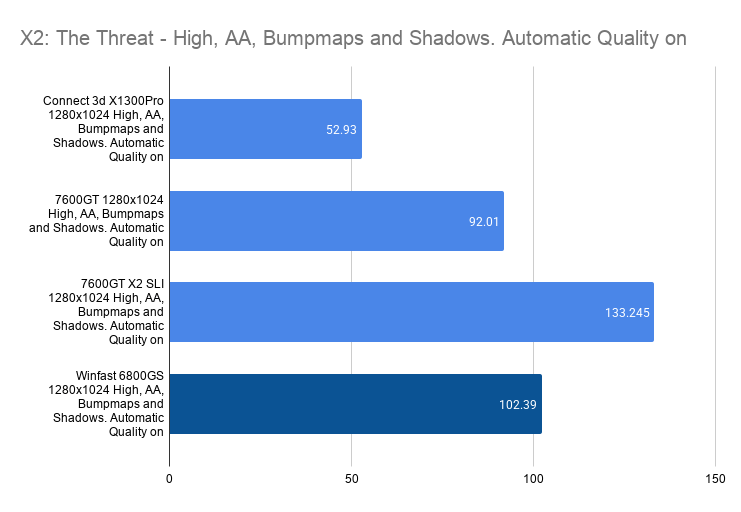
The WinFast 6800 GS does very well here, turning in 102.39 FPS at 1280×1024 with AA, bump maps, and shadows enabled. That puts it clearly ahead of the single 7600 GT in this test, which makes the 6800 GS look especially strong in this heavier setting.
The 7600 GT X2 SLI setup still leads overall at 133.25 FPS, but the 6800 GS is much closer to that dual-card result than you might expect, which speaks well for its balance of performance and efficiency.
Against the Connect3D X1300 Pro, the 6800 GS is in a completely different class, more than doubling its performance..
FarCry (2004)
Game Overview:
Far Cry launched in March 2004, developed by Crytek and built on the original CryEngine. It was a technical marvel at the time, with massive outdoor environments, dynamic lighting, and advanced AI. The game leaned heavily on pixel shaders and draw distance, making it a solid stress test for mid-2000s GPUs. It also laid the groundwork for what would later become the Crysis legacy.
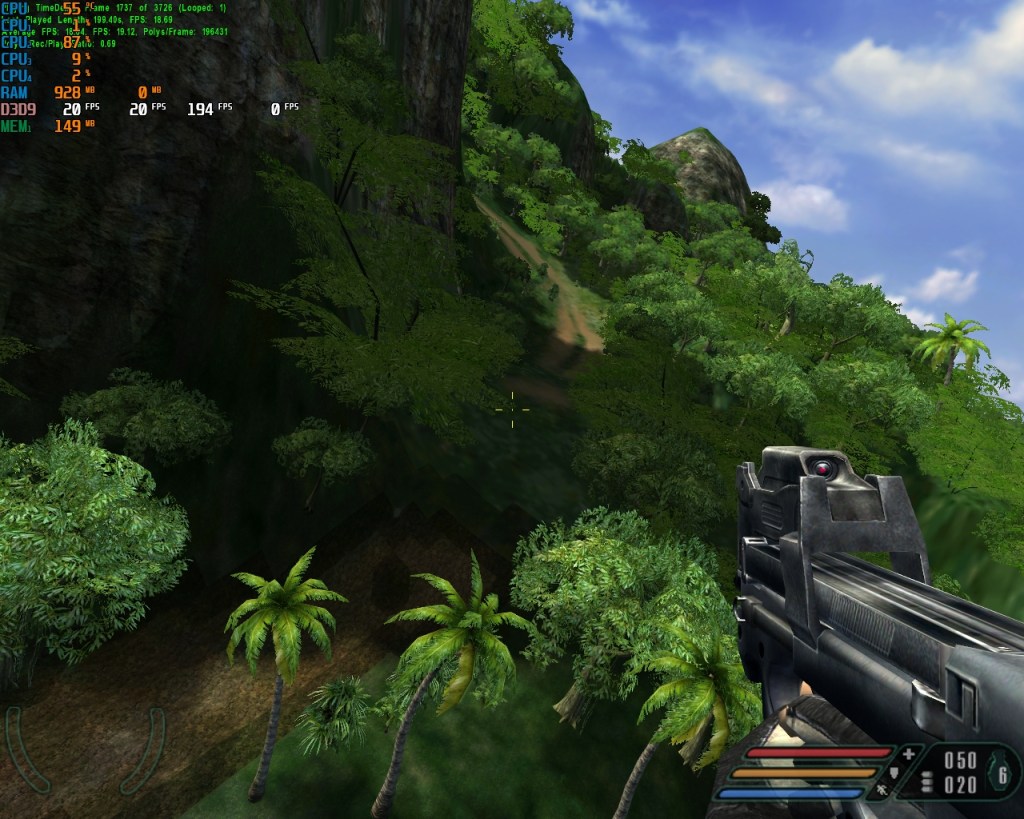
I use HardwareOC FarCry Benchmark to get these results with three runs at each setting.
Performance Notes:
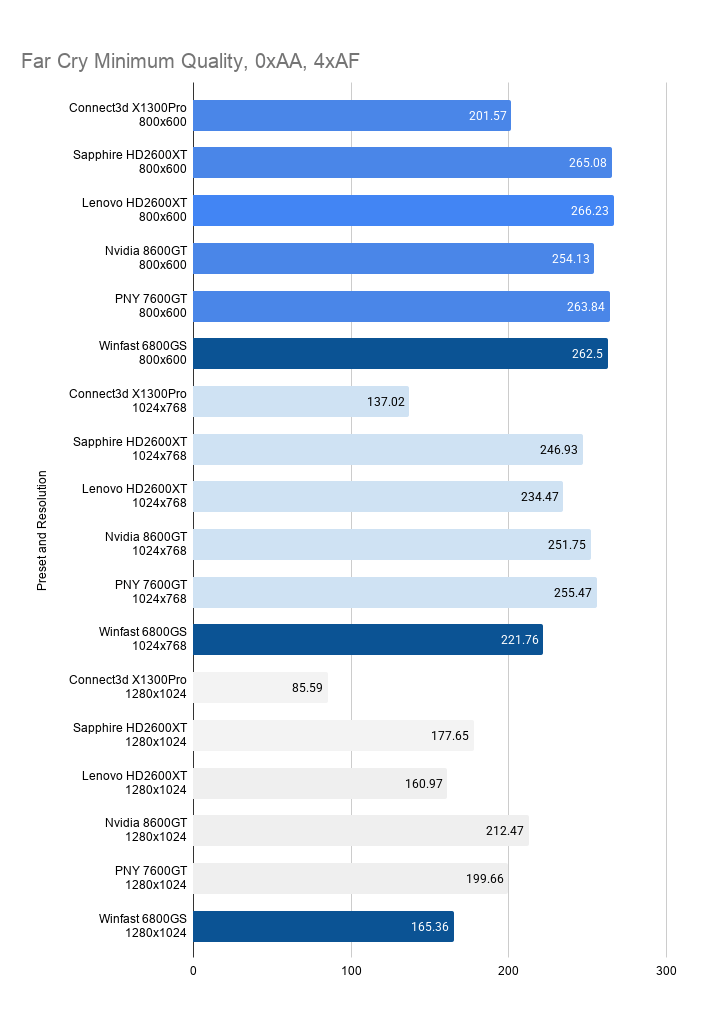
At minimum settings the 6800GS behaves like a card still very much in its comfort zone, landing 262.5 FPS at 800×600 and sitting shoulder‑to‑shoulder with the 7600GT and the two HD2600XT cards. As resolution rises it begins to drift downward, hitting 221.76 at 1024×768 and 165.36 at 1280×1024, where the 8600GT and 7600GT pull ahead thanks to newer shader hardware. Even so, the 6800GS remains firmly competitive and era‑authentic, showing the classic NV40 balance of fill‑rate and bandwidth.
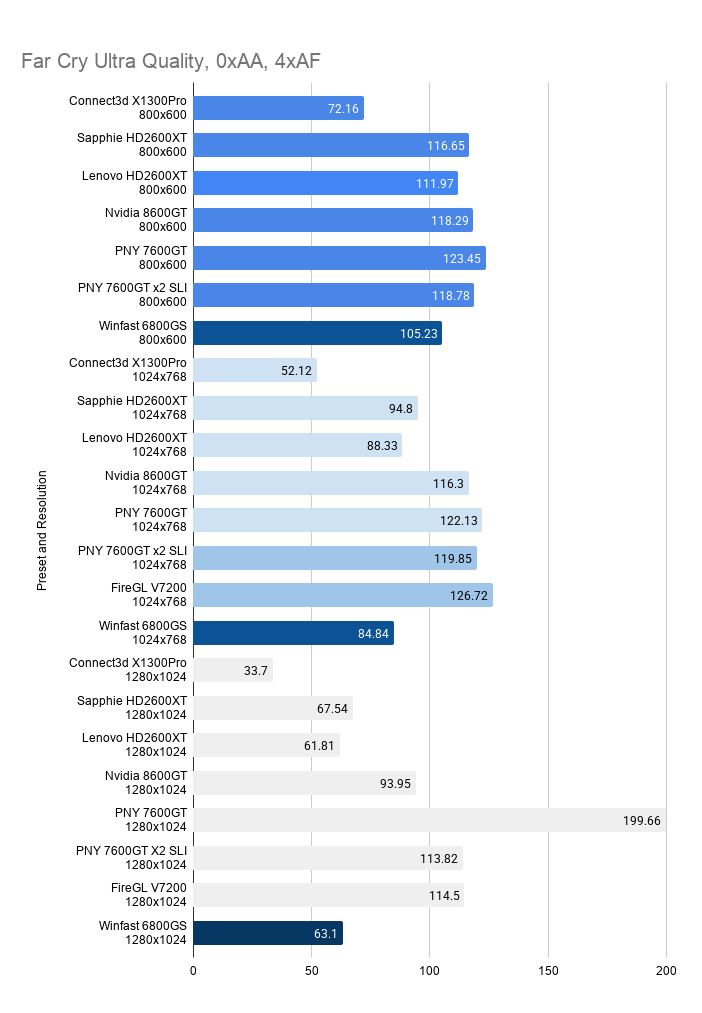
Ultra settings immediately widen the generational gap, with the 6800GS posting 105.23 FPS at 800×600 and trailing the 7600GT, 8600GT, and both HD2600XT cards. At 1024×768 it drops to 84.84 FPS, now clearly mid‑pack, and by 1280×1024 it settles at 63.1 FPS while newer cards — including the FireGL V7200 — scale more gracefully. The 6800GS stays smooth, but it’s no longer fighting for the upper half of the chart.
With AA enabled the 6800GS shows its age most clearly, delivering 97.9 FPS at 800×600 and sitting behind the 8600GT and 7600GT, both of which handle AA resolve more efficiently. At 1024×768 it reaches 77.62 FPS, and at 1280×1024 it lands at 57.07 FPS, still playable but clearly outpaced by the later mid‑range cards and the FireGL. The card doesn’t collapse under AA load, but it no longer keeps up with the newer architectures.
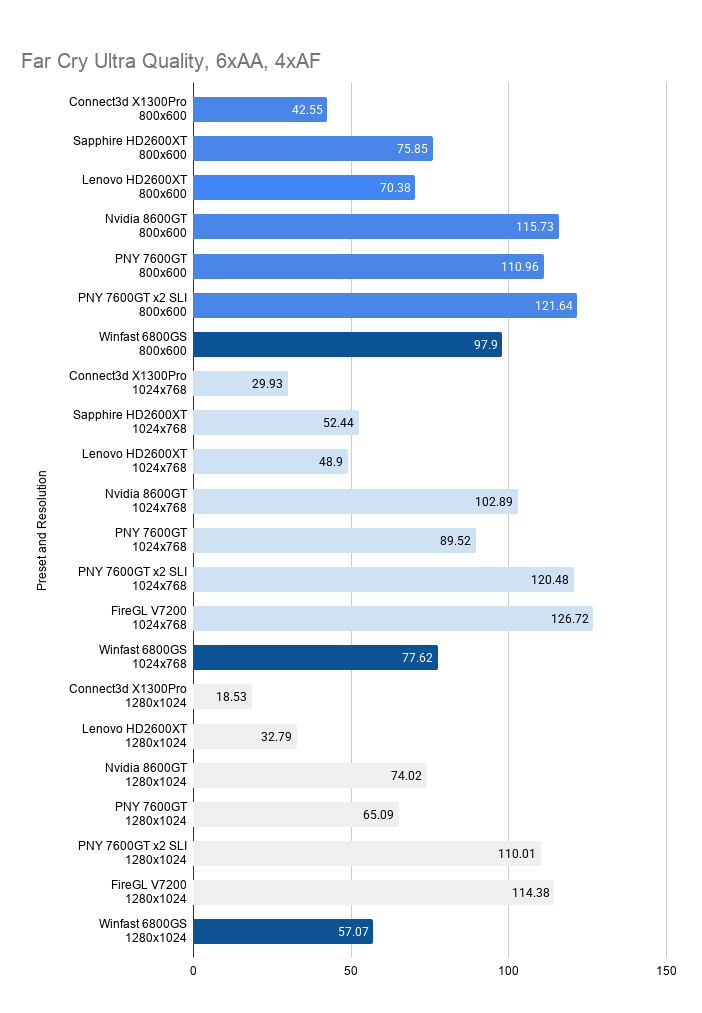
Across all three test sets the 6800GS behaves exactly as a late‑NV40 card should: strong at light loads, respectable at medium ones, and increasingly outclassed as shader complexity and AA demands rise. It keeps pace with the 7600GT and HD2600XT at minimum settings, but Ultra Quality and AA reveal the limits of its 12‑pipe design. Still, it remains a capable, smooth, and very era‑correct performer.
Doom 3 (2004)
Game Overview:
Released in August 2004, Doom 3 was built on id Tech 4 and took the series in a darker, slower direction. It’s more horror than run-and-gun, with tight corridors, dynamic shadows, and a heavy focus on atmosphere. The engine introduced unified lighting and per-pixel effects, which made it a demanding title for its time, and still a good one to test mid-2000s hardware.
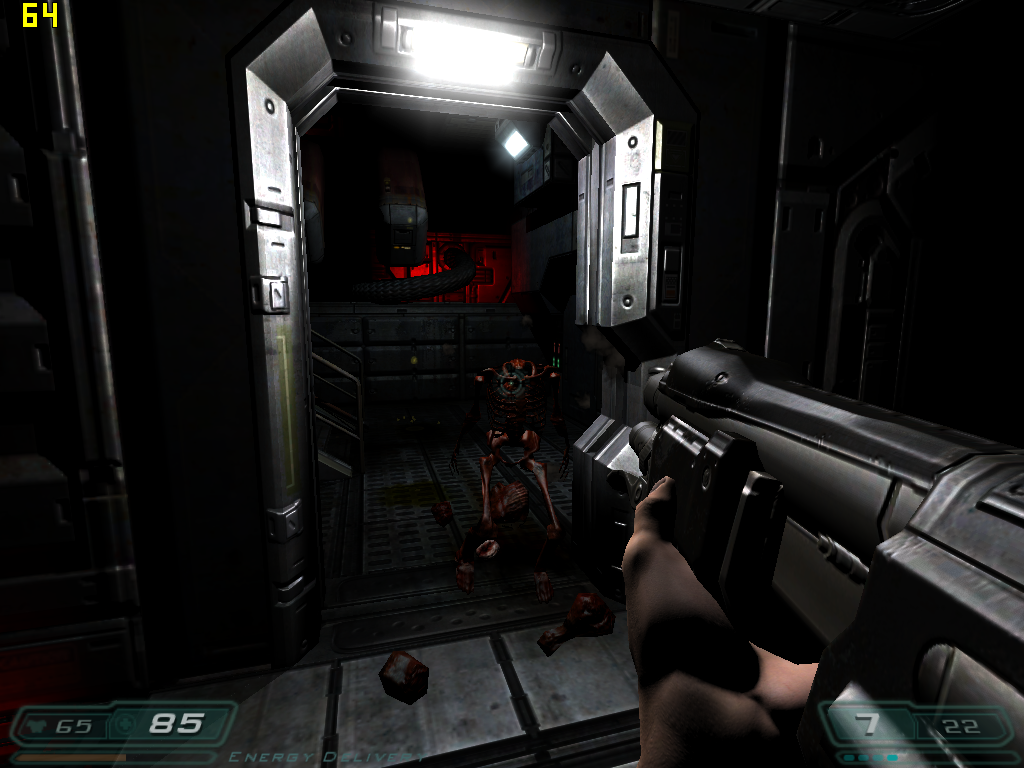
The game engine is limited to 60 FPS, but it includes an in-game benchmark that can be used for testing that doesn’t have this limit.
Performance Notes:
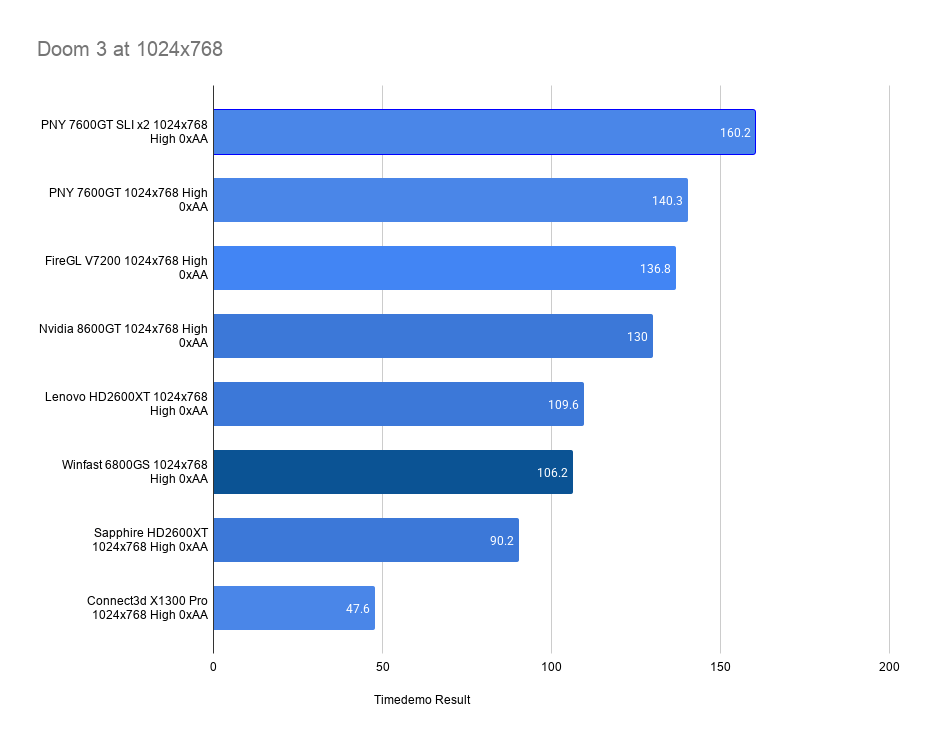
At 1024×768 with no AA, the 6800GS lands at 106.2 FPS, putting it just behind the Lenovo HD2600XT and well behind the 8600GT and 7600GT, both of which benefit from stronger shader throughput in id Tech 4. Doom 3’s heavy reliance on per‑pixel lighting favours newer architectures, and the FireGL V7200’s 136.8 FPS reinforces that trend. The 6800GS remains smooth and consistent, but it’s clearly operating a tier below the later mid‑range cards.
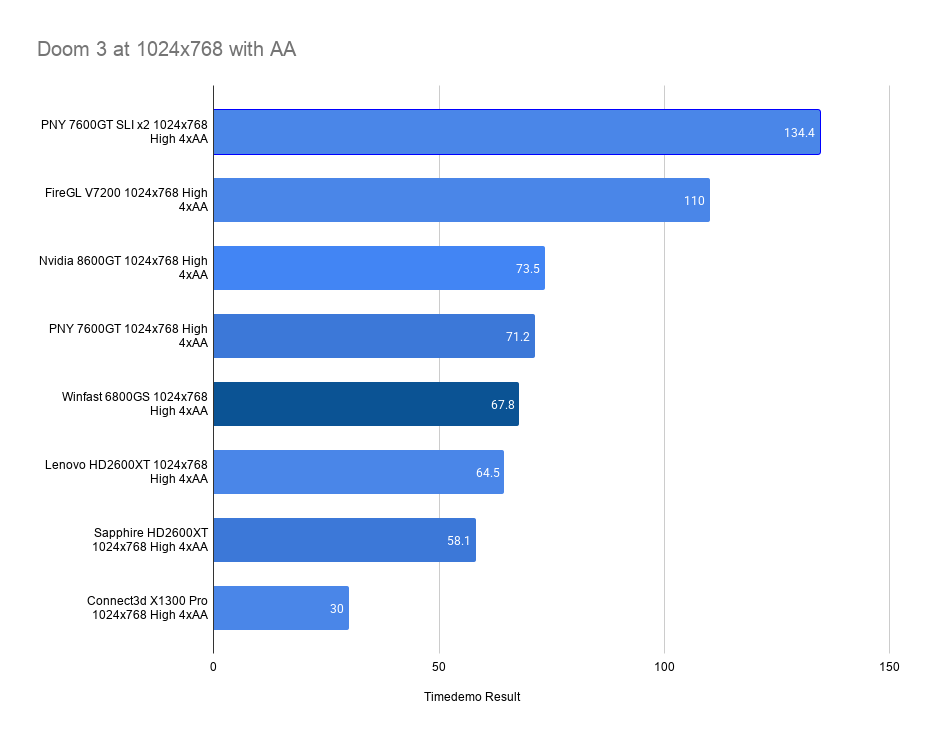
With 4×AA enabled, the 6800GS drops to 67.8 FPS, still playable but now firmly mid‑pack. The 7600GT and 8600GT sit in the low 70s, while the FireGL V7200 maintains a strong 110 FPS thanks to its workstation‑class bandwidth. Even the Lenovo HD2600XT edges ahead at 64.5 FPS. The 6800GS doesn’t collapse under AA load, but it no longer has the headroom to challenge the newer designs.
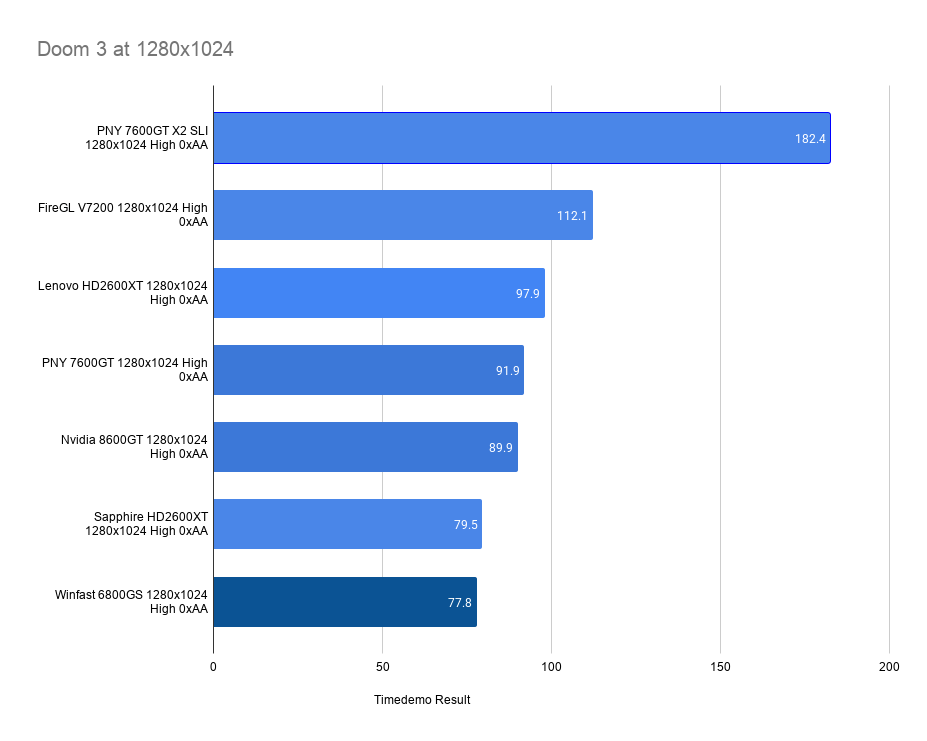
At the higher resolution the 6800GS posts 77.8 FPS, trailing the 8600GT, the 7600GT, and the Lenovo HD2600XT, all of which scale better with Doom 3’s lighting‑heavy rendering path. The FireGL V7200 again stands out at 112.1 FPS, and the 7600GT SLI setup shoots far ahead at 182.4 FPS. The 6800GS remains smooth, but it’s now clearly in the lower half of the chart.
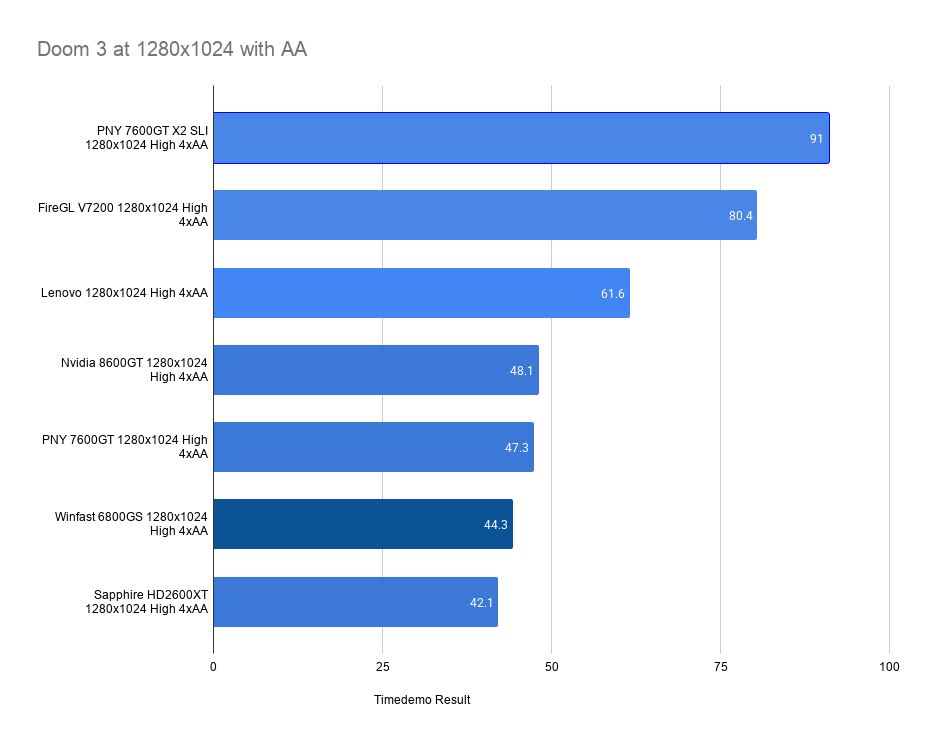
With 4×AA at 1280×1024 the 6800GS drops to 44.3 FPS, still functional but now noticeably behind the 7600GT, 8600GT, and the HD2600XT cards. The FireGL V7200 continues to dominate at 80.4 FPS, and even the single 7600GT stays ahead at 47.3 FPS. This is the point where the NV40‑era AA resolve and memory bandwidth show their limits against newer mid‑range hardware.
Across all Doom 3 tests the 6800GS behaves like a solid but aging NV40 derivative: smooth at baseline settings, respectable with light AA, and increasingly outpaced as resolution and AA climb. The 7600GT and 8600GT consistently stay ahead thanks to more efficient shader hardware, while the FireGL V7200 repeatedly demonstrates how well‑tuned workstation cards can be for id Tech 4. The 6800GS never feels weak, but it settles into a clear mid‑table role in this engine.
F.E.A.R. (2005)
Game Overview:
F.E.A.R. (First Encounter Assault Recon) launched on October 17, 2005 for Windows, developed by Monolith Productions. Built on the LithTech Jupiter EX engine, it was a technical showcase for dynamic lighting, volumetric effects, and intelligent enemy AI. The game blended tactical first‑person gunplay, horror elements, and cinematic slow‑motion combat, creating an experience that stood out sharply from other shooters of the era.
The engine supported per‑pixel lighting, soft shadows, volumetric fog, and advanced particle effects, all of which pushed mid‑2000s hardware hard, especially when maximum shadow quality was enabled. F.E.A.R. became a popular benchmark title thanks to its combination of heavy GPU lighting workloads and CPU‑intensive AI routines, which were among the most advanced in any shooter at the time.
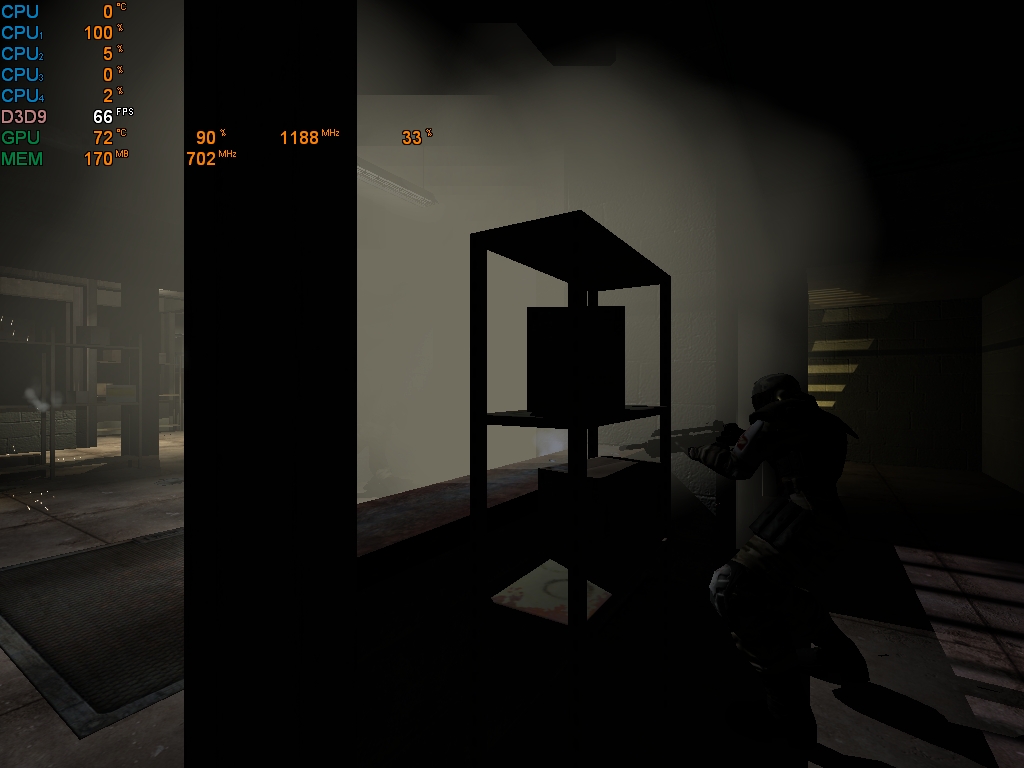
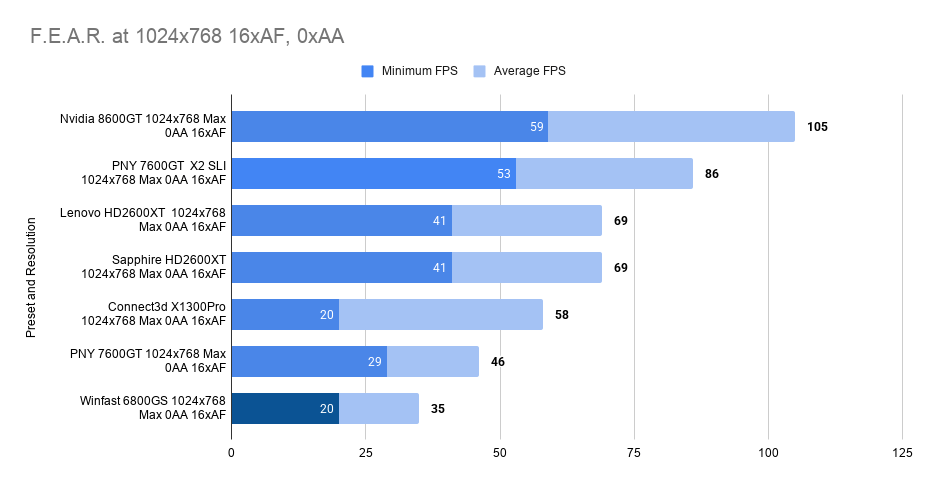
In the no‑AA run the 6800GS lands at 20 minimum and 35 average, putting it at the bottom of the mid‑range group and clearly behind the 7600GT, the 8600GT, and both HD2600XT cards. FEAR’s heavy CPU‑side AI load and deferred‑style lighting tend to favour newer shader hardware, which is why the 8600GT’s 105 average and even the single 7600GT’s 46 average sit so far ahead. The 6800GS remains playable but never stretches its legs, behaving more like an early‑DX9 card trying to keep up with a much later engine.
With 4×AA enabled the 6800GS drops to 14 minimum and 25 average, still functional but now firmly at the back of the pack. The 7600GT and 8600GT maintain mid‑40s averages, and even the HD2600XT cards stay ahead despite their weaker minimums. FEAR’s AA resolve path is notoriously punishing on older architectures, and the 6800GS shows exactly that behaviour: stable, predictable, but unable to scale with the newer mid‑range designs. The X1300Pro collapsing to a 10 FPS average highlights how demanding this engine becomes under AA.
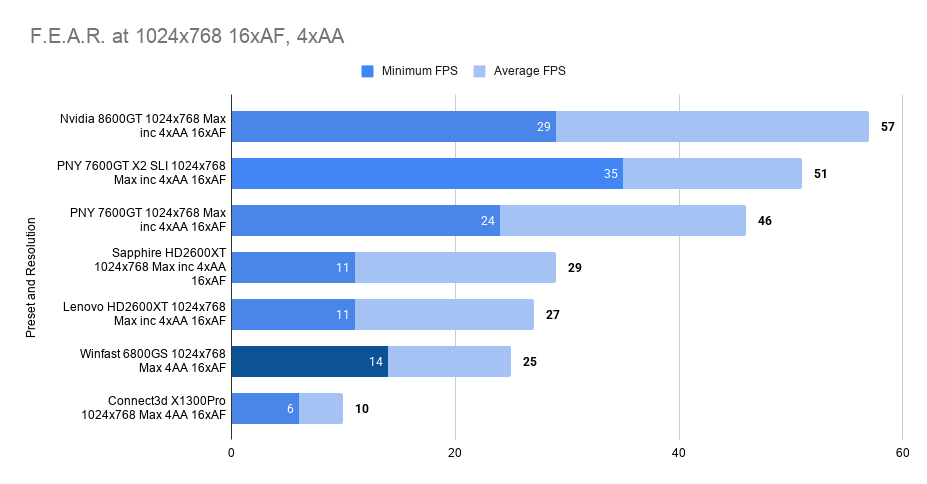
Across both FEAR test sets the 6800GS settles into a clear lower‑mid‑tier role, delivering playable but modest results while newer cards like the 7600GT, 8600GT, and the HD2600XT family pull ahead. FEAR’s lighting model and AA path favour later shader hardware, and the 6800GS simply doesn’t have the architectural headroom to keep pace. It remains consistent and smooth enough for the era.
Need for Speed: Carbon (2006)
Game Overview:
Need for Speed: Carbon released on October 31, 2006, developed by EA Black Box and published by Electronic Arts. It continued the street‑racing direction established by Underground and Most Wanted, shifting the series toward canyon duels, crew‑based racing, and a darker, more stylised presentation. Built on an enhanced version of the EAGL engine, it featured motion‑blur effects, HDR‑style lighting, depth‑of‑field, and detailed night‑time environments that pushed mid‑2000s GPUs far harder than earlier entries. Its mix of open‑city racing and narrow mountain passes made it a demanding benchmark for lower‑end hardware, especially when post‑processing and texture quality were set high.

Performance Notes:
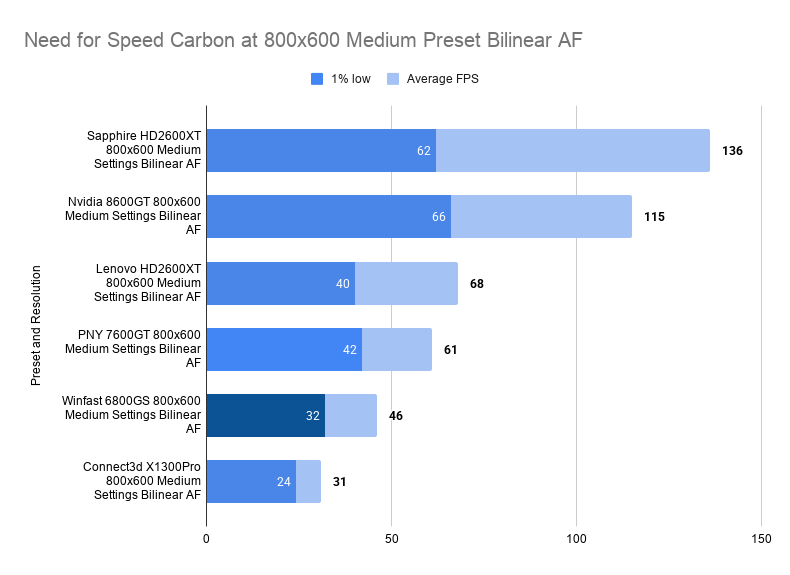
At 800×600 the 6800GS posts 32 minimum and 46 average, placing it above the X1300Pro but clearly behind the 7600GT and well below the 8600GT and the Sapphire HD2600XT. Carbon’s shader‑heavy renderer strongly favours later architectures, and the 6800GS shows its age here: smooth enough, but lacking the headroom to keep pace with the newer mid‑range cards. It behaves like a solid early‑DX9 design trying to keep up with a more modern engine.
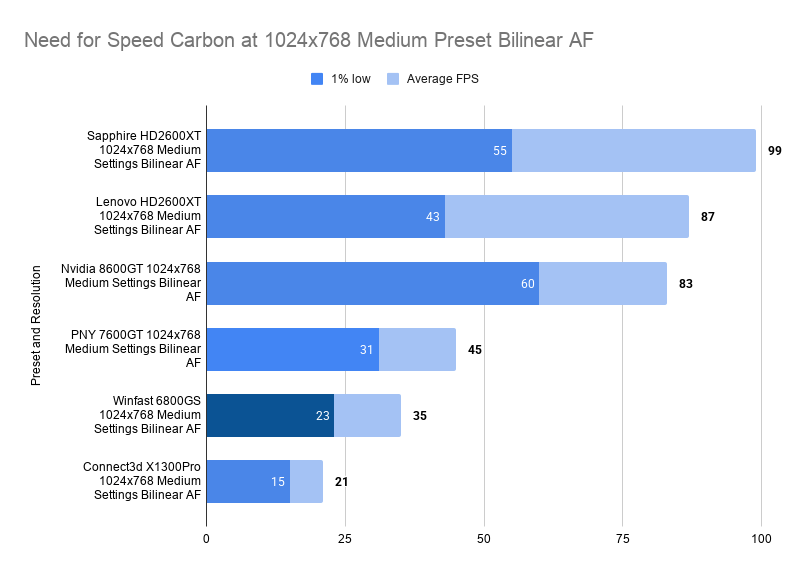
At 1024×768 the 6800GS drops to 23 minimum and 35 average, again ahead of the X1300Pro but behind everything else. The 7600GT sits at 45 average, and the HD2600XT cards stretch into the high‑80s and 90s, showing how much Carbon benefits from more advanced shader hardware. The 6800GS remains playable but clearly operates a tier below the later cards, especially as resolution increases.
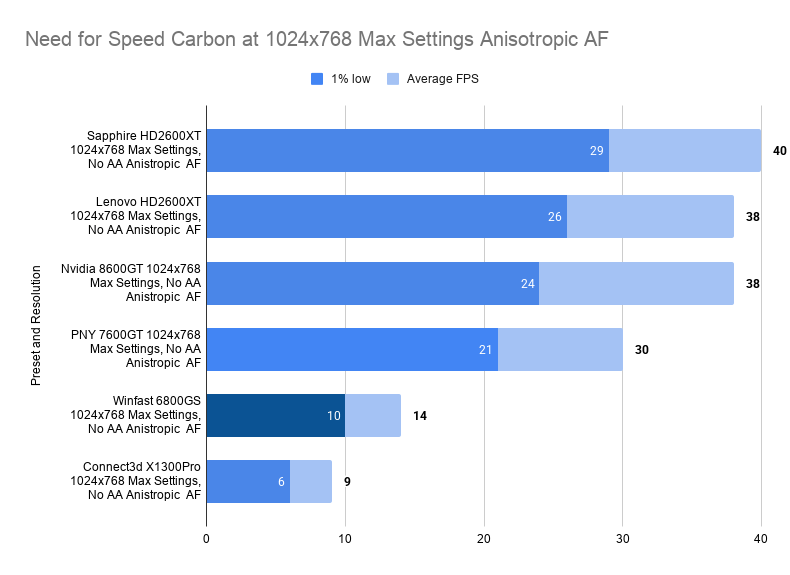
Under maximum settings without AA, the 6800GS falls to 10 minimum and 14 average, which is a steep drop compared to the 7600GT’s 21/30 and the 8600GT’s 24/38. This is where Carbon’s lighting and post‑processing really expose the NV40 architecture’s limits. The card stays functional, but it’s now firmly in the lower bracket, only just ahead of the X1300Pro.
With 4×AA enabled the 6800GS posts 9 minimum and 13 average, essentially matching its no‑AA result — a sign that Carbon’s AA path is relatively light, but also that the card is already at its limit. The 7600GT and 8600GT maintain clear leads, and even the Lenovo HD2600XT edges ahead despite its modest numbers. The 6800GS remains stable but never competitive in this configuration.
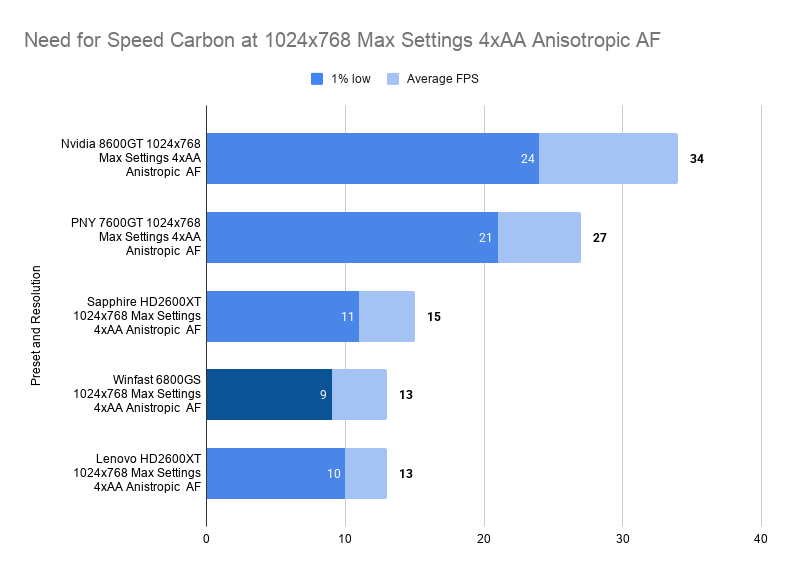
Across all NFS Carbon tests the 6800GS settles into a clear lower‑mid‑tier role: consistently ahead of the X1300Pro, consistently behind the 7600GT, and nowhere near the HD2600XT or 8600GT. Carbon’s shader‑centric engine simply favours newer hardware, and the NV40‑era design can’t stretch far enough to keep up. It stays smooth at medium settings and low resolutions, but once max settings or heavier effects come into play, the 6800GS becomes the first card to run out of headroom.
Medieval II: Total War (2006)
Game Overview:
Released on 10 November 2006, Medieval II: Total War was developed by Creative Assembly and published by Sega. It’s the fourth entry in the Total War series, built on the enhanced Total War engine with support for Shader Model 2.0 and 3.0. The game blends turn-based strategy with real-time battles, set during the High Middle Ages, and includes historical scenarios like Agincourt.
I run the intro to the Agincourt battle, this is in-engine so does render as if you are playing the game and will give like-for-like results in all scenarios.

Performance Notes:
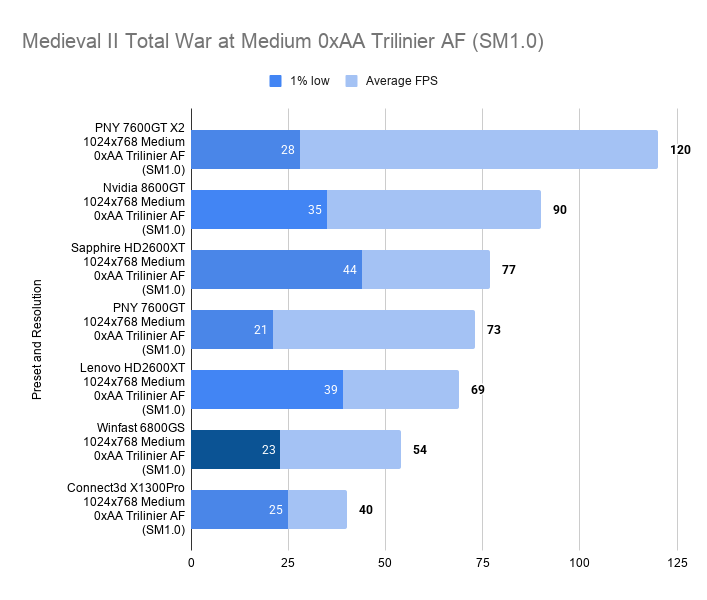
At medium settings on the SM1.0 path, the 6800GS posts 23 minimum and 54 average, placing it above the X1300Pro but behind the 7600GT and well behind the 8600GT and Sapphire HD2600XT. The SM1.0 renderer is light enough that newer mid‑range cards stretch out big leads, and the 6800GS settles into a steady mid‑lower position, delivering smooth but clearly older‑generation performance.
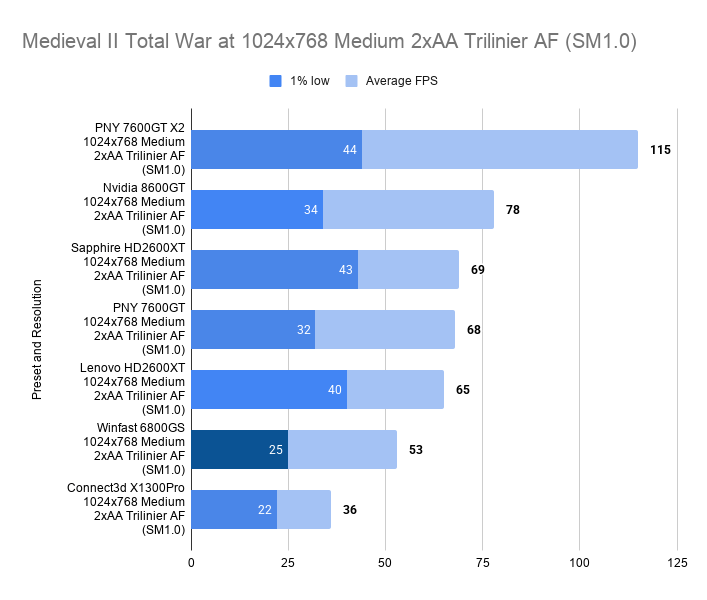
With 2×AA enabled, the 6800GS lands at 25 minimum and 53 average — almost identical to the no‑AA run, showing that AA has a modest impact on this card in the SM1.0 path. The 7600GT, 8600GT, and HD2600XT cards all maintain comfortable margins, and the 7600GT SLI setup demonstrates how well the engine scales when the GPU has the horsepower. The 6800GS remains consistent but never threatens the upper half of the table.
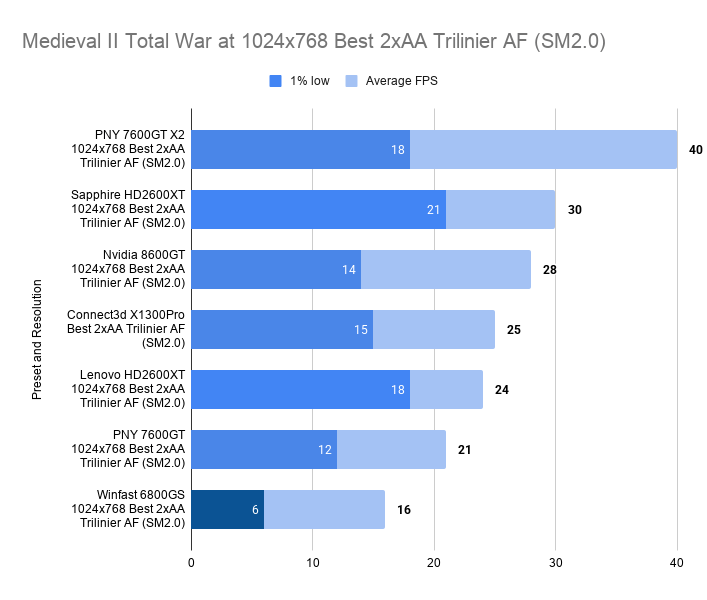
Switching to the SM2.0 path is where the 6800GS struggles most. It drops to 6 minimum and 16 average, placing it at the bottom of the pack and well behind the 7600GT’s 12/21 and the 8600GT’s 14/28. The heavier shader load of the SM2.0 renderer exposes the NV40 architecture’s limitations, and the 6800GS simply doesn’t have the shader efficiency to keep pace with the later mid‑range cards.
With 4×AA added on top of the SM2.0 path, the 6800GS posts 5 minimum and 16 average — essentially the same average as the 2×AA run, but with a slightly lower floor. The 7600GT, 8600GT, and HD2600XT cards all stay ahead, and the FireGL V7200’s 31 average shows how much bandwidth and shader throughput matter in this mode. The 6800GS remains stable but clearly outclassed at this highest‑quality setting.
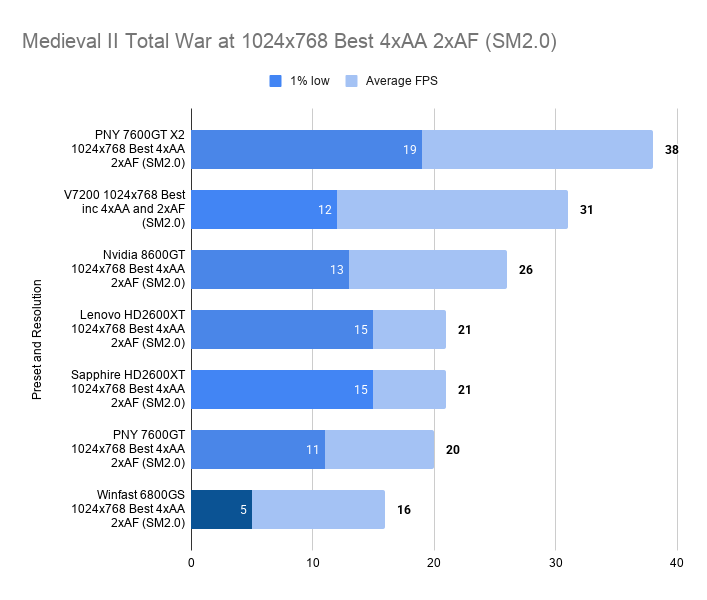
Across all Medieval II tests the 6800GS behaves like a capable early‑DX9 card that handles the lighter SM1.0 path well enough but runs out of shader horsepower once the SM2.0 renderer is enabled. It stays ahead of the X1300Pro and remains playable at medium settings, but the 7600GT, 8600GT, and HD2600XT family consistently outperform it — especially in the heavier shader modes. The 7600GT SLI results underline that this is a GPU‑limited scenario, and the 6800GS simply doesn’t have the architectural headroom to scale the way newer cards do.

The Elder Scrolls IV: Oblivion
Game Overview:
Oblivion launched on March 20, 2006, developed by Bethesda Game Studios. Built on the Gamebryo engine, it introduced a vast open world, dynamic weather, and real-time lighting. The game was a technical leap for RPGs, with detailed environments and extensive mod support that kept it alive well beyond its release window (it’s just had a re-release recently).
Known for its sprawling world, Oblivion remains a benchmark title for mid-2000s hardware. The game’s reliance on draw distance and lighting effects makes GPUs struggle.
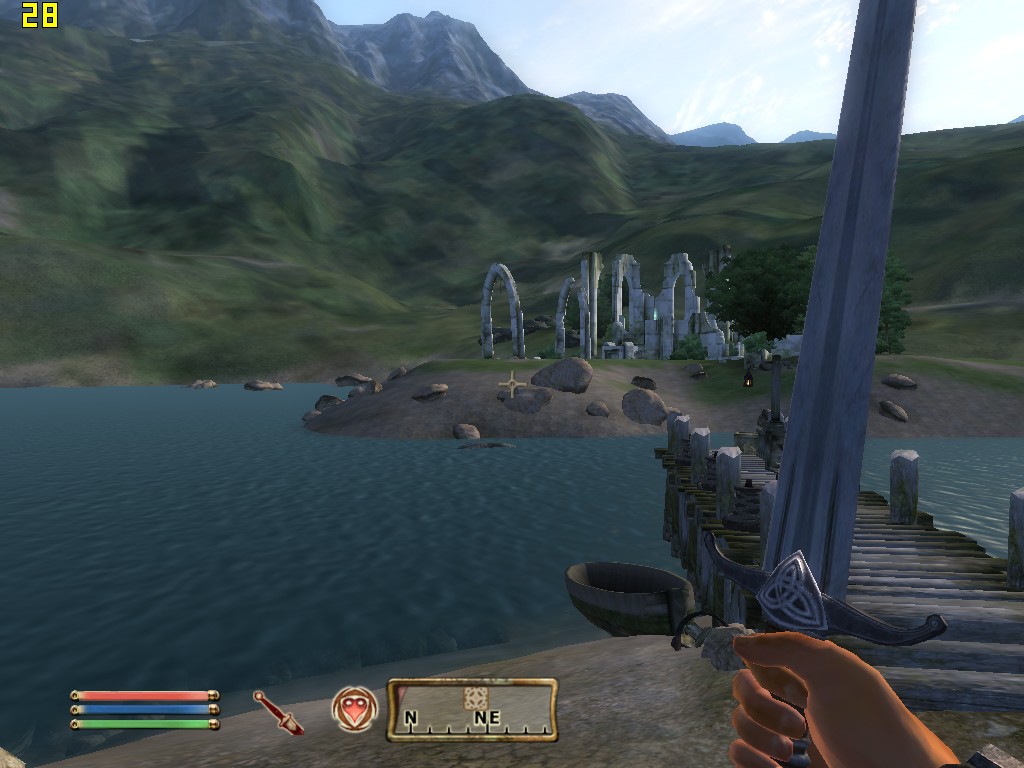
The benchmark run involves a run to the top of the hill opposite the sewer entrance, killing the two bandits on the way. The weapon is kept out for the duration (which costs about 5fps if you can believe it).
Performance Notes:
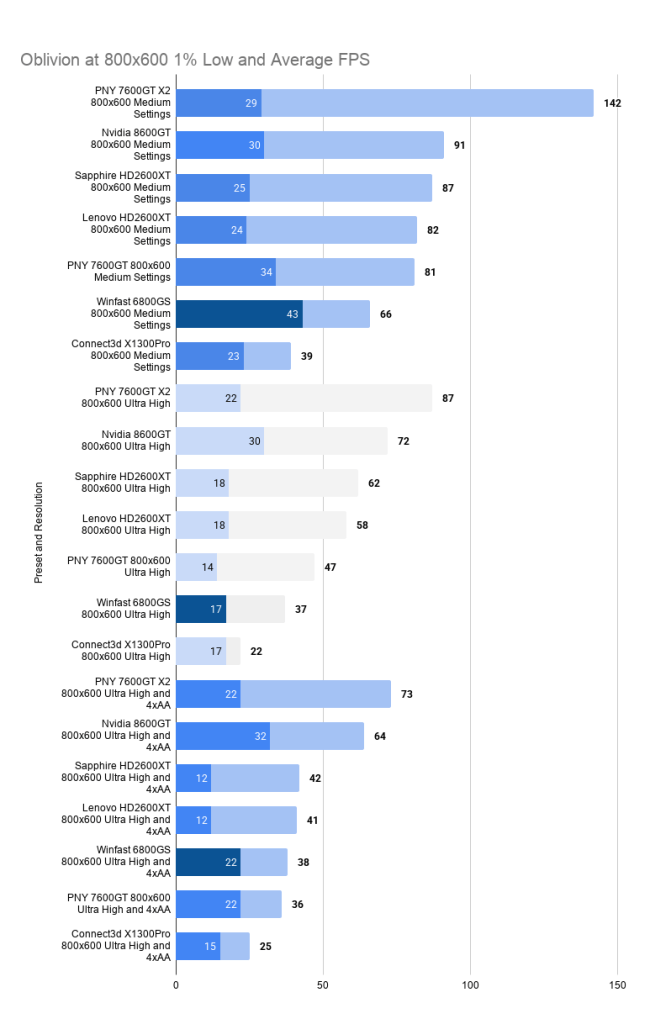
At 800×600 Medium the 6800GS posts 43 minimum and 66 average, which is one of its strongest showings across the suite. With HDR off and shader load relatively light, the NV40 architecture is in its comfort zone, even outperforming the single 7600GT and sitting not far behind the 8600GT and the HD2600XT cards. This is the classic “fill‑rate friendly Oblivion” scenario, and the 6800GS feels genuinely well‑matched to it.
Once HDR is enabled, the 6800GS drops sharply to 17 minimum and 37 average. HDR in Oblivion is notoriously heavy on older shader hardware, and NV40 simply doesn’t have the throughput to keep pace with later mid‑range cards. The 7600GT, 8600GT, and HD2600XT family all pull ahead here. The 6800GS remains playable, but this is the first configuration where the engine’s lighting model clearly overwhelms it.
Switching to 4×AA disables HDR and reverts the game to Bloom, which is far lighter on shader hardware. That’s why the 6800GS improves to 22 minimum and 38 average — slightly better than the HDR run despite AA being enabled. The 7600GT and 8600GT still lead, but the gap narrows because Bloom is much friendlier to NV40 than HDR. This is a rare case where enabling AA actually helps the card by removing the heavier lighting path.
At 1024×768 Medium the 6800GS posts 20 minimum and 32 average, now clearly behind the 7600GT and far behind the 8600GT and HD2600XT cards. The higher resolution pushes more shader work even in Medium mode, and the 6800GS begins to show the same pattern seen in TDU and Carbon: stable, but lacking the shader headroom of later architectures.
With HDR enabled at this resolution, the 6800GS drops to 16 minimum and 30 average, placing it behind every other card except the X1300Pro tier. The 7600GT, 8600GT, and HD2600XT family all maintain clear leads, and the FireGL V7200’s 52 average shows how much Oblivion benefits from bandwidth and shader throughput. The 6800GS remains consistent, but HDR is simply too heavy for NV40 at this resolution.
With 4×AA enabled, HDR is disabled again and Bloom takes over — which is why the 6800GS posts 14 minimum and 31 average, essentially identical to the HDR run but with slightly smoother lows. The 7600GT, 8600GT, and HD2600XT cards all stay ahead, and the FireGL V7200 again shows its strength. The 6800GS remains playable, but this is the configuration where it feels most outclassed.
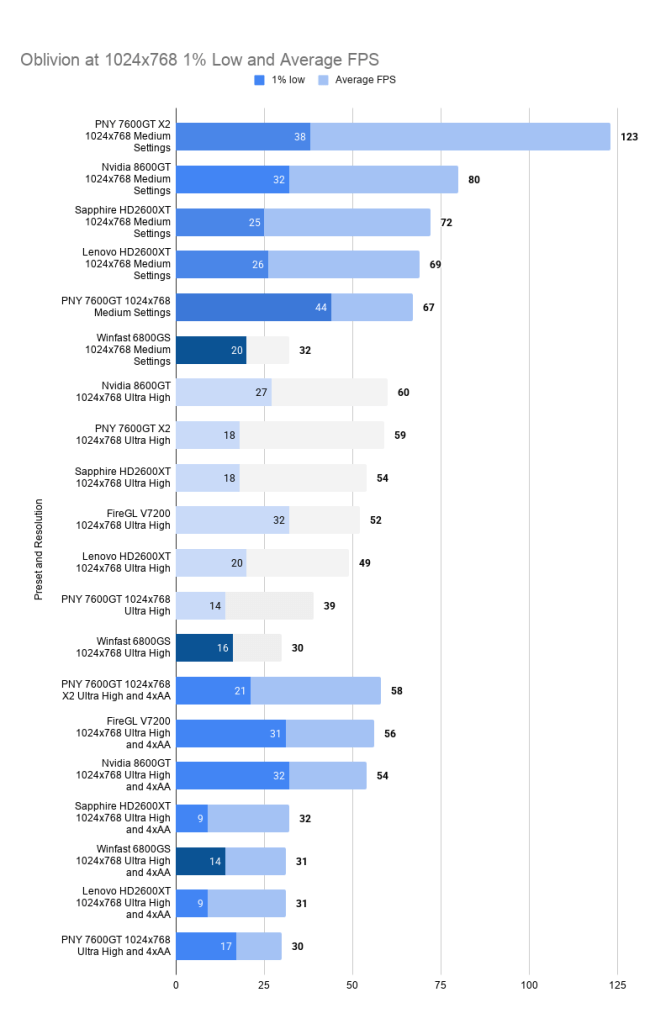
Across all Oblivion tests the 6800GS shows a clear split: it performs well in Bloom/Medium scenarios but falls behind sharply when HDR is enabled. The HDR path is simply too heavy for NV40, while Bloom lets the card breathe and even outperform the 7600GT in some cases.
Test Drive Unlimited (2006)
Game Overview:
Released on September 5, 2006, Test Drive Unlimited was developed by Eden Games and published by Atari. It marked a major technical leap for the Test Drive franchise, built on the proprietary Twilight Engine, which supported streaming open-world assets, real-time weather, and Shader Model 3.0 effects. The game ran on DirectX 9, with enhanced support for HDR lighting and dynamic shadows, optimized for both PC and seventh-gen consoles.
At launch, TDU was praised for its ambitious scale, vehicle fidelity, and online integration, though some critics noted AI quirks, limited damage modelling, and performance bottlenecks on lower-end rigs. The PC version especially benefited from community mods and unofficial patches that expanded car libraries and improved stability.
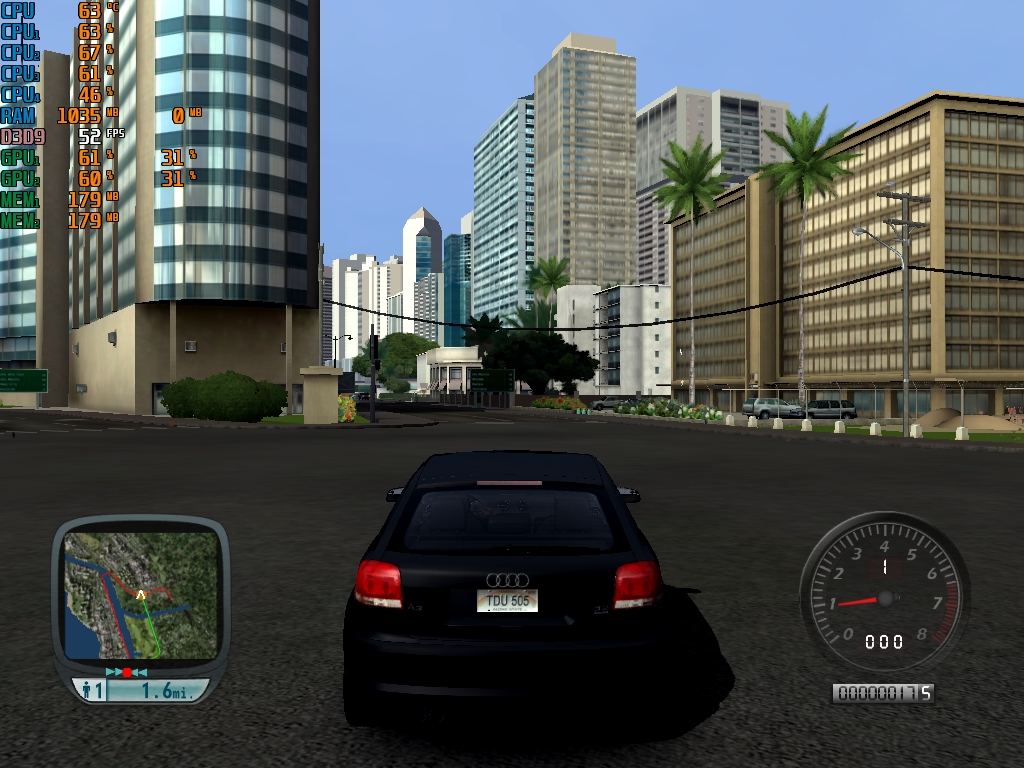
I do a high speed run up and down the same streets in a loop for each run, traffic density is medium but still will add an element of randomness but it still gives a good reflection of the performance you can expect.
Performance Notes:
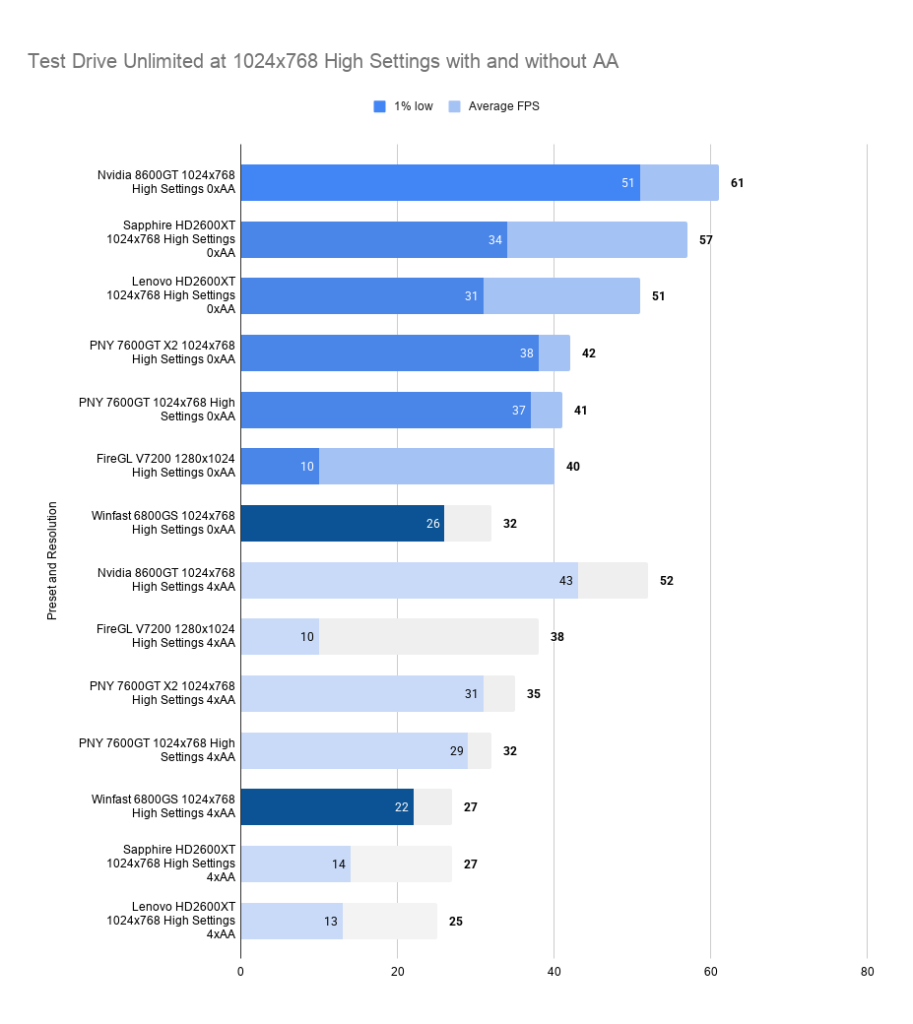
At 1024×768 with no AA, the 6800GS posts 26 for the 1% low and 32 average, placing it above only the X1300Pro‑tier results and well behind the 7600GT, the 7600GT SLI setup, and the 8600GT. The Sapphire HD2600XT also stretches a clear lead with a 57 average. TDU’s long‑distance rendering and shader‑heavy lighting favour later architectures, and the 6800GS settles into a lower‑mid position: smooth enough, but clearly showing its NV40‑era limits.
With 4×AA enabled, the 6800GS drops slightly to 22 for the 1% low and 27 average, a modest reduction that mirrors the behaviour seen in Carbon — AA doesn’t hit NV40 as hard as you’d expect, but the card is already close to its ceiling. The 7600GT and 7600GT SLI setups maintain small but consistent leads, and the 8600GT remains comfortably ahead. The HD2600XT cards fall back under AA, but still stay above the 6800GS. The card remains stable, just not competitive.
At the higher resolution the 6800GS posts 19 for the 1% low and 25 average, again ahead of only the very lowest performers and behind the 7600GT, 7600GT SLI, and the 8600GT. The HD2600XT cards sit in the low‑40s, showing how much TDU benefits from newer shader hardware. The 6800GS remains playable but clearly operates a tier below the later mid‑range cards at this resolution.
With 4×AA at 1280×1024, the 6800GS lands at 17 for the 1% low and 21 average, a small drop from the no‑AA run. The 7600GT and 8600GT maintain their leads, and the HD2600XT cards fall back but still stay ahead. The FireGL V7200’s 38 average highlights how much bandwidth and shader throughput matter in this engine. The 6800GS remains consistent, but this is the configuration where it feels most outclassed.
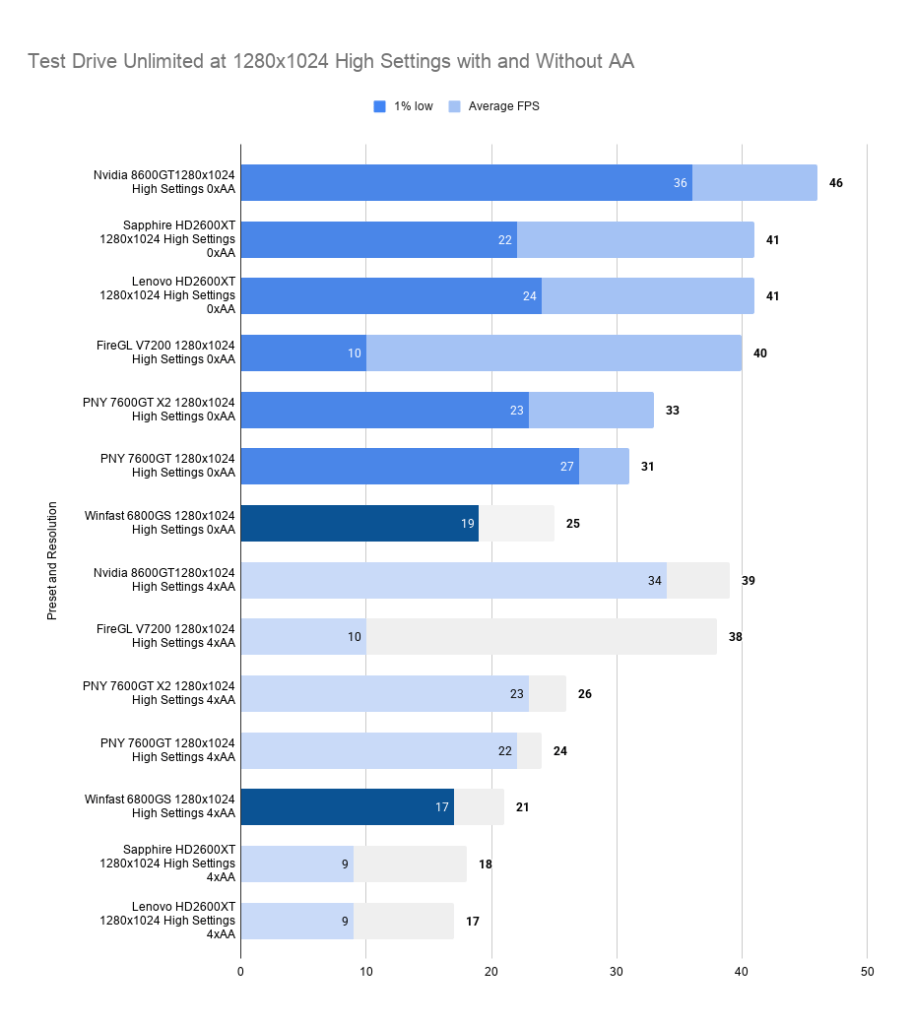
Across all TDU tests the 6800GS behaves like a steady but clearly aging early‑DX9 card: always ahead of the X1300Pro tier, always behind the 7600GT, and nowhere near the 8600GT or HD2600XT family. TDU’s long‑range rendering and shader‑heavy lighting simply favour newer architectures, and the NV40 design doesn’t have the shader efficiency to keep up. The 6800GS stays smooth and predictable, but it never climbs out of the lower‑mid bracket in this title.
Crysis (2007)
Game Overview:
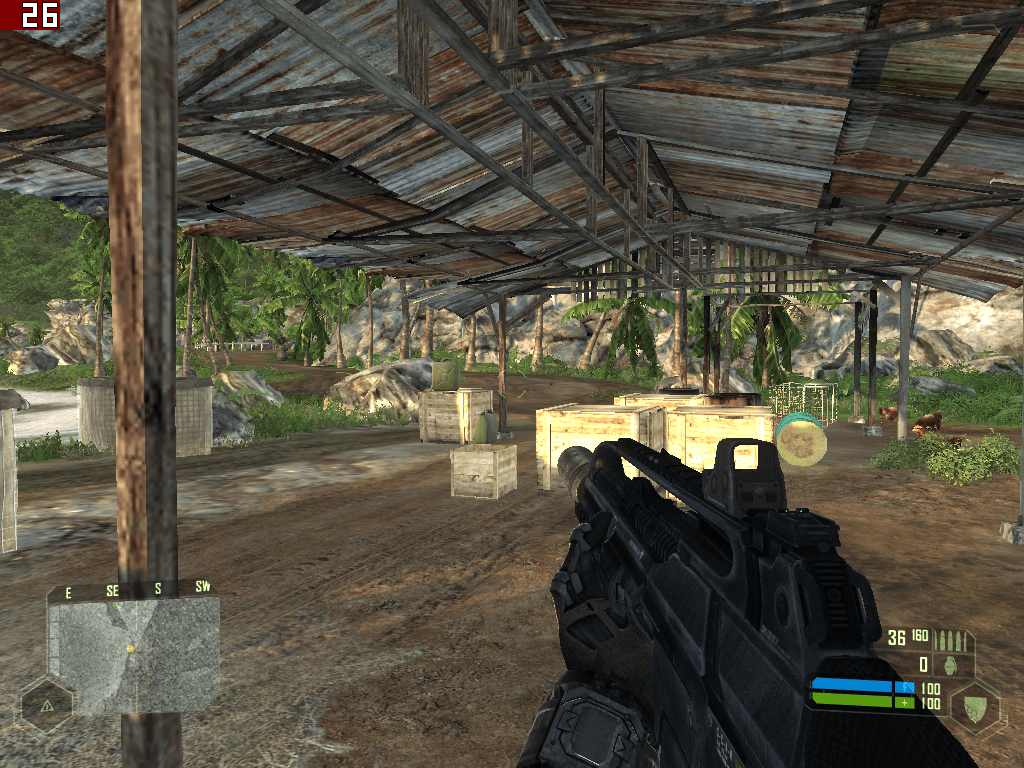
Crysis launched in November 2007 and quickly became the go-to benchmark title for PC gamers. Built on CryEngine 2, it pushed hardware to the limit with massive draw distances, dynamic lighting, destructible environments, and full DirectX 10 support.
The Run is down into the first occupied village taking out the bad guys, it’s not an identical run each time.
Performance Notes:
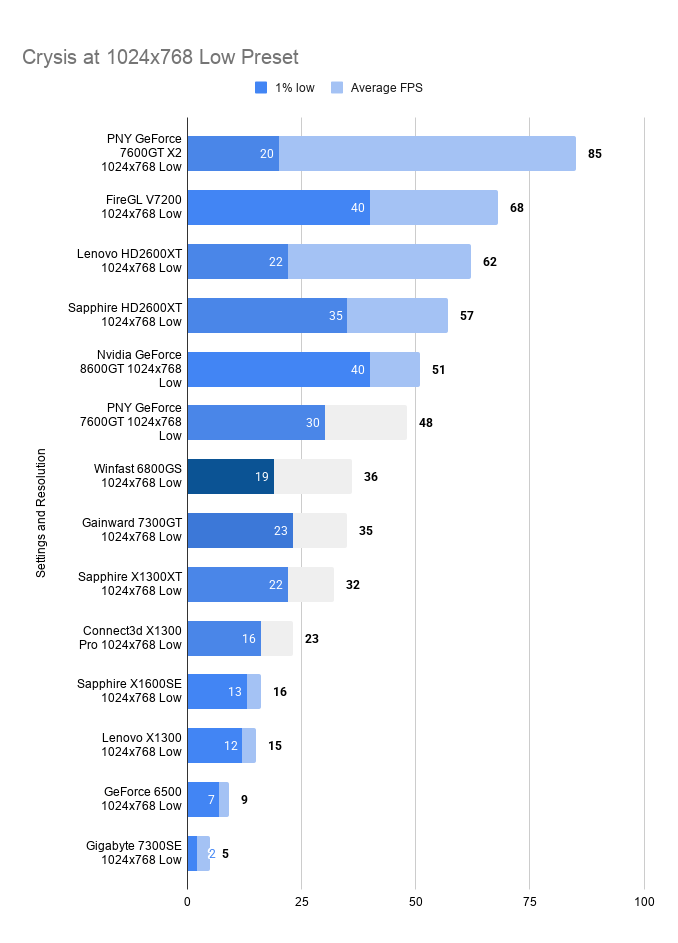
At 1024×768 Low the 6800GS posts 19 for the 1% low and 36 average, placing it only slightly above the true budget cards and well behind the 7600GT, the 8600GT, and even the Lenovo and Sapphire HD2600XT cards. Crysis leans heavily on complex shaders and deferred lighting, and NV40 simply doesn’t have the architecture to cope. The 7600GT SLI setup hits 85 average, the 8600GT reaches 51, and even the 7300GT sits close behind the 6800GS. The card remains technically playable, but this is one of the weakest showings.
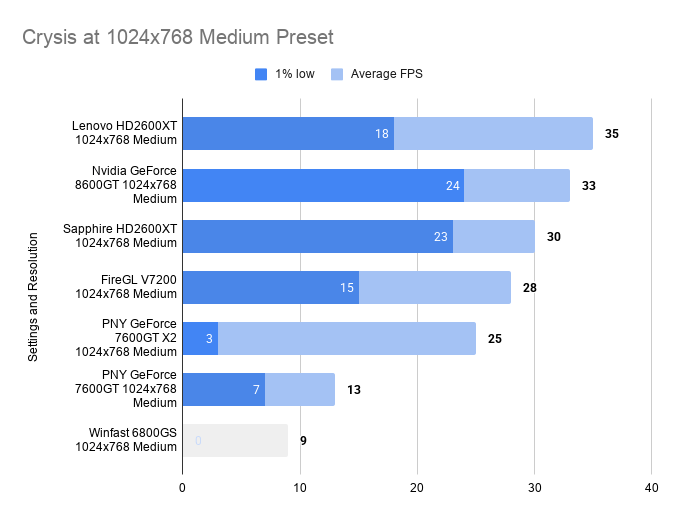
Medium settings are effectively unplayable on the 6800GS, with a 0 FPS 1% low caused by long multi‑second hangs and an average of just 9 FPS. This isn’t a crash — it’s the engine stalling while NV40 tries to chew through shader workloads it was never designed for. The 7600GT and 7600GT SLI setups also struggle badly here, but the 6800GS is the first card to fall into single‑digit averages.
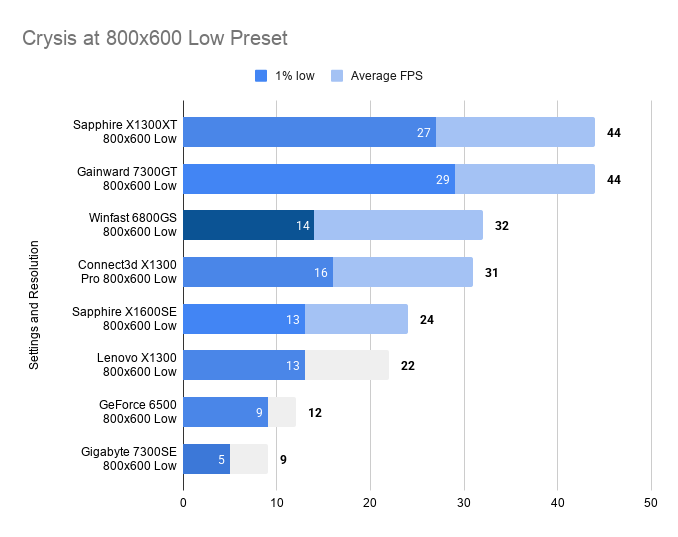
At 800×600 Low the 6800GS posts 14 for the 1% low and 32 average, which puts it right in the middle of the budget‑card cluster — above the X1300 Pro and X1600SE, but behind the 7300GT and even the X1300XT. This is the only setting where the 6800GS feels remotely usable, and even here it behaves like a lower‑mid card rather than the upper‑mid hardware it was in 2005. Crysis simply does not scale down well enough for NV40 to breathe.
Crysis is, without question, the 6800GS’s worst‑case scenario. At 1024×768 Low it performs only slightly above true budget cards, and at Medium it becomes borderline unplayable, with long hangs dragging the 1% low to 0 FPS. The architecture is simply too old and too limited for Crysis’s shader‑heavy design, and the card never rises above the lower‑mid bracket even at 800×600 Low.
S.T.A.L.K.E.R.: Shadow of Chernobyl (2007)
Game Overview:
Released in March 2007, S.T.A.L.K.E.R.: Shadow of Chernobyl was developed by GSC Game World and runs on the X-Ray engine. It’s a gritty survival shooter set in the Chernobyl Exclusion Zone, blending open-world exploration with horror elements and tactical combat. The engine supports DirectX 8 and 9, with optional dynamic lighting and physics that can push older hardware to its limits.
The Benchmark run is through the first village and out into the wilderness.

Performance Notes:
With Static Lighting enabled, the 6800GS posts 37 for the 1% low and 44 average. That places it just behind the 7600GT and the 7300GT, and well behind the 8600GT and the HD2600XT cards. STALKER’s Static Lighting mode is heavily dependent on raw fill‑rate and older shader paths, which helps the 6800GS stay reasonably stable, but the later mid‑range cards still stretch out clear leads. The 7600GT SLI setup and the 8600GT both reach the mid‑70s, showing how well the engine scales when the hardware has more shader throughput. The 6800GS remains smooth enough, but it settles into a lower‑mid position in this configuration.
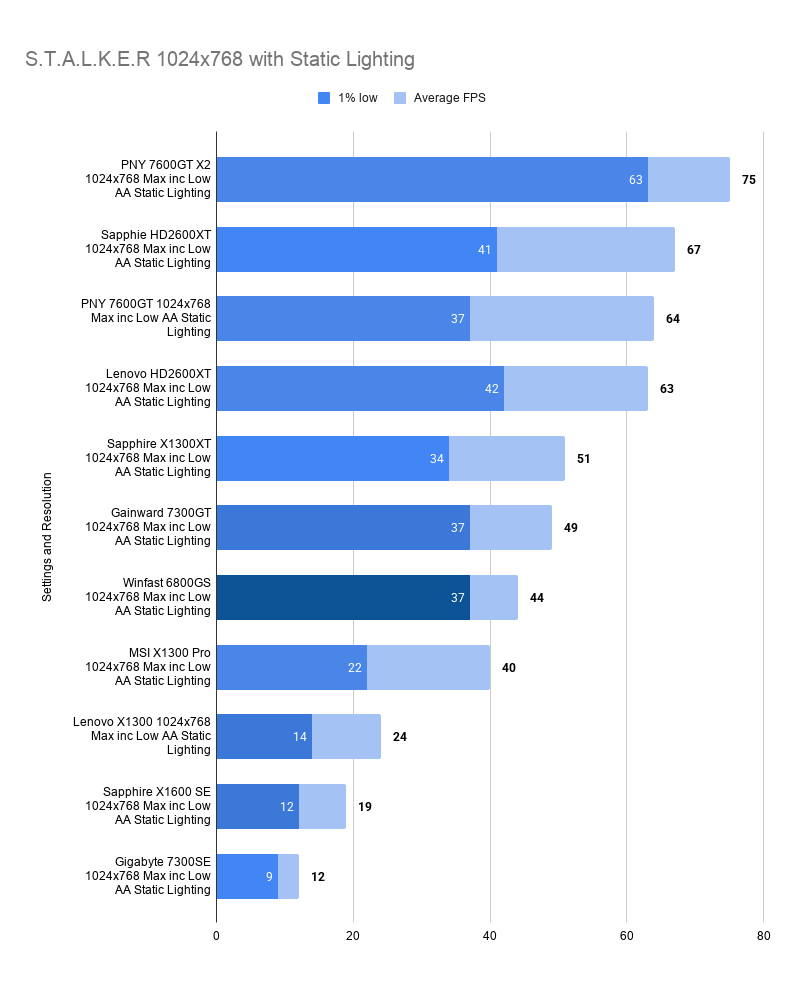
STALKER’s Static Lighting renderer is one of the more forgiving paths for older hardware, and the 6800GS benefits from that, delivering a playable 44 FPS average at 1024×768 Max with low AA. Even so, the card sits behind the 7600GT, the 8600GT and the HD2600XT family, all of which handle the game’s lighting and geometry load more efficiently. The 6800GS stays stable and predictable, but in this title it behaves like a lower‑mid card rather than the upper‑mid hardware it once was.
Assassin’s Creed (2007)
Game Overview:
Assassin’s Creed launched in November 2007, developed by Ubisoft Montreal and built on the Anvil engine. It introduced open-world stealth gameplay, parkour movement, and historical settings wrapped in sci-fi framing. The first entry takes place during the Third Crusade, with cities like Damascus, Acre, and Jerusalem rendered in impressive detail for the time.
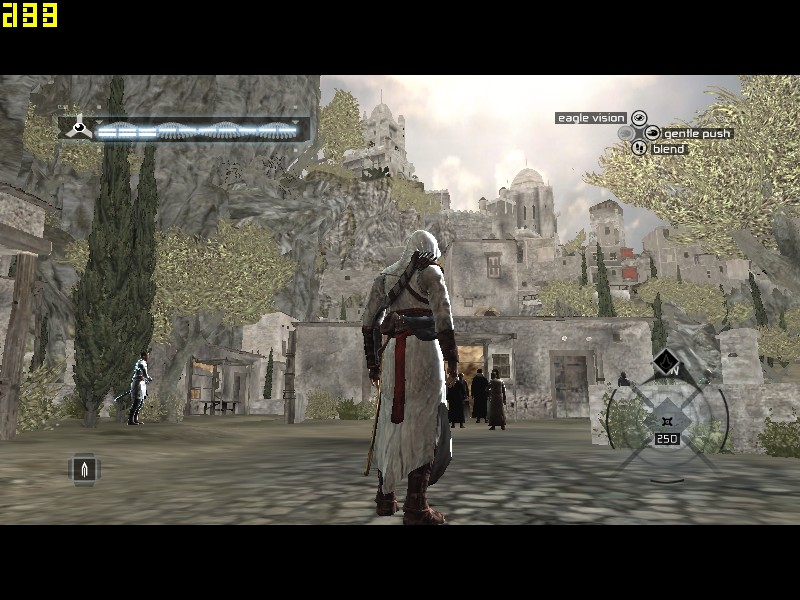
The Benchmark run is up to the top of the town and back down again to the gate at the beginning of the game after the tutorial part is finished.
Performance Notes:
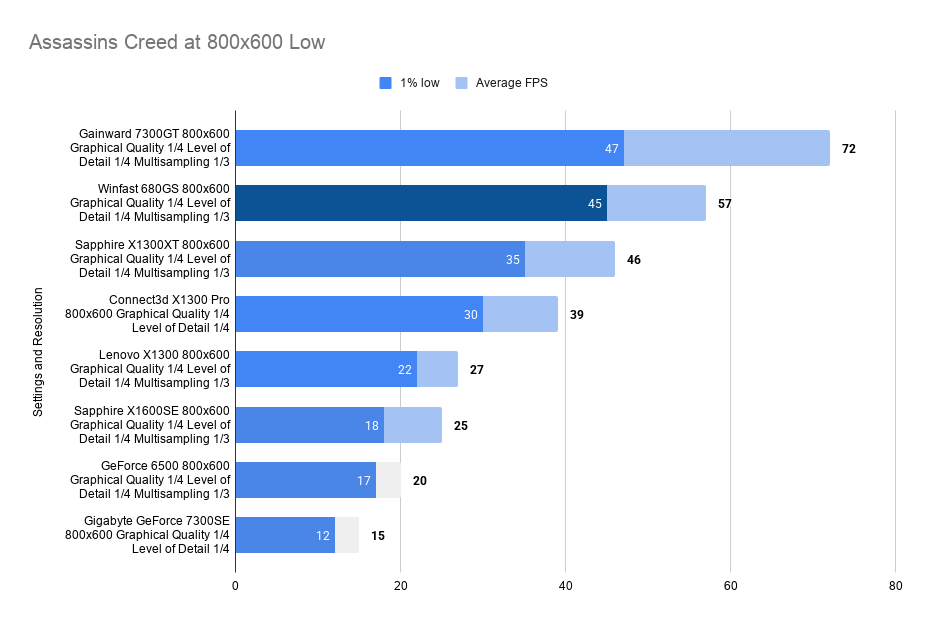
At the lowest settings the 6800GS posts 45 for the 1% low and 57 average, placing it just behind the 7300GT but well ahead of the X1300‑series cards. This is the only configuration where the 6800GS feels comfortable: the reduced geometry load and light shader path suit NV40, and the card behaves like a solid lower‑mid option. It’s playable and stable, but already showing that it’s close to its limit.
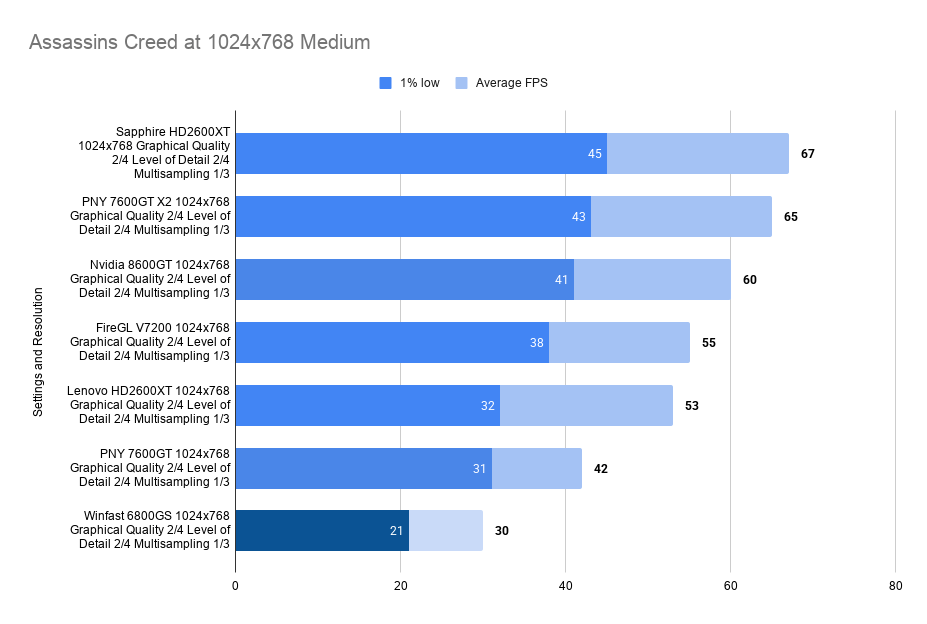
At these mid‑range settings the 6800GS drops to 21 for the 1% low and 30 average, falling behind the 7600GT, the 8600GT and both HD2600XT cards. Assassin’s Creed leans heavily on shader throughput and geometry processing, and the 6800GS simply can’t keep pace with later mid‑range hardware. The card remains playable, but the gap to the newer architectures becomes very clear.
At high quality (without post‑FX) the 6800GS drops further to 16 for the 1% low and 25 average. The 7600GT, 8600GT and HD2600XT family all maintain comfortable leads, and even the FireGL V7200 stays well ahead. This is the point where the card begins to feel genuinely strained: the higher‑detail geometry and heavier shader load expose NV40’s age.
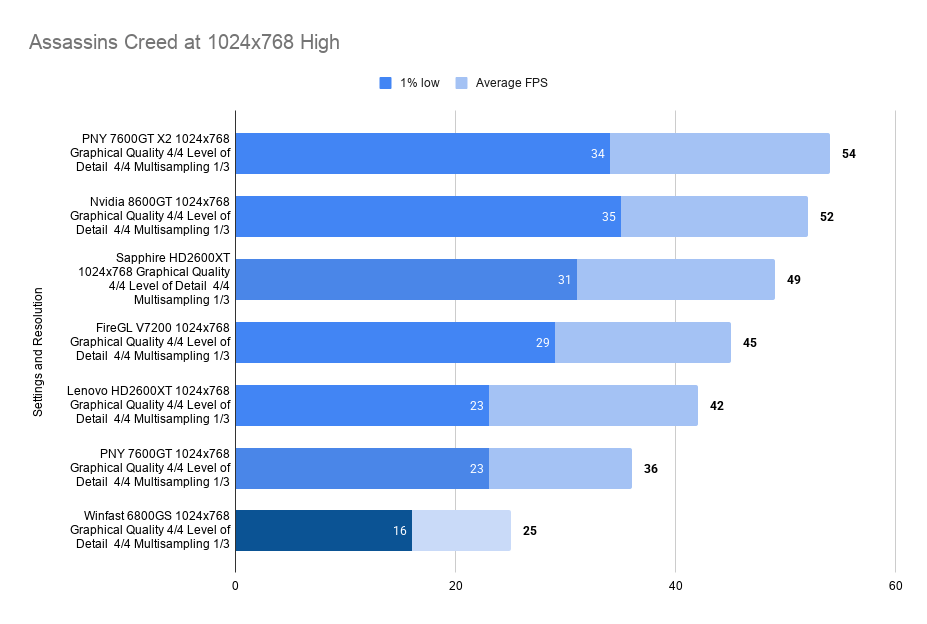
With post‑processing enabled the 6800GS posts 12 for the 1% low and 20 average, placing it firmly at the bottom of the tested mid‑range cards. Assassin’s Creed’s post‑FX pipeline is particularly unfriendly to older architectures, and the 6800GS simply doesn’t have the shader flexibility to keep up. The card remains technically functional, but performance is clearly below the threshold most players would consider smooth.
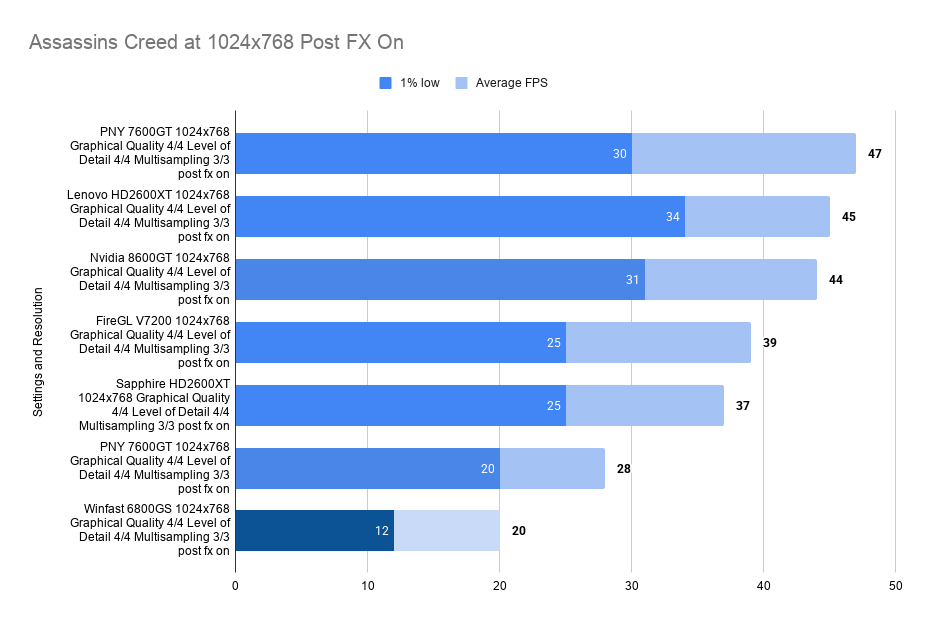
Assassin’s Creed is playable on the 6800GS only at the very lowest settings, where reduced geometry and lighter shaders allow the card to deliver a respectable 57 FPS average at 800×600. Once resolution, detail and post‑processing increase, the 6800GS quickly falls behind the 7600GT, 8600GT and the HD2600XT family. The engine’s reliance on shader throughput and post‑FX exposes NV40’s limitations, and the card settles into a lower‑mid position overall.
Synthetic Benchmarks
3d Mark 2001SE
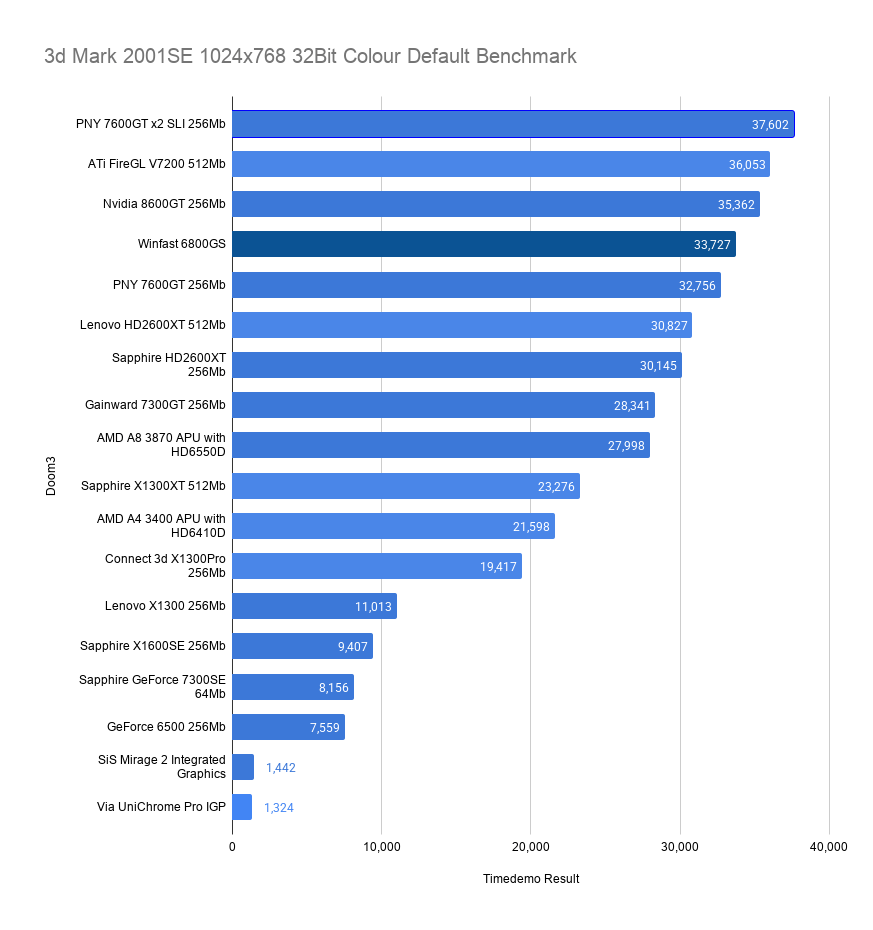
With a score of 33,727, the 6800GS performs exactly as an upper‑mid 2005 card should in 3DMark 2001 SE, landing just behind the 8600GT and the FireGL V7200, and slightly ahead of the single 7600GT. This benchmark favours strong fixed‑function throughput and early‑DX9 efficiency, both of which suit NV40 well, allowing the 6800GS to punch above the HD2600XT cards and comfortably ahead of the 7300GT and all X1300/X1600‑series hardware. It’s one of the few tests where the 6800GS shows its original class clearly, sitting near the top of the chart and behaving like the high‑end‑leaning mid‑range card it was designed to be.
3d Mark 2003
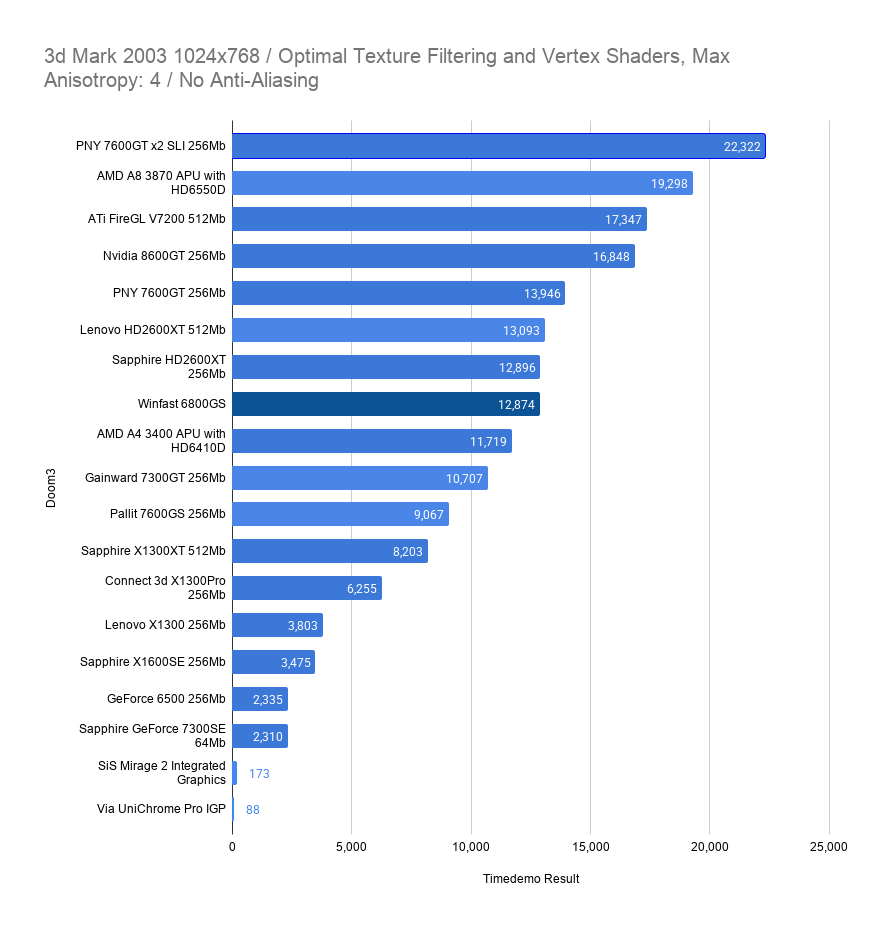
With a score of 12,874, the 6800GS lands in the middle of the pack for 3DMark 2003, sitting just behind the HD2600XT cards and the single 7600GT, and well below the 8600GT, FireGL V7200 and the 7600GT SLI setup. This benchmark leans heavily on early‑DX9 shader performance, and the results reflect NV40’s age: competent, but clearly outpaced by later mid‑range architectures. Even so, the 6800GS stays comfortably ahead of the 7300GT, the 7600GS, the X1300/X1600‑series cards and all entry‑level GPUs, placing it firmly in the lower‑mid to mid‑range bracket for this synthetic test.
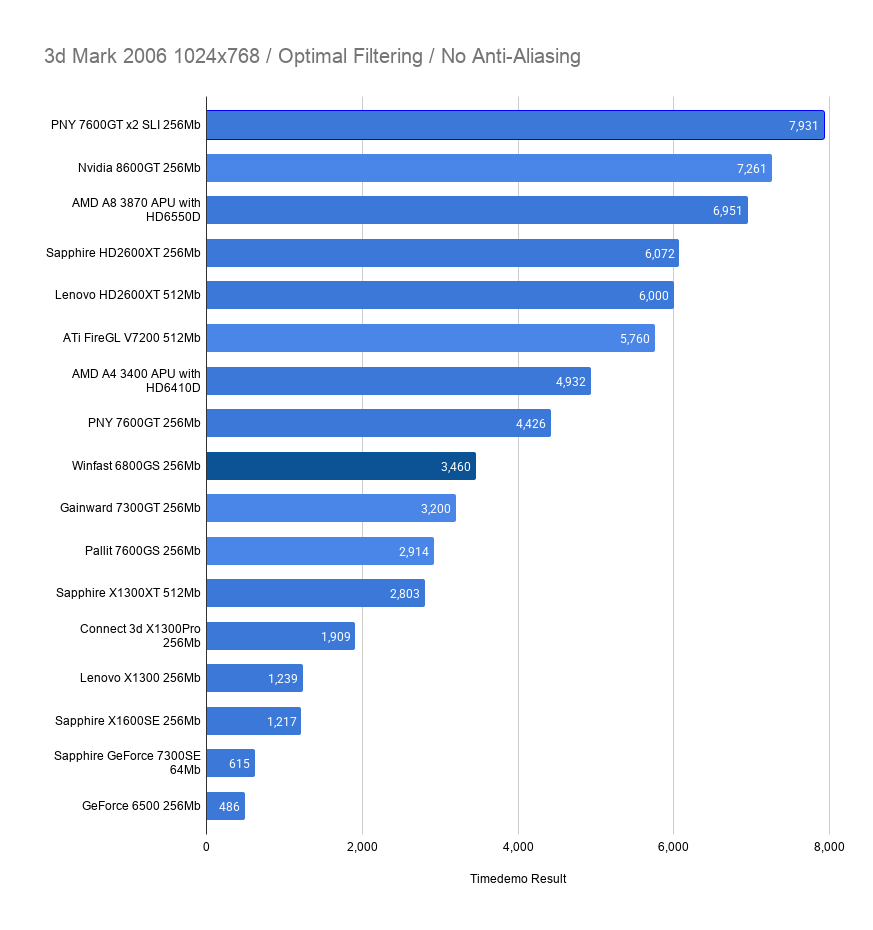
3d Mark 2006
In 3DMark 2005 the 6800GS scores 3,460 overall, placing it below the 7600GT, 8600GT, HD2600XT cards and the FireGL V7200, but still ahead of the 7300GT, 7600GS and all X1300/X1600‑series hardware. The SM2.0 score of 1,265 reflects NV40’s ageing shader efficiency compared with later mid‑range GPUs, while the HDR/SM3.0 score of 1,199 shows that although the card supports Shader Model 3.0, it lacks the throughput to compete with newer architectures. Overall, the 6800GS behaves like a lower‑mid performer in this benchmark: clearly outpaced by the 7600GT and HD2600XT family, but still comfortably ahead of entry‑level and budget cards.
Unigine Sanctuary
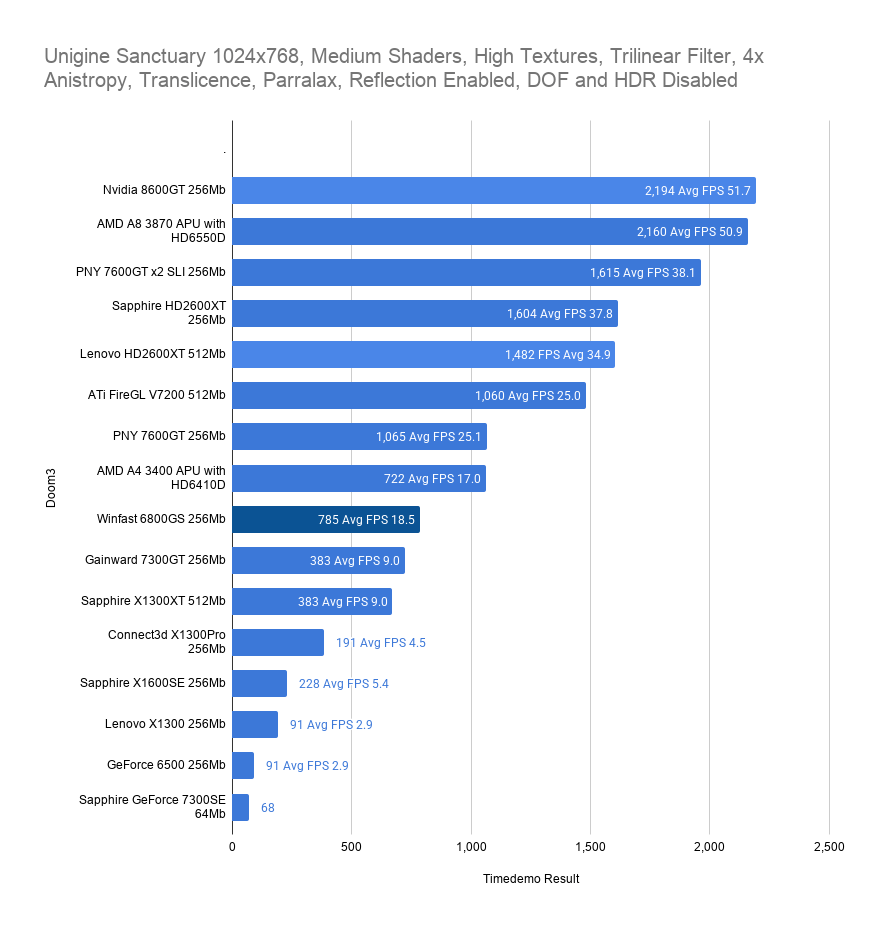
In Unigine Sanctuary the 6800GS scores 785, placing it well behind the 7600GT, the 8600GT and the HD2600XT cards, and even trailing the FireGL V7200 by a wide margin. Sanctuary’s heavy reliance on dynamic lighting, shadow complexity and modern shader paths exposes NV40’s age immediately, and the card settles into a lower‑mid position overall. It stays ahead of the 7300GT and all X1300/X1600‑series hardware, but it never approaches the performance of later mid‑range GPUs. This benchmark highlights exactly where the 6800GS begins to fall away from newer architectures: shader throughput and advanced lighting workloads.
Power and Heat
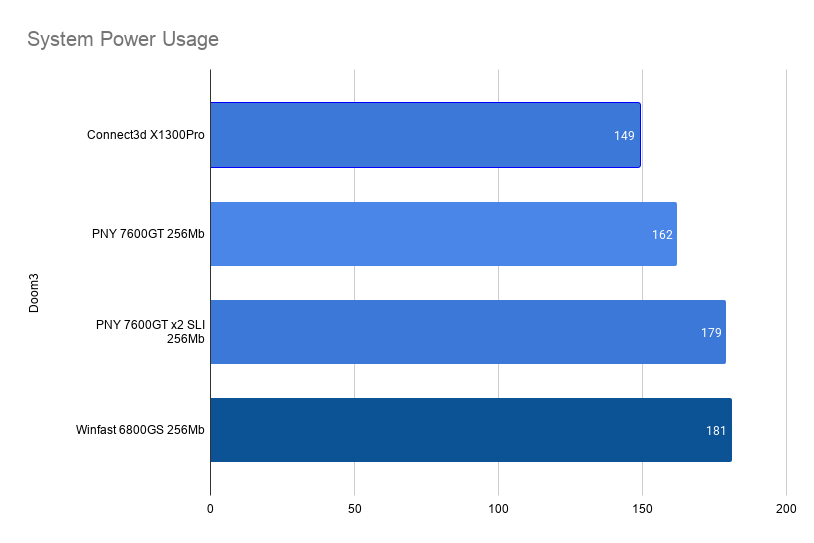
Under a sustained run of Unigine Sanctuary the system draws a steady 181 watts at the wall, making the 6800GS one of the hungriest cards in this entire group and even exceeding the draw of 7600GT SLI. Thermal behaviour is more controlled: the GPU levels out at 64°C, while the PCB sensor reports 41°C, both entirely reasonable for hardware of this era.
Acoustics are far less pleasant. The fan appears locked at a constant 53% duty, never ramping up or down, and produces a noticeably loud, fixed‑pitch noise throughout testing. It keeps the card cool, but it’s intrusive enough that removing the 6800GS from the test system is going to feel like a relief.
Conclusions
Across the whole test range, the 6800GS does seem to struggle, perhaps it’s to be expected, early 2000s graphics technology was moving at a frantic pace and this is 2004 technology – games of 2004 and earlier really did perform well here.
Once shader load and lighting get heavier though, you can see it starting to slip. In games that rely on simpler rendering paths, like STALKER’s Static Lighting mode or Assassin’s Creed on its lowest settings things do remain smooth and behaves like a perfectly capable lower mid card.
Crysis is a problem. Even at 1024×768 on Low the 6800GS is already working overtime, and at Medium it hits long stalls that drag the 1 percent low all the way to zero. At that point it behaves like a budget card, which really shows how quickly NV40 runs out of shader horsepower in newer engines.
Unigine Sanctuary backs this up. Once dynamic lighting and more advanced shaders kick in, the 6800GS drops far below the mid range cards that came after it.
Synthetic benchmarks tell a similar story. In 3DMark 2001 SE it’s still great, sitting near the top thanks to the fixed function and early shader strengths NV40 was built around. By 3DMark 2003 it settles into the middle of the pack, and in 3DMark 2005 it behaves like a lower mid card with limited SM3.0 support (hey at least it has SM3.0 support).
It lines up almost perfectly with what you see in real games: strong in older engines, increasingly outpaced in newer ones.
Taken together, the 6800GS feels like a transitional product. It’s strong in the games of its own era, it struggles in the ones that came only a short time after.
It’s interesting historically as one of the last NV40 cards bridging the DX8 to DX9 shift and AGP to SLI shift. It’s a neat snapshot of mid 2000s GPU design, showing both what the architecture did well and where it was about to hit a wall.
It’s great in the collection but far from a recommended card to stick in a retro-pc.
I have heard others describe the 6800 series as the best choice for a Windows 98 build as it has driver support for that earlier OS (where the 7000 series does not). This is easy to believe, I woudl expect early 2000s titles to be playable at the highest possible settings on the 6800GS.
Links
Some further reading:
https://www.techpowerup.com/gpu-specs/geforce-6800-gs.c143
https://pcper.com/2006/01/xfx-geforce-6800-gs-review-nvidias-mid-range-monster/
https://www.guru3d.com/review/geforce-6800-gs-256-mb-(agp)
 Ash's Retro Hardware Reviews
Leave a comment