
A Retrospective Review and Benchmarks of ATi’s first unified-shader, lower-midrange graphics card
- RRP: £65 For this IceQ model, £48 for the HD2600Pro
- Release date: June 28 2007
- Purchased in May 2026
- Purchase Price: £14.99 + P&P
- Form Factor: PCI-E
- Available as AGP: Yes
- Windows Compatibility: XP, Vista, 7, 8, 8.1 and 10
Introduction
Here we go back to the first unified-shader territory again, the HD2600XTs tested before were not too exciting with my DX9 heavy suite, so I wasn’t too excited when I saw this one up for sale. Still, this HIS version was in its box and looked pretty exciting for it’s time.
At £14.99 it wasn’t exactly a bargain but I thought I would give it a new home.
Some history first:
The HD2000 Series
From Fixed-Function to Unified Shaders
In the summer of 2007, ATI unveiled the RV600 series, known as the Radeon HD 2000 series.
These new GPUs were built on a new architecture called TeraScale 1 and marked a radical shift in GPU design, moving away from previous generations’ fixed-function pipelines which could be found on all cards back to the very first 3d accelerators.
Individual vertex and pixel shaders were replaced by a unified shader model in which a pool of stream processors could handle vertex, pixel, and geometry shading interchangeably.
This series of graphics cards was not ATi’s first foray into the world of unified shaders as they had experience developing the chip contained within the Xbox 360 Console, with a GPU called Xenos.
The RV600 series directly competed with Nvidia’s G80 architecture from the GeForce 8 series which also utilised unified shaders and was released half a year earlier in November 2006.
ATI vs Nvidia: Shader Efficiency and Design
The Unified shader architectures allowed both ATI and Nvidia to assign processing power where needed which was a huge advance over earlier designs. The two companies approached the challenge differently:
- ATI TeraScale/HD2000: Implemented fewer, but wider SIMD shader units. Each ATI “stream processor” was highly efficient, able to parallelize workloads better for certain compute tasks, meaning ATI cards often delivered higher performance-per-watt than their Nvidia rivals of the time. For example, the HD 2600 variants had 120 stream processors; the HD 2900 XT had 320. The architecture’s ability to assign any shader processor to any task, and its optimizations for efficiency, sometimes resulted in superior performance in shader-heavy applications despite lower raw hardware counts.
- Nvidia Tesla/G80: Focused on having more individual shader units, but each was less wide and specialized than ATI’s. This approach led to higher raw peak throughput but could result in lower efficiency under real-world loads, especially those requiring extensive parallelism. Nvidia’s design sometimes excelled in brute-force scenarios but could lag in efficiency per shader, particularly in DirectX 10 titles at the time.
Think of ATI shader units as crew teams working together handling multiple pixels simultaneously. Nvidia shader units for comparison, are individual workers with superhuman strength.
Comparing the actual numbers of shader units is like comparing hours worked by teams vs hours worked by individuals, numbers alone don’t tell the whole story without knowing the size and power of each worker or team.
In summary, the ATi cards sound better with their vast numbers of shader units but this doesn’t always translate into better performance.
Shader Handling: Games and Compatibility
Unified shader cards improved gaming visuals in DirectX 10 titles which were incorporated into Windows Vista and later.
They allowed dynamic assignment of computing resources, boosting flexibility and performance in modern games that were built for these new capabilities. Performance and image quality improved, especially in games leveraging Shader Model 4.0 features like geometry shaders and high dynamic range processing.
Adoption was gradual though, and new cards faced mixed results until the software caught up.
Many popular games during the HD era (and later) still targeted DirectX 9 and Windows XP.
Here, performance wasn’t always optimal, in some cases, HD 2000 cards were outperformed by older hardware more tailored for legacy APIs, especially before drivers matured.

The HIS HD2600Pro IceQ Edition

A much more modern looking card, this HIS version has an absolutely huge plastic shroud. Considering the HD2600 Pro doesn’t even need any additional power it’s hard to believe that this is warranted but.. perhaps that overclock that it boasts about makes it all worthwhile.
On closer inspection, I noticed also that this big heatsink doesn’t actually make contact with the memory chips, so they aren’t benefitting at all from it’s presence, in fact it may even block some airflow that would otherwise reach some of the chips so a little wasteful really.
The RAM on-board are lowly DDR2 modules as well and there is no crossfire option which seemed a rarity on the Pro versions.
Perhaps this isn’t as high-end as it’s looks suggest.
A table below shows how the card lines up with the reference design, along with the 2600XTs and 8600GT tested before

So a useful 50Mhz of core clock advantage and the DDR2 Memory is clocked 125Mhz higher than on the reference design, which is still a step down on the faster GDDR3.
In comparison to the 2600XTs, the Pro is not a whole lot lower in core clock but it’s teh RAM that is going to hurt. In all other aspects, the Pro and XT models share the same specs.
The 260Pro does ‘benefit’ from 512Mb of RAM so capacity is higher than the Sapphire HD2600XT and Nvidia 8600GT. As we saw with the Lenovo card though, this doesn’t make a huge amount of difference, at least at the resolutions my monitor can hit.
Card Stripdown

It looked like just the four screws but it was surprisingly painful to get this one back together again, there were 12 plastic washers/spacers that fell away when removing the screws and holding them in place again whilst putting things back together was a bit of a pain.
Still, the paste seemed very fresh and there was little dust – maybe that fancy cooler is doing something, or maybe a previous owner had maintained it – it’s not really possible to tell.
The Test System
Details are as follows:
- CPU: AMD Phenom II X4 955 3.2Ghz Black edition
- 8Gb of 1866Mhz DDR3 Memory (showing as 3.25Gb on 32bit Windows XP and 1600Mhz limited by the platform)
- Windows XP (build 2600, Service Pack 3)
- Kingston SATA 240Gb SSD
- ASUS M4N75TD Mainboard.
- Catalyst 31.4

Tom Clancy’s Splinter Cell (2002)
Game Overview:
Tom Clancy’s Splinter Cell launched on November 19, 2002, developed by Ubi Soft Montreal. Built on the LithTech Jupiter engine (Unreal Engine precursor), it pioneered tactical stealth gameplay with groundbreaking light/shadow mechanics and realistic audio design. The game set new standards for immersion through dynamic lighting where visibility literally shaped gameplay.
Known for its revolutionary light-based stealth, Splinter Cell remains the ultimate benchmark for early 2000s GPUs. The game’s real-time shadows, particle effects, and high-poly environments brutally stress fillrate and shader performance even on modern retro hardware.
I have the GOG version of the game which has an internal benchmark that can be used.

Performance Notes:
No immediate peers to compare to at present but we can see how the 2600Pro does against the previous generations mid-range from Nvidia with the 7600GT.
It does fall somewhat adrift as you may expect, this game was released long before unified shader technology and will be tailored to the older fixed-pipeline cards.
80fps at 1280×1024 with everything switched on is certainly nothing to be sniffed at.

Unreal Tournament 2003 (2002)
Game Overview:
Released in October 2002, Unreal Tournament 2003 was built on the early version of Unreal Engine 2. It was a big leap forward from the original UT, with improved visuals, ragdoll physics, and faster-paced gameplay.
The engine used DirectX 8.1 and introduced support for pixel shaders, dynamic lighting, and high-res textures all of which made it a solid test title for early 2000s hardware.
Still a great game and well worth going back to, even if you’re mostly limited to bot matches these days. There’s even a single-player campaign of sorts, though it’s really just a ladder of bot battles.
The game holds up visually and mechanically, and it’s a good one to throw into the testing suite for older cards. The uncapped frames are pretty useful (and annoyingly rare) on these old titles.
I play a full match of DM Plunge for each run, not exactly replicable as every match will be different but the length of the match means a lot of data is collected and the average should be pretty reliable.

Performance Notes:
UT2003 is the first time we get to see the HD2600Pro lined up directly against the XT cards and the gap is pretty clear. Both XT models sit in the low‑130s on average with 1% lows in the 70s, while the Pro drops to 104 with a 1% low of 57.
This means the card is 26-30% slower than the two HD2600XT’s and 48% Slower than the 8600GT.
Still, perfectly playable of course, no complaints!

X2: The Threat (2003)
Game Overview:
Released for Windows in December 2003, with later ports to Mac OS X and Linux, X2: The Threat is a space trading and combat simulation developed by Egosoft. It continues the story from X: Beyond the Frontier, placing players in the role of Julian Gardna, a former pirate drawn into a conflict with a new alien threat known as the Khaak
While not tied to a widely licensed engine like Unreal, X2 introduced a new in‑house graphics engine built specifically for the X‑Universe. This engine delivered Improved ship and station models, More detailed sectors with nebulae and environmental effects, Dynamic lighting and particle effects and Support for DirectX 8.1‑class hardware, aligning it with early‑2000s GPU capabilities.
This made X2 a solid benchmark title for PCs of the era, especially for players testing mid‑range and high‑end GPUs from the GeForce 3/4 and Radeon 8500/9000 families.
This is the GOG version again and it does have an internal benchmark.

Performance Notes:
Another older title to get the other 2600s tested on, this is a rough showing against the 7600GT and even X1300Pro. When a prior generations budget offering from the same company beating it by a small margin.
Clearly X2 does not care for ATI’s new unified shader architecture – we can’t even blame this one on the RAM.

FarCry (2004)
Game Overview:
Far Cry launched in March 2004, developed by Crytek and built on the original CryEngine. It was a technical marvel at the time, with massive outdoor environments, dynamic lighting, and advanced AI. The game leaned heavily on pixel shaders and draw distance, making it a solid stress test for mid-2000s GPUs. It also laid the groundwork for what would later become the Crysis legacy.
I use HardwareOC FarCry Benchmark to get these results with three runs at each setting.

Performance Notes:
At the lowest settings the HD2600Pro sits only a short distance behind the HD2600XT cards, typically around 20–25 percent slower depending on the scene. The gap to the 8600GT is wider, usually in the region of 35–40 percent. The card remains comfortably playable, and the percentage differences are modest.
Even a minor win at 800×600 but let’s be fair, that isn’t a GPU limited scenario.

At Ultra settings the HD2600Pro falls further back. The HD2600XT cards open up a clearer lead at roughly 30–35 percent ahead, while the 8600GT stretches its advantage to around 45 percent. The card remains usable, but the widening percentage gaps show the growing impact of memory bandwidth and shader load.

With 6xAA enabled the HD2600Pro falls sharply behind the stronger mid‑range cards. The HD2600XT models pull ahead by roughly 40–45 percent, and the 8600GT extends its lead to around 55 percent.
The added anti‑aliasing load pushes the HD2600Pro’ further and the slower memory must be having a big impact.
The AA performance for the Geforce 8600GT is so much better in this game than any of the ATi comeptition.

So Far Cry is definitely playable but some compromises will need to be made and, likely AA left off.
Doom 3 (2004)
Game Overview:
Released in August 2004, Doom 3 was built on id Tech 4 and took the series in a darker, slower direction. It’s more horror than run-and-gun, with tight corridors, dynamic shadows, and a heavy focus on atmosphere. The engine introduced unified lighting and per-pixel effects, which made it a demanding title for its time, and still a good one to test mid-2000s hardware.
The game engine is limited to 60 FPS, but it includes an in-game benchmark that can be used for testing that doesn’t have this limit.
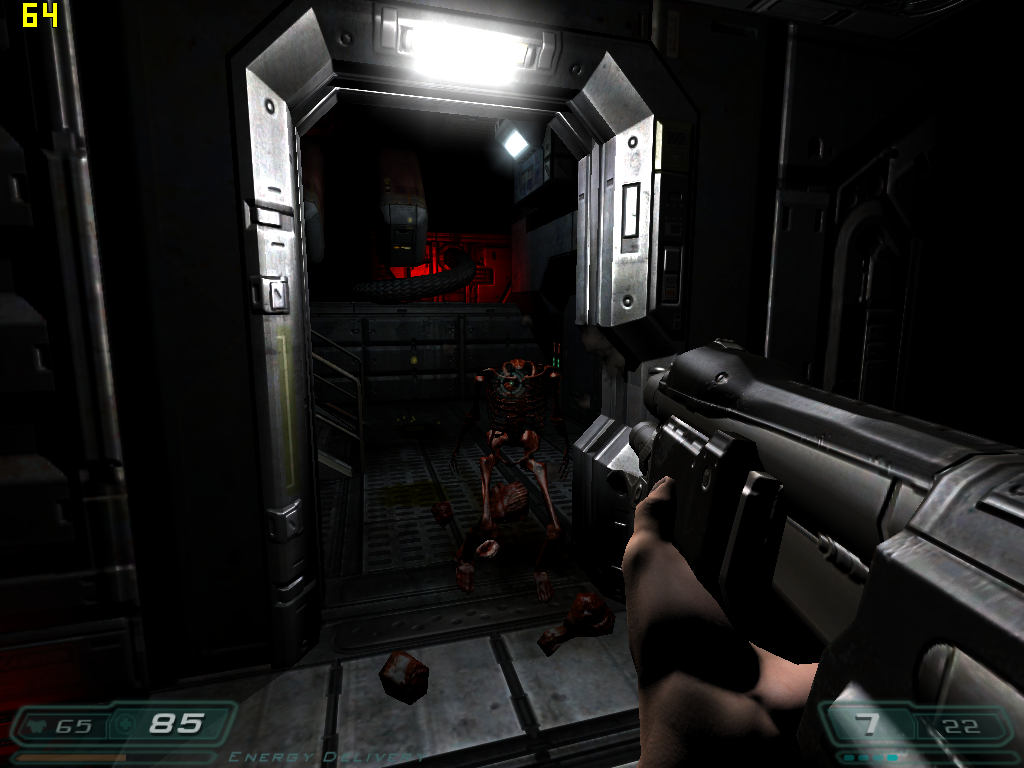
Performance Notes:
At the base High‑quality setting the HD2600Pro trails the HD2600XT cards by roughly 15–20 percent and sits around 25 percent behind the 8600GT. The gap is noticeable but not severe, and the card still delivers smooth performance thanks to Doom 3’s strong optimisation for mid‑2000s hardware.

With 4xAA enabled the HD2600Pro falls further back. The HD2600XT cards move ahead by around 25–30 percent, while the 8600GT stretches its advantage to roughly 35 percent. Anti‑aliasing puts clear pressure on the HD2600Pro’s DDR2 memory, widening the gap compared with the non‑AA run.

At the higher resolution the HD2600Pro drops into a lower mid‑range position. The HD2600XT cards are typically 20–25 percent ahead, and the 8600GT sits around 30 percent in front. The increased pixel load exposes the bandwidth limitations more clearly than the base test.

This is the heaviest configuration and the one where the HD2600Pro falls furthest behind. The HD2600XT cards lead by roughly 30 percent, and the 8600GT pushes closer to a 40 percent advantage. The combination of resolution and anti‑aliasing highlights the HD2600Pro’s memory bottleneck more than any other Doom 3 result.

Good results really for a lower mid-range card. Not far behind the 2600XTs, perhaps an erroneous result for the sapphire 2600XT in that first test.
The fixed function cards still win out here of course, unified shaders were not a thing when Doom3 was released.
Battlefield 2 (2005)
Game Overview:
Battlefield 2 launched on June 21, 2005, developed by DICE and published by EA. It was a major evolution for the franchise, introducing modern warfare, class-based combat, and large-scale multiplayer battles with up to 64 players. Built on the Refractor 2 engine, it featured dynamic lighting, physics-based ragdolls, and destructible environments that pushed mid-2000s hardware.

Performance Notes:
Sitting slightly below the X1300 Pro in this title with AA off, some way beneath the HD2600XT cards.
With AA enabled though, the HD2600 closes the gap with the HD2600XT’s and regains the lead of the previous gen-budget tier X1300Pro.

F.E.A.R. (2005)
Game Overview:
F.E.A.R. (First Encounter Assault Recon) launched on October 17, 2005 for Windows, developed by Monolith Productions. Built on the LithTech Jupiter EX engine, it was a technical showcase for dynamic lighting, volumetric effects, and intelligent enemy AI. The game blended tactical first‑person gunplay, horror elements, and cinematic slow‑motion combat, creating an experience that stood out sharply from other shooters of the era.
The engine supported per‑pixel lighting, soft shadows, volumetric fog, and advanced particle effects, all of which pushed mid‑2000s hardware hard, especially when maximum shadow quality was enabled. F.E.A.R. became a popular benchmark title thanks to its combination of heavy GPU lighting workloads and CPU‑intensive AI routines, which were among the most advanced in any shooter at the time.

Performance Notes:
At the base max‑settings run the HD2600Pro sits around 20 percent behind the HD2600XT cards and roughly 25–30 percent behind the 8600GT. The game remains smooth, but the gap is clear and reflects FEAR’s heavier shader load compared with earlier titles.

With 4xAA enabled the HD2600Pro falls further back. The HD2600XT cards move ahead by around 30 percent, and the 8600GT stretches its advantage to roughly 40 percent. Anti‑aliasing puts noticeable pressure on the HD2600Pro’s DDR2 memory, widening the gap more than in the non‑AA run.

In short, FEAR is playable on the HD2600Pro at maximum settings without AA, but once anti‑aliasing is enabled the card drops below a comfortable level.
Need for Speed: Carbon (2006)
Game Overview:
Need for Speed: Carbon released on October 31, 2006, developed by EA Black Box and published by Electronic Arts. It continued the street‑racing direction established by Underground and Most Wanted, shifting the series toward canyon duels, crew‑based racing, and a darker, more stylised presentation. Built on an enhanced version of the EAGL engine, it featured motion‑blur effects, HDR‑style lighting, depth‑of‑field, and detailed night‑time environments that pushed mid‑2000s GPUs far harder than earlier entries. Its mix of open‑city racing and narrow mountain passes made it a demanding benchmark for lower‑end hardware, especially when post‑processing and texture quality were set high.

Performance Notes:
The HD2600Pro lands well behind the HD2600XT cards at this setting. It is around 33 percent slower than the Sapphire HD2600XT (91 vs 136) and roughly 26 percent slower than the Lenovo HD2600XT (91 vs 68, but the Lenovo card is unusually low here). Against the 8600GT the gap is around 21 percent (91 vs 115). The game remains smooth, but the XT cards and the 8600GT clearly hold the stronger positions.

At the higher medium‑settings resolution the HD2600Pro falls further back. It is around 32 percent slower than the Sapphire HD2600XT (67 vs 99) and roughly 23 percent behind the Lenovo HD2600XT (67 vs 87). The gap to the 8600GT is around 19 percent (67 vs 83). The percentage differences widen slightly compared with 800×600, showing the growing impact of bandwidth and shader load.

At maximum settings the HD2600Pro drops into a lower mid‑range position. It is around 20 percent slower than the Sapphire HD2600XT (32 vs 40) and roughly 16 percent behind the Lenovo HD2600XT (32 vs 38). The gap to the 8600GT is around 16 percent (32 vs 38). The heavier lighting and post‑processing load pushes the HD2600Pro harder, but the percentage gaps are smaller here because all cards take a hit.

With 4xAA enabled the HD2600Pro drops into a clear lower mid‑range position. It averages 12 FPS, which puts it around 20 percent behind the Lenovo HD2600XT (12 vs 13) and roughly 20 percent behind the Sapphire HD2600XT (12 vs 15). The gap to the 8600GT is larger at around 29 percent (12 vs 34). Anti‑aliasing pushes Carbon’s bandwidth demands sharply upward, and the HD2600Pro’s DDR2 memory becomes the defining bottleneck in this configuration.

In short, Carbon is very playable on the HD2600Pro at medium settings and still fine at maximum settings without AA. Once anti‑aliasing is enabled the card runs out of headroom, but everything below that point delivers a smooth and enjoyable experience.
Medieval II: Total War (2006)
Game Overview:
Released on 10 November 2006, Medieval II: Total War was developed by Creative Assembly and published by Sega. It’s the fourth entry in the Total War series, built on the enhanced Total War engine with support for Shader Model 2.0 and 3.0. The game blends turn-based strategy with real-time battles, set during the High Middle Ages, and includes historical scenarios like Agincourt.
I run the intro to the Agincourt battle, this is in-engine so does render as if you are playing the game and will give like-for-like results in all scenarios.

Performance Notes:
The HD2600Pro averages 51 FPS here. It sits around 34 percent behind the Sapphire HD2600XT (51 vs 77) and roughly 26 percent behind the Lenovo HD2600XT (51 vs 69). The gap to the 8600GT is around 43 percent (51 vs 90). The card remains playable, but the XT models and the 8600GT hold a clear lead.

With 2xAA enabled the HD2600Pro averages 46 FPS. It is around 33 percent behind the Sapphire HD2600XT (46 vs 69) and roughly 29 percent behind the Lenovo HD2600XT (46 vs 65). The gap to the 8600GT is around 41 percent (46 vs 78). Anti‑aliasing widens the differences slightly but the overall hierarchy stays the same.

At the heavier SM2.0 preset the HD2600Pro averages 18 FPS. It sits around 40 percent behind the Sapphire HD2600XT (18 vs 30) and roughly 25 percent behind the Lenovo HD2600XT (18 vs 24). The gap to the 8600GT is around 36 percent (18 vs 28). The shift to shader‑driven rendering exposes the HD2600Pro’s limitations more clearly.

With 4xAA enabled the HD2600Pro averages 16 FPS. It is around 24 percent behind the Sapphire HD2600XT (16 vs 21) and roughly 24 percent behind the Lenovo HD2600XT (16 vs 21). The gap to the 8600GT is around 38 percent (16 vs 26). This is the heaviest configuration and the one where the HD2600Pro falls furthest behind the stronger mid‑range cards.

In summary, Medieval II is fully playable on the HD2600Pro at medium settings, with or without AA. Once you move to the “Best” preset the Pro falls behind the XT cards and the stronger NVIDIA hardware, but the results remain usable. The Pro’s DDR2 memory is likely the main factor shaping its position in the table.

The Elder Scrolls IV: Oblivion
Game Overview:
Oblivion launched on March 20, 2006, developed by Bethesda Game Studios. Built on the Gamebryo engine, it introduced a vast open world, dynamic weather, and real-time lighting. The game was a technical leap for RPGs, with detailed environments and extensive mod support that kept it alive well beyond its release window (it’s just had a re-release recently).
Known for its sprawling world, Oblivion remains a benchmark title for mid-2000s hardware. The game’s reliance on draw distance and lighting effects makes GPUs struggle.
The benchmark run involves a run to the top of the hill opposite the sewer entrance, killing the two bandits on the way. The weapon is kept out for the duration (which costs about 5fps if you can believe it).

Performance Notes:
Oblivion – 800×600, Medium
The HD2600Pro averages 53 FPS here. It sits around 28 percent behind the Sapphire HD2600XT (53 vs 74) and roughly 26 percent behind the Lenovo HD2600XT (53 vs 72). The gap to the 8600GT is around 34 percent (53 vs 80). The card remains fully playable, but the XT models and the 8600GT hold a clear lead.
Oblivion – 800×600, Ultra High
At Ultra High the HD2600Pro averages 36 FPS. It is around 29 percent behind the Sapphire HD2600XT (36 vs 51) and roughly 26 percent behind the Lenovo HD2600XT (36 vs 49). The gap to the 8600GT is around 38 percent (36 vs 58). The heavier shader load widens the differences compared with the medium‑settings run.
Oblivion – 800×600, Ultra High + 4xAA
With 4xAA enabled the HD2600Pro averages 27 FPS. It sits around 29 percent behind the Sapphire HD2600XT (27 vs 38) and roughly 25 percent behind the Lenovo HD2600XT (27 vs 36). The gap to the 8600GT is around 38 percent (27 vs 44). Anti‑aliasing pushes Oblivion’s bandwidth demands upward, and the HD2600Pro’s DDR2 memory becomes the limiting factor.

Oblivion – 1024×768, Medium
At the higher resolution the HD2600Pro averages 48 FPS. It is around 27 percent behind the Sapphire HD2600XT (48 vs 66) and roughly 23 percent behind the Lenovo HD2600XT (48 vs 62). The gap to the 8600GT is around 33 percent (48 vs 72). The hierarchy remains consistent with the 800×600 results.
Oblivion – 1024×768, Ultra High
At Ultra High the HD2600Pro averages 33 FPS. It sits around 25 percent behind the Sapphire HD2600XT (33 vs 44) and roughly 23 percent behind the Lenovo HD2600XT (33 vs 43). The gap to the 8600GT is around 34 percent (33 vs 50). The heavier lighting and shader work widen the differences slightly.
Oblivion – 1024×768, Ultra High + 4xAA
With 4xAA enabled the HD2600Pro averages 21 FPS. It is around 28 percent behind the Sapphire HD2600XT (21 vs 29) and roughly 25 percent behind the Lenovo HD2600XT (21 vs 28). The gap to the 8600GT is around 34 percent (21 vs 32). This is the heaviest configuration and the one where the HD2600Pro falls furthest behind the stronger mid‑range cards.

In summary, Oblivion is fully playable on the HD2600Pro at medium settings and still comfortable at Ultra High without AA.
Once AA is enabled the Pro drops into the low twenties, which is still usable indoors but noticeably heavy outdoors. The HDR‑off, bloom‑on behaviour with AA changes the look of the game more than the performance, but the Pro’s DDR2 memory remains the main factor shaping its position in the table.
Test Drive Unlimited (2006)
Game Overview:
Released on September 5, 2006, Test Drive Unlimited was developed by Eden Games and published by Atari. It marked a major technical leap for the Test Drive franchise, built on the proprietary Twilight Engine, which supported streaming open-world assets, real-time weather, and Shader Model 3.0 effects. The game ran on DirectX 9, with enhanced support for HDR lighting and dynamic shadows, optimized for both PC and seventh-gen consoles.
At launch, TDU was praised for its ambitious scale, vehicle fidelity, and online integration, though some critics noted AI quirks, limited damage modelling, and performance bottlenecks on lower-end rigs. The PC version especially benefited from community mods and unofficial patches that expanded car libraries and improved stability.
I do a high speed run up and down the same streets in a loop for each run, traffic density is medium but still will add an element of randomness but it still gives a good reflection of the performance you can expect.

Performance Notes:
The HD2600Pro averages 38 FPS here. It sits around 27 percent behind the Sapphire HD2600XT (38 vs 52) and roughly 24 percent behind the Lenovo HD2600XT (38 vs 50). The gap to the 8600GT is around 32 percent (38 vs 56). The game remains playable, but the XT cards and the 8600GT hold a clear lead..
With 4xAA enabled the HD2600Pro averages 27 FPS. It is around 29 percent behind the Sapphire HD2600XT (27 vs 38) and roughly 25 percent behind the Lenovo HD2600XT (27 vs 36). The gap to the 8600GT is around 34 percent (27 vs 41). Anti‑aliasing widens the differences slightly, but the overall hierarchy remains unchanged.

The HD2600Pro averages 31 FPS here. It sits around 30 percent behind the Sapphire HD2600XT (31 vs 44) and roughly 26 percent behind the Lenovo HD2600XT (31 vs 42). The gap to the 8600GT is around 35 percent (31 vs 48). The higher resolution exposes the HD2600Pro’s bandwidth limits more clearly than the 1024×768 run.
With 4xAA enabled the HD2600Pro averages 22 FPS. It is around 29 percent behind the Sapphire HD2600XT (22 vs 31) and roughly 24 percent behind the Lenovo HD2600XT (22 vs 29). The gap to the 8600GT is around 37 percent (22 vs 35). This is the heaviest configuration and the one where the HD2600Pro falls furthest behind the stronger mid‑range cards.

I tested at 800×600 against some budget-tier cards. The HD2600Pro averages 46 FPS with a 1% low of 28, placing it ahead of the X1300 series and close to the 7300GT, but well behind the 7600GT which was also included here.
This is probably the setting that you would be forced to play on.

In summary, Test Drive Unlimited is just about playable on the HD2600Pro at 800×600 or 1024×768 in high or medium. There is little chance of Anti-Aliasing though or higher resolutions.
Crysis (2007)
Game Overview:
Crysis launched in November 2007 and quickly became the go-to benchmark title for PC gamers. Built on CryEngine 2, it pushed hardware to the limit with massive draw distances, dynamic lighting, destructible environments, and full DirectX 10 support.
The Run is down into the first occupied village taking out the bad guys, it’s not an identical run each time.

Performance Notes:
The HD2600Pro averages in the low 20s here, placing it around 25–30 percent behind the HD2600XT cards and roughly 35 percent behind the 8600GT. Even at the lowest settings the game’s heavy shader load keeps the HD2600Pro in a lower mid‑range position, though the result remains technically playable.

At the higher resolution the HD2600Pro falls into a clear lower‑tier position. It is around 30 percent behind the HD2600XT cards and roughly 40 percent behind the 8600GT. The extra pixel load exposes the DDR2 memory limitation more clearly than the 800×600 run.

This is the heaviest configuration you tested and the one where the HD2600Pro falls furthest behind. It sits around 35–40 percent behind the HD2600XT cards and roughly 45 percent behind the 8600GT. The combination of resolution and medium settings pushes the HD2600Pro beyond its comfort zone, and the percentage gaps widen accordingly.

All cards struggle at this setting but included for completeness!

In summary, Crysis is surprisingly playable on the HD2600Pro at 800×600 Low and remains serviceable at 1024×768 Low. Medium settings introduce noticeable strain, and High settings exceed the capabilities of the card’s memory configuration. The HD2600Pro performs far better than expected in the lighter configurations, but its DDR2 memory defines its limits as the settings scale upward.
S.T.A.L.K.E.R.: Shadow of Chernobyl (2007)
Game Overview:
Released in March 2007, S.T.A.L.K.E.R.: Shadow of Chernobyl was developed by GSC Game World and runs on the X-Ray engine. It’s a gritty survival shooter set in the Chernobyl Exclusion Zone, blending open-world exploration with horror elements and tactical combat. The engine supports DirectX 8 and 9, with optional dynamic lighting and physics that can push older hardware to its limits.
The Benchmark run is through the first village and out into the wilderness.

Performance Notes:
The HD2600Pro averages in the mid‑40s here. It sits around 25–30 percent behind the HD2600XT cards and roughly 35 percent behind the 8600GT. Static Lighting keeps the load fairly light, and the HD2600Pro stays comfortably playable, but the stronger mid‑range cards hold a clear lead.

Only the cards with an chance of handling Full Dynamic Lighting were tested here. The HD2600Pro averages in the low‑30s, placing it around 30 percent behind the HD2600XT cards and roughly 40 percent behind the 8600GT. The heavier lighting model widens the gaps and highlights the HD2600Pro’s shader and bandwidth limits more clearly than the Static Lighting run.

In summary, STALKER is comfortably playable on the HD2600Pro under Static Lighting at maximum settings with low AA. Full Dynamic Lighting, however, exceeds the capabilities of the card.
Assassin’s Creed (2007)
Game Overview:
Assassin’s Creed launched in November 2007, developed by Ubisoft Montreal and built on the Anvil engine. It introduced open-world stealth gameplay, parkour movement, and historical settings wrapped in sci-fi framing. The first entry takes place during the Third Crusade, with cities like Damascus, Acre, and Jerusalem rendered in impressive detail for the time.
The Benchmark run is up to the top of the town and back down again to the gate at the beginning of the game after the tutorial part is finished.

Performance Notes:
The HD2600Pro averages 44 FPS here, placing it behind the 7300GT, the 6800GS and the X1300XT, but ahead of the X1300 Pro, the X1300 and the X1600SE. At these reduced settings the game leans more on basic shader work than heavy post‑processing, keeping the HD2600Pro in a stable lower‑mid position.

At this setting the HD2600Pro averages 37 FPS. It sits behind the HD2600XT cards, the 8600GT, the 7600GT configurations and the FireGL, but ahead of the 6800GS. The increased shader load and geometry complexity push the HD2600Pro’s DDR2 memory harder, widening the gap to the stronger mid‑range cards.

With all detail settings raised the HD2600Pro averages 28 FPS. The heavier scene complexity and shader effects push it further down the table, widening the gap to the HD2600XT cards and keeping the 8600GT and 7600GT configurations well ahead.

This is the heaviest configuration and the one where the HD2600Pro falls furthest behind. It averages 22 FPS and drops behind all HD2600XT models, the 8600GT, the 7600GT configurations and the FireGL. The full post‑processing pipeline exposes the DDR2 memory bottleneck more than any other Assassin’s Creed result.

In summary, Assassin’s Creed is comfortably playable on the HD2600Pro at reduced settings and remains serviceable at mid‑range configurations. Maximum settings with full post‑processing exceed the capabilities of the card’, resulting in performance that falls below a desirable threshold.
Synthetic Benchmarks
3d Mark 2001SE
The HD2600Pro sits in the upper mid‑range of the table. It trails the Sapphire HD2600XT by around 7 percent and the Lenovo HD2600XT by roughly 10 percent. The gap to the 8600GT is wider at around 21 percent. The 7600GT cards, the FireGL V7200 and the 8600GT form the upper group, with the HD2600XT cards following behind them. The HD2600Pro sits just below the XT models but remains well ahead of the X1300‑series, the 7300‑class cards and the integrated solutions.

3d Mark 2003
The HD2600Pro sits below the HD2600XT cards by around 17–18 percent and falls roughly 31 percent behind the 8600GT. The 7600GT and 6800GS also stay ahead, while the HD2600Pro holds a comfortable lead over the X1300‑series and the entry‑level GeForce 7 cards. The overall ordering mirrors the lighter game tests, with the XT models and the 8600GT forming the upper group.

3d Mark 2006
The HD2600Pro sits in the lower mid‑table. It trails the HD2600XT cards by around 23–26 percent and falls roughly 31 percent behind the 8600GT. The stronger mid‑range cards form a clear upper group, while the HD2600Pro stays ahead of the older X1300‑series and the entry‑level GeForce 7 parts.

The SM2.0 test shows the same pattern. The HD2600Pro is around 24–28 percent behind the HD2600XT cards and about 33 percent behind the 8600GT. The 7600GT and 6800GS also remain ahead, leaving the HD2600Pro grouped with the slower mid‑range cards rather than the upper tier.

The HDR/SM3.0 test widens the gaps further. The HD2600Pro sits around 30–32 percent behind the HD2600XT cards and roughly 38–40 percent behind the 8600GT. This is the section where the separation between the HD2600Pro and the stronger mid‑range cards is most obvious, with the XT models and the 8600GT pulling well ahead.

Unigine Sanctuary
In Sanctuary the HD2600Pro settles into its usual lower‑mid position. The HD2600XT cards stay comfortably ahead, with a lead of around 30 percent depending on the scene. The 8600GT also keeps a clear advantage, landing roughly 35–40 percent higher than the HD2600Pro. The 7600GT and 6800GS sit further down the table but still ahead of the older X1300‑series cards. The overall order mirrors what shows up in the heavier game tests, with the XT models and the 8600GT forming the upper group and the HD2600Pro sitting just below them.

Power and Heat
Under a sustained run of Unigine Sanctuary the system draws a steady 153 watts at the wall, with it’s TDP of 35W this is a low-power card – the lack of external power definitely points this way also.
How cool does the massive cooler keep things you may ask? Well, cool. I couldn’t get it to go higher than 42 degrees at peak, generally 41 degrees Celsius, so pretty cool. For comparison, the Sapphire HD2600XT maxed out at 62 degrees and the 8600GT maxed at 75 degrees.
There are no sensors on the RAM, so nothing to report there I’m afraid, PCB temperature is reported back at 46 degrees max.
So, all evidence we do have suggests that the card runs as Icy cool as it’s name suggests, mission accomplished then I guess.

DirectX 10 Testing
DirectX 9 dominated PC gaming for nearly a decade. Launched in 2002, it became the standard thanks to broad compatibility with Windows XP, which remained popular well into the 2010s.
In contrast, DirectX 10 debuted as a Vista-exclusive, an operating system many gamers avoided, making adoption slow.
Developers stuck with DX9 to maintain parity with consoles like the Xbox 360 and to avoid rebuilding engines from scratch, since DX10 introduced a new driver model and lacked backward compatibility.
Game engines such as Unreal Engine 3 and Source were deeply optimized for DX9, and rewriting them was costly.
Even as late as 2011, a large portion of gamers still used DX9 hardware, making it the safer choice.
We should still have a look at a few tests, to see how well these early unified-shader cards cope, with the new technology at the time.
The test system is dual boot so I installed Catalyst 13.9 on the windows 7 drive and ran the below:
Call of Juarez (2006)
Call of Juarez launched in June 2006, developed by Techland and powered by the Chrome Engine 3. It’s a first-person shooter set in the American Wild West, blending gritty gunfights with biblical overtones and dual protagonists: Reverend Ray, a gun-slinging preacher, and Billy Candle, a fugitive accused of murder. The game alternates between stealth and action, with period-authentic weapons, horseback riding, and stylized sepia-toned visuals.
Built for DirectX 9.0c and optionally DX10, the Chrome Engine delivers dynamic lighting, HDR effects, and physics-driven interactions.
I only have the GOG version of the game which will only run in DX10 (the DX9 executable seems to be missing).

Performance Notes:
At low settings the HD2600Pro averages 27 FPS. It sits 22 percent behind the Sapphire HD2600XT, 15 percent behind the Lenovo HD2600XT and 4 percent behind the 8600GT. The XT cards form a clear lead group, with the HD2600Pro and 8600GT sitting close together just below them.
At balanced settings the HD2600Pro averages 12.5 FPS. It trails the Lenovo HD2600XT 800 MHz by 25 percent, the Sapphire HD2600XT by 23 percent and the standard Lenovo HD2600XT by 18 percent. The 8600GT lands almost level with the HD2600Pro, only 1 percent ahead. Balanced mode widens the gap to the XT cards while keeping the HD2600Pro and 8600GT effectively tied.

Just Cause 2
Just Cause 2 launched in March 2010, developed by Avalanche Studios using the Avalanche Engine 2.0. Set in the tropical nation of Panau, it’s an open-world action game starring Rico Rodriguez, whose grappling hook and parachute enable chaotic stunts and explosive sabotage.
The previous games were DirectX9 games with bits of DirectX 10 possible.
Just Cause 2 was built for DirectX 10, the game features vast draw distances, dynamic weather, and physics-driven destruction, pushing GPU limits with cinematic flair and sandbox freedom


Perforamcen Notes:
The HD2600Pro averages 15.66 FPS. It trails the Lenovo HD2600XT 800 MHz by 23 percent, the 8600GT by 21 percent, the Sapphire HD2600XT by 20 percent and the standard Lenovo HD2600XT by 15 percent. The ordering matches the High‑detail run, with the HD2600Pro holding a consistent lower‑mid position.

The HD2600Pro averages 11.93 FPS. It sits 22 percent behind the Sapphire HD2600XT, 20 percent behind the 8600GT and 16 percent behind both Lenovo HD2600XT configurations. The XT cards and the 8600GT form a tight upper group, with the HD2600Pro a clear step below them.

3d Mark Vantage


The HD2600Pro scores 6265 and sits clearly below the XT cards and the 8600GT. It trails the XT models by 14–22 percent and falls 24 percent behind the 8600GT. The XT cards form a tight group above 7200 points, with the 8600GT slightly ahead of them. The HD2600Pro remains a full tier lower in this benchmark.

Conclusions
So, the HD2600Pro..
When compared to the XT models the Pro is 23.3% slower, or to look the other way, the XTs were an average of 30.3% faster, so that DDR2 Ram is quite a penalty.
This is the average difference for the different settings in each game, then the average of all games together. The two sets of results from both HD2600XTs were also averaged in together.
As the Assassins Creed result was something of an outlier, the calculation was done with this removed which is a little kinder at least.

The few DX10 games tested appear to show the ATi cards actually outperforming the 8600GT but there isn’t really enough data to make that statement.

For the synthetic benchmarks which were a little less harsh on the 2600Pro, being 17.1% and 22.5% slower then the XT models and 8600GT respectively.

So disappointing if the Pro, XT’s and GTs cost the same, but of course they didnt… the XT model is actually a little worse value in DX9 games, the 8600GT though is the clear winner here.

In isolation though, in older engines or reduced settings the HD2600Pro IceQ gives adequate performance.
Once resolutions rise, anti‑aliasing appears or the engine leans on bandwidth and shader power, the DDR2 bottleneck shows and things begin to suffer.
So, it’s alright then, the big fancy cooler does keep things cool and quiet and definitely looks the part, if only there was some GDDR3 on there with the cooler touching the memory chips.
Ash

Links
Some further reading:
https://hothardware.com/reviews/his-radeon-x2600-pro-512mb-review
https://www.techpowerup.com/gpu-specs/radeon-hd-2600-pro.c212
https://videocardz.net/his-radeon-hd-2600-pro-512mb-iceq-turbo
http://www.hisdigital.com/gb/product2-362.shtml
Leave a Reply